The hoofbeats had faded into the west before the dust even thought about settling. Hank Mercer lay on his side, tasting grit and blood, every breath a knife between his ribs. His boy Luke knelt in the dirt, hands shaking worse than the first time he’d tried to rope a calf, pressing a bandanna to the split in his father’s lip like that could hold the whole man together. Over the ridge, the outlaws’ laughter drifted back, lazy and sure, the sound of men who believed the world ended at their gun barrels.
Luke’s mind kept replaying the leader’s boot on Hank’s neck, the words hissed through tobacco-stained teeth: “No law, no God, no help coming.” The kid had stood tied to a wagon wheel, wrists bleeding, watching his pa’s eyes stay steady, silently ordering him to run when there was nowhere to run to. Now the rope lay cut in the dust, the gang was gone, and the only thing moving was the slow creep of blood soaking through Hank’s shirt.
“I’ll get you fixed,” Luke whispered, but the ranch was two hours’ ride and the doctor was four days’ drunk in town. Hank’s fingers found the boy’s sleeve, grip feeble yet fierce. “Forget me,” he rasped. “They’ll come back. You ride east. Don’t stop.” Luke shook his head so hard tears flew off his cheeks. East was nothing but more empty. North was memory. South was the river. West was the answer he’d never dared speak aloud.
When Luke was eight, he and Hank had pulled a half-drowned Apache boy from the spring flood. Neighbors cursed and called it inviting trouble, but Hank carried the kid home, stoked the fire, and fed him biscuit until color returned. For three weeks the boy, Koa, slept in their loft, teaching Luke Apache words while Luke taught him how to whistle through a blade of grass. When Chief Tahate arrived to claim his grandson, he touched Hank’s chest once—no handshake, just palm over heart—and said, “The river remembers.” Hank never mentioned it again, but Luke stored the moment like ammunition.
Now Luke saddled the flea-bitten gelding, pocketed jerky and the last canteen, and turned toward the canyon everyone told him to avoid. Night swallowed the trail, coyotes gossiping from ridge to ridge. He rode until the horse foamed and the moon climbed high enough to silver the three-fingered mesa Koa once sketched in dirt. At dawn, smoke ribboned from hidden depths. Luke raised both empty hands and shouted the word for brother until his throat bled. Arrows answered, then riders, paint streaked, feathers snapping. Koa emerged, scar still carving his cheek, grin fierce enough to split the morning.
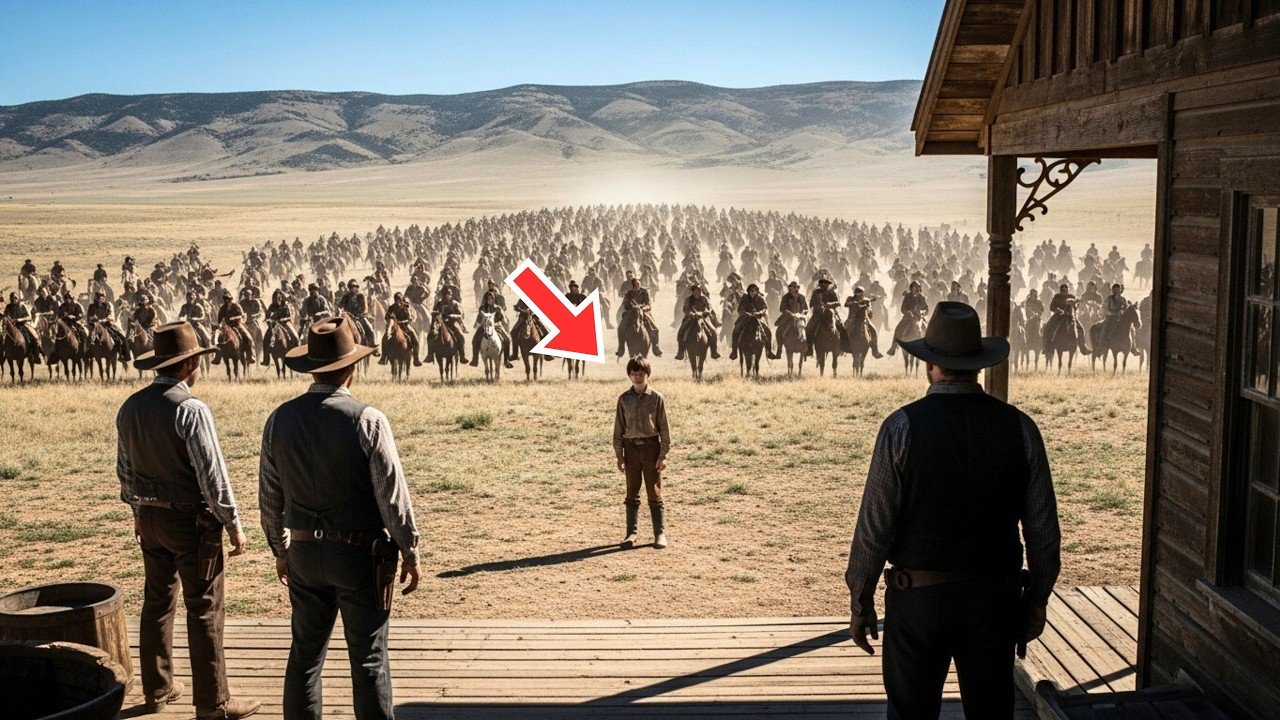
Inside the canyon, lodges hugged stone like they had grown there. Chief Tahate’s eyes were slower but no softer. Luke spoke in careful Apache, each word a stepping-stone across shame and fear. He told of the boot on Hank’s neck, the mocking promise, the blood in the dust. Warriors listened, still as statues carved by wind. Tahate tapped his spear once against volcanic floor. “The river remembers,” he repeated, and the canyon exploded into motion—horses, lances, paint, four hundred voices rising like thunder learning its own name.
They swept out at midday, a brown wave rolling across the valley. The outlaws were drunk on stolen whiskey when the ridge line darkened. Cards froze mid-deal, bottles slipped, and the leader’s grin died half-formed. Luke rode at the front, hat off, hair whipping, the carved feather Koa had given him knocking against his heart. The gang reached for guns but the circle closed too tight; arrows pinned sleeves to saloon walls, lances rested on trembling chests. No bullets flew—only voices, low and certain, promising that stories would end here.
Justice was swift and plain. Some men were bound and carted to distant jurisdiction; others met quieter fate beneath the same sky they had polluted. The leader knelt in the dirt, eyes finally small enough to fit his soul. Luke did not raise a fist; he simply spoke the words no one had spoken for him: “Help is here.” When it was finished, the warriors turned homeward, dust rising again, but this time it carried song.
They found Hank propped on the porch, shotgun across his lap, face gray but eyes alive. When he saw Apache feathers mingling with cattle brands, his cracked lip twitched toward a smile. Tahate dismounted, pressed palm to the bandages, and said, “The river is repaid.” Hank rested his hand over the chief’s, two maps of scars overlapping. Luke stood beside them, no longer boy or bridge but both, carrying a bone feather that meant more than any deed.
Months later, when barbed wire mysteriously stayed uncut and wells refused to run dry for certain ranchers, folks muttered about mercy and coincidence. Travelers told of thunder on clear days, of dust rising where no wind stirred. Children at the Mercer place learned to ride with Apache cousins, swapping English and Apache jokes while cattle grazed unafraid. Luke grew tall, voice settling into calm that made men step back without knowing why. Hank’s ribs still ached when storms brewed, but he welcomed the pain—proof that help sometimes rides in from the places you were warned to fear, and promises made beside rivers can outlast the bones of those who break them.