Caleb Dunn had spent most of his life being the extra nail in other men’s fences—useful, bent, and easy to lose. He owned no cows, no brand, no kin, just a one-room shack that leaned like it was tired of standing. Each sunrise he patched other folks’ cattle, fixed other folks’ water lines, and went home to beans that tasted of loneliness. He figured the world had already handed out its prizes; he was just the leftover hand still waiting.
Then the ground shook.
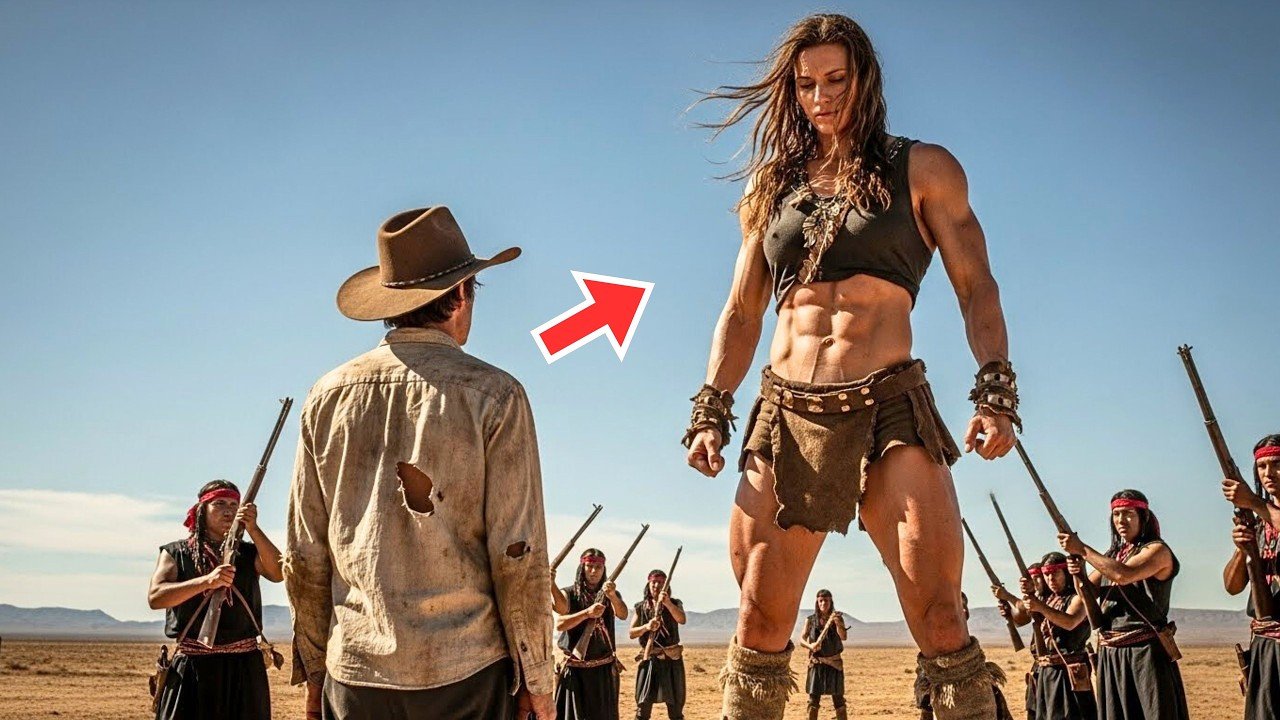
Not thunder, not stampede—footsteps. A woman stepped out of the dusk, tall as a wagon stood on end, her braids swinging like anchor ropes. She dropped to her knees beside his rotting fence, and the rail groaned under fingers thick as fence posts. Caleb’s hammer slipped from his grip and rang like a cowbell in the quiet. Her shoulders shook, not from cold but from the kind of crying that has no place to go. “They will give me to a man I do not want,” she said, voice soft as creek foam. “I ran.”
Caleb’s mind flicked through every story he had heard in saloons—giant Apache sisters born under a comet, blessed, feared, whispered about but never seen. Here one was, leaking tears onto his sorry land. He should have been terrified. Instead, his mouth opened and reckless words walked out. “Then stay here as my wife. Let them think the choice is made.” The plan sounded crazy even to him, but the woman lifted her head and for the first time her eyes held light instead of storm.
Three days later the war chief arrived with thirty riders, feathers and fury fluttering in the breeze. Caleb’s knees knocked like loose gate hinges, yet he stepped forward, hat in hand, and lied straight into the teeth of power. “She is already mine.” Gasps rose, blades flashed, but the giant sister moved beside him, her hand covering his whole shoulder, and repeated the claim. An elder raised a palm, silence fell, and tradition bent. The riders wheeled away, dust curling like smoke from a snuffed candle. Caleb’s heart hammered so hard he thought it might crack his ribs, yet the woman’s fingers stayed steady on his collarbone, anchoring him to the earth.
What began as play-acting soon grew roots. She lifted logs he could not roll; he read her labels on sacks of flour. He showed her how to fry onions without burning them; she showed him how to walk without leaving tracks. At night they sat on the sagging porch, boots and moccasins side by side, sharing stories the stars seemed to lean closer to hear. The cabin still listed, but laughter inside pushed the walls straighter. Caleb discovered that love, like good rope, tightens when tested.
Word travels faster than kindness. The war chief, stung before witnesses, began recruiting new friends—rough men who sold their guns to the highest grudge. One dawn, scouts found fresh horse apples and cigarette papers on the far ridge. Caleb stared at the tracks, feeling the old helplessness rise, but the giant sister placed a hand over his fist. “We chose each other,” she said. “Now we choose to keep choosing.” Together they rode to the Apache camp, spoke of unity, of cattle shared and ranges guarded. Warriors listened, saw the pair standing hand in hand—small man, tall woman—and agreed to stand with them.
The second confrontation never blossomed into battle. Forty riders lined the ridge above Caleb’s pasture, not for war but for show. The war chief rode close, saw the ranch hand backed by Apache bows and neighbor ranchers who had finally found courage in the strangest of couples, and turned away without a word. Strength, he learned, can come in pairs that do not match in height yet match in will.
Seasons rolled. Calves dropped, beans grew, and the cabin gained a second room built from logs the woman carried two at a time. One evening Caleb caught her humming as she stitched new curtains; the sound wrapped around his heart like warm wire. He realized the world had indeed handed out its prizes—he had simply needed to stay in the field long enough for one to find him. Love, he now knew, was not something you owned; it was something you practiced daily, like mending fence or gentling a skittish colt.
Folks still talk about the bent shack where the ranch hand and the sky daughter live. Children ride past just to see the woman lift a plow single-handed while Caleb stands beside her, grinning like a man who won a raffle he never meant to enter. Travelers ask if the story is true, and the couple only smile, fingers laced, proof that sometimes the best way to save someone is to let them save you right back.