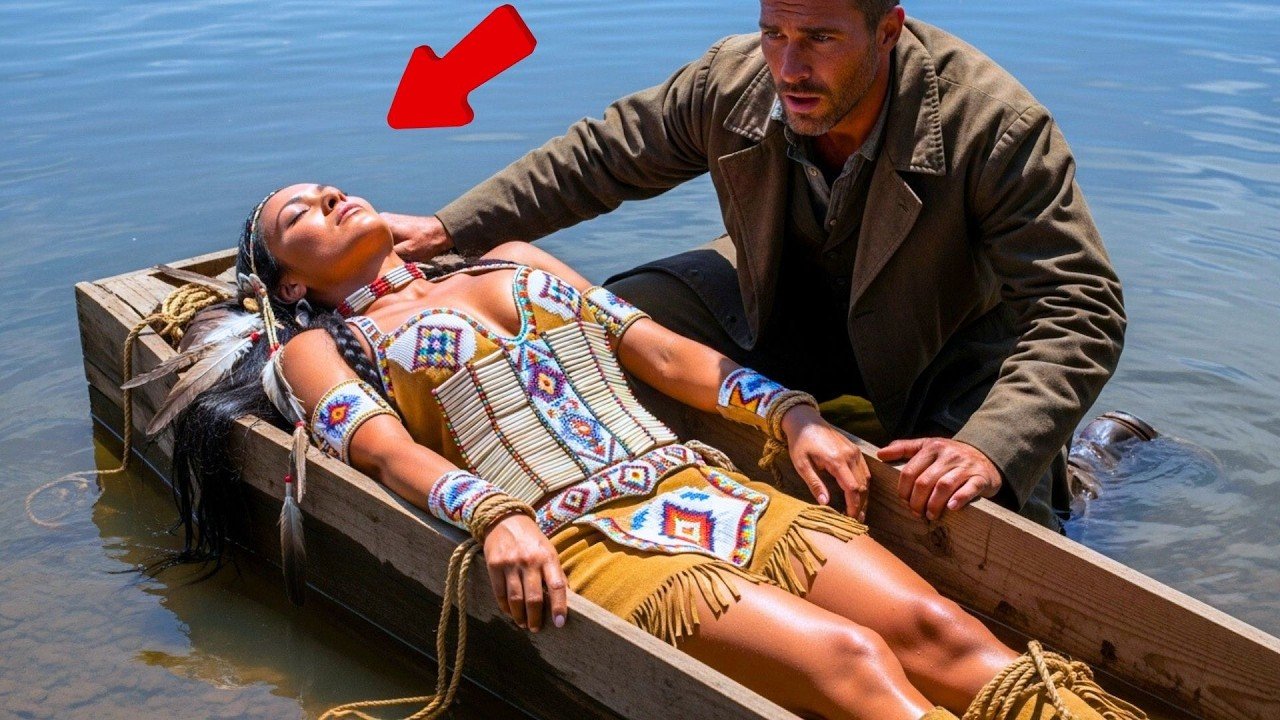
Noah Briggs heard the drums before he saw the water. They beat against the canyon walls like a second heart, low and steady, telling everyone the hunt was still on. Down below, the spring river clawed at its banks, white with melted snow and hungry for anything it could carry. Between the foam and floating logs, Noah spotted a patch of dark hair and a limp hand. A woman’s body drifted, tossed by the current like a broken doll. One look was enough. He threw off his gun belt, boots, and fear, and jumped.
The water hit so hard it stole his breath and tried to fold him in half. He fought upstream, arms burning, until his fingers closed around cloth and skin. She did not move, did not help, just hung there while the river tugged them both toward the rocks. Noah braced his boots against a boulder, hauled her across his chest, and kicked for the bank. When they finally rolled onto gravel, he was shaking too hard to stand.
She was Apache, tall and strong-boned, but her legs lay twisted and still. Water streamed from her braids; her lips were the color of storm clouds. Noah pressed an ear to her chest and caught a faint drum of life. He tore off his coat, wrapped her close, and scanned the cliffs. Warriors moved along the ridge, shadows against sky, carrying torches and anger. One voice carried down: “No use keeping the paralyzed.” The words felt like gravel in Noah’s ears. He knew the custom—some tribes sent the sick or injured to the river, letting the spirits decide fate. He also knew he had just stolen their offering.
Footprints would give them away, so Noah made a mess of them. He stomped in circles, splashed back into the shallows, then climbed a hidden ledge beneath an overhang. Thorn bushes grew thick across the opening; from below it looked like solid wall. Inside, the space was tight and dark, but dry. He laid the woman on dust and stone, coat under her head. Her eyes fluttered open, black and sharp as obsidian. “You should have let me go,” she whispered. “The river remembers.”
Noah gave his name and asked for hers. Talulah, she said—running water. A cruel joke, she added, since her legs felt like dead wood. He wrung out his coat and built a screen of branches while she talked. The tribe feared her paralysis would bring bad luck, so her uncle carried her to the current and let go. She had floated miles before Noah dove in. Now both of them were hunted.
Drums changed rhythm—faster, urgent. Somewhere upstream soldiers were moving; the tribe would circle back soon. Noah studied the cliffs, the smoke on the horizon, the woman who refused to cry. “I can’t take you home,” he said. “And I won’t take you back to the water. So we’ll go somewhere in between.” He described an old line shack on neutral ground, a place no one wanted because nothing grew there but loneliness. She listened, then nodded once. “Somewhere in between sounds like freedom.”
Carrying her was like hauling a sack of wet grain that breathed. Noah’s thighs burned on the climb, but he kept thinking of his brother—fever took him years ago and left Noah branded as cursed. He knew what it felt like to have your own people decide you were bad luck. He would not let the river finish that story. When they reached the shack, moonlight slipped through the cracked roof and painted silver bars across her face. He laid her on musty blankets, started a small fire, and watched her sleep.
Morning brought no answers, only choices. Fort soldiers would lock her behind iron beds and call it protection. Her uncle would drag her back to the current and call it fate. Noah offered a third road—west to a Spanish mission that fed the forgotten. Talulah studied the ceiling for a long time. “I do not know if I want their stories,” she said. “But I know I want my own.” She agreed to ride at least that far, and farther if the road stayed kind.
Noah built a travois from lodge poles and blanket, hitched it to his mare. They moved at dusk, avoiding ridges and campfires, drinking from seeps, eating jerky hard as iron. Each mile, Talulah kept her eyes open, naming plants, stars, memories. She refused to let the world shrink just because her legs did. When pain bit her spine, she bit back with jokes about the cowboy too skinny to carry a mountain. Laughter became their campfire.
One night, scouts from her band found their trail. Noah’s horse snorted, ears flat. He slipped into the dark, rifle ready, but Talulah called out in Apache, voice steady as stone. The warriors listened, then faded back into sage. Word spread: the woman taken by the river rode beside the pale cowboy, choosing her own days. Pursuit slackened; curiosity grew. Some even followed at distance, guarding the pair from soldiers who might claim the credit.
Weeks later, the mission bells rang over scrub hills. Two Spanish brothers met them at the gate, eyes wide at the sight of a giant woman on a litter and the sunburned man who would not leave her side. They offered bread, beds, and no questions beyond what she wished to tell. Talulah learned to weave cloth; Noah learned to mend wagons. Children brought her flowers just to watch her laugh. The uncle came once, stood beyond the fence, and saw her smile. He turned away without a word, debt paid to the river that had failed to keep her.
Seasons turned. Noah replaced the shack’s roof, widened doorways so her head would not brush the beams. They planted peach trees in soil everyone swore would never grow anything but thorns. Each spring, blossoms pink as dawn spilled over the porch. Talulah never walked, but she ruled acres from a wheeled chair Noah built from barrel staves. Travelers spoke of the ranch where the running-water woman sang while her cowboy husband hummed off-key, both of them proof that the world could be larger than the space fear allows.
Some nights, wind still carries the faint pulse of drums from distant canyons. Noah sits on the porch, hand on Talulah’s shoulder, and listens. He no longer hears threat—only reminder that choices echo longer than guns. The river that tried to claim her now irrigates their orchard, tame behind a stone ditch he laid stone by stone. They call the place Between—neither tribe nor town, just home. And every year, when spring melt swells the current, they ride to the water’s edge, throw in two wildflowers, and thank the river for changing its mind.