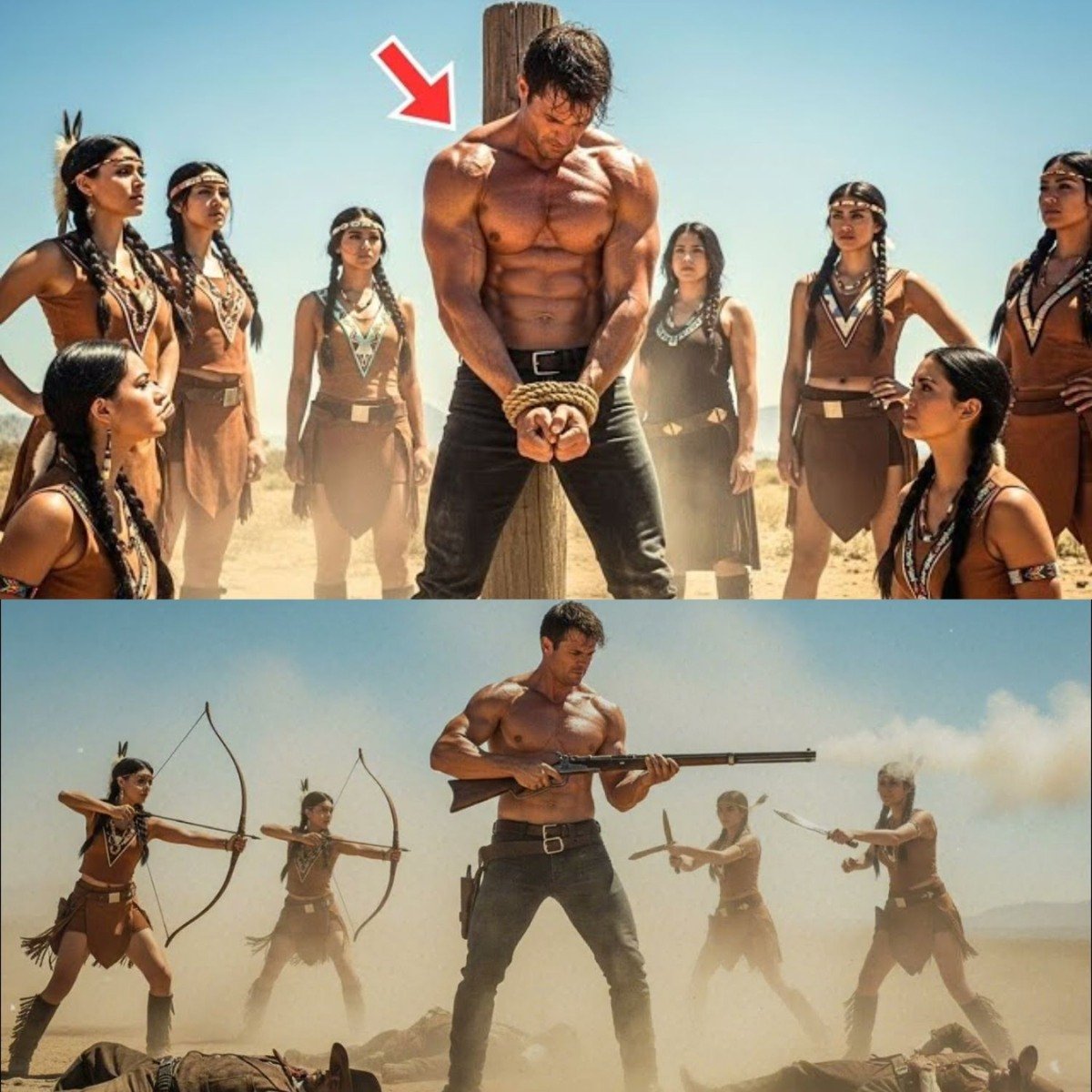
Santiago Valenzuela—Gray Wolf to anyone who knew his habits—rode alone because grief had taught him that company only doubled the weight. His ranch outside Magdalena was little more than a shack, a corral, and the echo of a fever that had taken his wife and child years before. He talked to horses because they never asked questions and to the horizon because it never answered back. When cattle began disappearing, he followed their sign north into the red hills everyone called Apache badlands, figuring hunger outweighed caution.
The women who found him moved like smoke given bones—twelve riders painted in ochre and black, braids heavy with eagle feathers, rifles across their knees. At their center sat Nayeli, taller than any man Santiago had ever faced, eyes reflecting storm clouds not yet born. A rope snapped around his wrists before his Colt cleared leather. They dragged him across broken lava to a hidden canyon where mesquite posts stood ready for trespassers. He expected a quick death; they expected him to break. Both guesses missed the mark.
For fifteen days they tested him—no food after sunrise, water carried in bound hands, hides scraped until his knuckles bled. He never asked for mercy, never offered excuse. Each night he sagged against the post, tasting dust, while Nayeli watched from the fire’s edge as though he were a colt that might buck or bow. On the sixteenth dusk she brought pinole and venison, feeding him slow spoonfuls while stars crowded overhead. “Why no scream?” she asked. He answered that pain was private; giving it voice only fed the hunger of those who caused it. Something in his tone made her loosen the rope, fingers brushing his like flint striking steel.
Weeks slid by. He taught them to shoe horses with barbed wire, to braid lariats that could hold a bull, to fire a Winchester until it felt like an extra limb. In return they showed him which plants knit bone, which songs quiet spooked livestock, which shadows belong to night and which to man. Tala, youngest of the warriors, slipped into his hut under a moon slit like a cat’s eye, leaving before dawn with flushed cheeks. Chenoa stitched him a deerskin shirt that fit as if his mother had measured it in childhood. Ischel sang sunrise over the corral while he forked hay, her voice slipping inside cracks he thought had sealed forever. One by one the widows claimed pieces of the Gray Wolf, yet Nayeli held back, pride and fear wrestling behind her eyes.
The raid came at noon—fifteen bandits riding hard up the canyon, bullets humming like angry bees. Santiago saw Nayeli fall, blood blooming on her sleeve, and something ancient tore loose inside him. He snapped his bonds against the post, seized a fallen rifle, and killed five men while the women rallied. When smoke cleared, he stood amid corpses, shirt scarlet, arms shaking. Nayeli demanded why he fought for captors. He shrugged. “I’ve seen what men do to women left unguarded. I’m not that kind of animal.” She studied him the way a person studies a map that suddenly makes sense, then nodded once—small, decisive.
Seasons turned. His ranch became their ranch—corrals widened, fields irrigated, children born who spoke Spanish and Apache in the same breath. Tala’s son had his gray eyes; Chenoa’s daughter had her mother’s laugh. Santiago taught the boys to shoe horses; the women taught him to hear sunrise. Still Nayeli kept her own heart tethered until a stormy night when lightning ripped the sky and she found him beside the fire, tears sliding into his beard. She accused him of stealing her certainty. He answered that certainty was a cage and offered his open hands. She stepped inside, chief and woman both, and for the first time the Gray Wolf felt the weight of someone else’s grief settle easy against his own.
Word traveled. Ranchers whispered about the canyon where a white man lived like an Apache king, surrounded by warriors deadlier than rattlesnakes. Government ink arrived—charges of rustling, harboring fugitives, corrupting civilized ground. Santiago rode to Magdalena alone, ready to face lies spun by a land baron named Esparza who wanted every valley fertile enough to dream on. Before irons could lock, arrows thudded around the scaffold—twelve shafts humming like hornets. Nayeli’s voice rang from rooftops, listing Esparza’s crimes, forcing townsfolk to speak truth. Soldiers clapped irons on the real thief instead. The captain declared Santiago friend of the territory and warned every greedy heart to stay west of the hidden canyon.
Home again, he and Nayeli stood before their people—warrior and rancher, wolf and moon—and spoke one sentence together: “We lead side by side.” Drums answered, children cheered, and the canyon walls threw the sound back until it felt like the desert itself had joined the tribe. Years later, travelers still tell of twilight on that ranch—of corral fires glowing orange, of silhouettes against sky: a tall woman with moonlit eyes and a gray-eyed man whose laughter carries farther than loneliness ever could. If you ride close enough at dusk, you might hear horses nicker welcome and catch the scent of beans and cedar smoke drifting on the wind. The Gray Wolf stopped wandering the day the Moon Widow called him home, and neither the desert nor the world beyond has found a way to break that circle since.