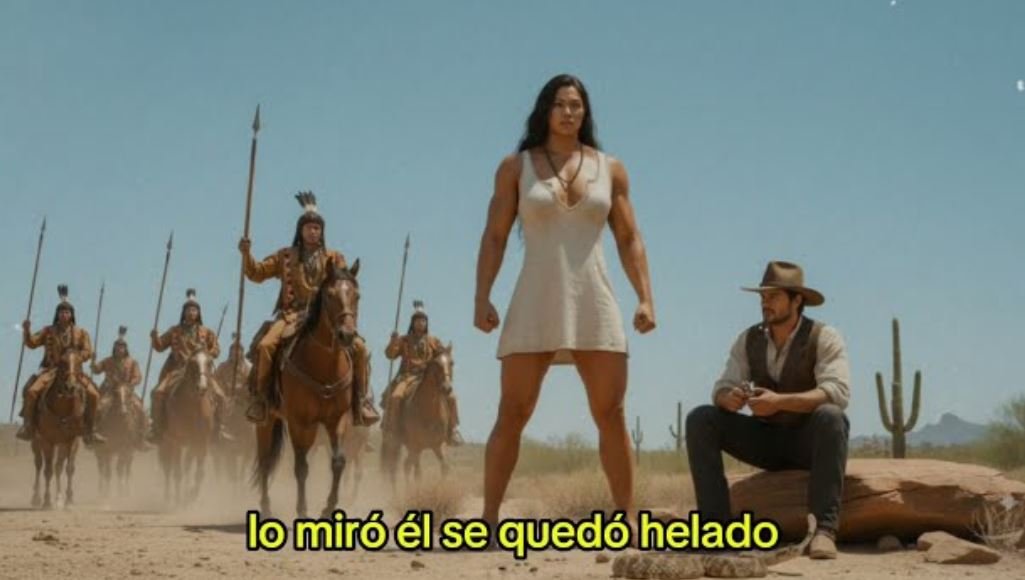
The Sonoran sun hammered the sand flat that afternoon in 1887 when the Texan’s horse stopped dead. Ahead, against a red rock shaped like a broken tooth, leaned a woman three yards tall. Her white dress hung in tatters, long legs stretched like mesquite trunks, two dead rattlesnakes crushed beside her feet. Blood dotted her right calf where fangs had found flesh. She opened eyes black as burned oil and asked for water in a tongue half Apache, half old-world Spanish. The Texan—Coahuila-born, Texas-raised, running from a rurales price on his head—handed over his canteen and watched her drink like a camel that had seen the last mirage.
He warned her the bites could kill. She answered she had birthed two children in desert silence and would not scream now. So he heated his Bowie blade, cut a cross over each puncture, and sucked poison until his spit ran black. Shirt strips became bandages. His knuckles brushed skin smooth as liquid bronze; the desert paused. When he moved to clean scratches higher on her thigh, his exhausted hand slipped beneath torn cloth to the secret place every woman keeps. Breath caught on both sides. She flinched, then laughed low as wind in a cave. “Small men always grow clumsy near large women,” she said. No anger, only something older than shame.
Night dropped fast. She gave her name—Tala, daughter of Nana, once companion to Victorio—and ate his last jerky in three bites. Apaches would come for her; soldiers and rurales would come for them both. Bugle calls echoed over the ridge before moonrise. A war party of twelve warriors appeared, led by Mangas Coloradas the younger, her promised husband, pride sharp as a fresh lance. He saw the Texan and reached for death. Tala stepped between, saying the stranger had drawn poison from her blood. Mangas spat but lowered his rifle. Choice, like love, is often made in a single heartbeat.
Then the real enemy arrived—fifty Mexican rural police and American blue-coats allied for once, rifles glittering. Bullets cut the dark. The Texan fired his Winchester until the barrel burned his glove. Tala lifted boulders no four men could roll and hurled them down the slope like thunder’s dice. Together they covered Mangas when a bullet dropped him, carried him on her shoulder while the Texan’s rifle covered retreat. By dawn they reached a hidden oasis where Apache women healed wounds with yucca and song. The Texan slept for the first time without keeping one eye open.
Days softened into weeks. Her leg mended; his name—never given—was accepted as brother. One night beside a fire low enough to keep secrets, Tala took his hand and placed it exactly where it had slipped before. “Now it is not accident,” she whispered. She carried him to a mesquite shade as old as the desert itself. They made love like people trying to erase war with skin and breath. After, she rested her chin on his chest and listened to his heart drum a new border between two worlds.
When soldiers finally found the oasis, the camp stood empty. Tracks led south into the Sierra Madre—giant footprints beside those of a common cowboy boot. Legends drift back: a woman tall as a saguaro riding beside a scar-faced man, their child strapped to her back, laughter echoing off canyon walls loud enough to make pursuers turn home. Some nights, when moonlight lays silver across the sand, old timers swear they hear hoofbeats—one horse carrying two hearts, a hand that once slipped now held forever, proof that even in a land drawn in blood and gunpowder, love can begin with a mistake and end with a legend.