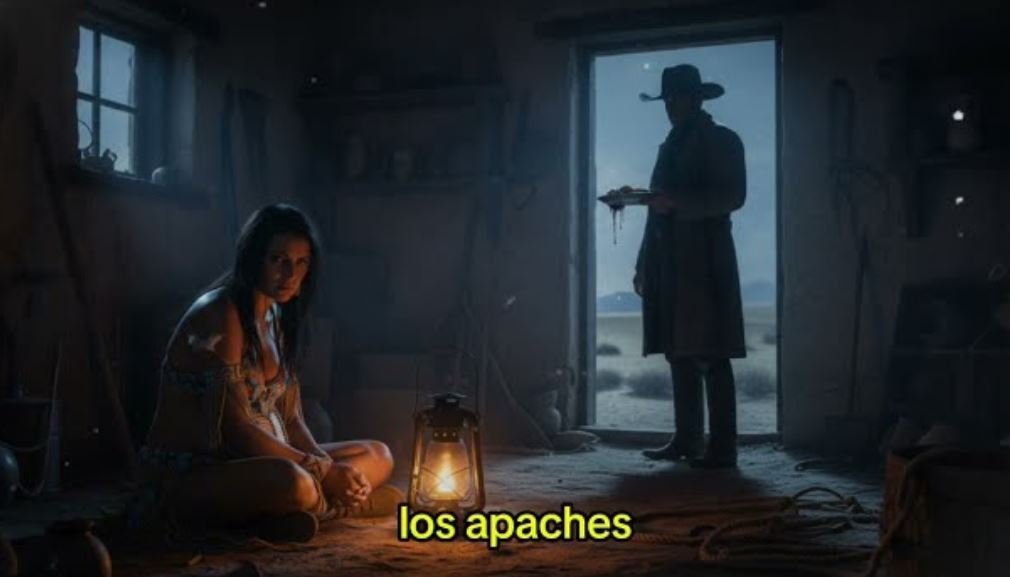
The auctioneer’s voice cracked across the dusty square of Casas Grandes like a whip made of paper and spit. “Lot seventeen—Apache woman, healthy, strong, sold as is.” Drunken cowboys laughed, soldiers shuffled their boots, and Don Luis Terrazas raised one calm hand. He spoke a number, high enough to end the bidding, and the girl became his. She walked toward him wrists tied, hair wild, eyes burning with a hatred so clean it felt holy. When she spat in his face, he wiped the spot slow, the way a man smooths a crumpled map, and lifted her onto the cart as if she were grain.
Three days north, at La Esperanza ranch, he locked her in the tack room and sent meals through old Concha the cook. He did not touch her. He did not speak. On the tenth day he entered with scissors and a comb. “If you live under my roof, at least be clean,” he said in Spanish slow enough to cut. She bit his hand until blood dotted the straw. He wrapped the wound with a strip of his own shirt and left without raising his voice. That night he slept on the porch, boots still on, listening to coyotes argue about whose hunger was bigger.
The ranch knew her story before she did. Soldiers had caught her near Babispe, Winchester in hand, face painted for war. Her father, Tasa the Red, was dead; her mother had died slower at the hands of troops. La Esperanza itself wore scars—charred beams, a mesquite tree that once held bodies, a wife and child buried beneath. Don Luis had stopped praying the day the smoke cleared. He worked the land like an enemy, breaking it because it had broken him.
Still, the girl stayed. She mucked corrals, gentled colts, moved with the quick grace of someone who expects the world to strike first. The cowboys feared her silence more than her knife. Don Luis watched from the porch, gray eyes unreadable, until the night the wild colt bolted during San Juan festival. Every hand was drunk, guitars still ringing, when Nayeli ran barefoot through rain and mud, rope singing over her head. She brought the colt back trembling but unhurt, hair plastered to her face, chest heaving. Don Luis stepped down, handed her a lantern, and said the horse was hers. She stroked the animal’s neck; the fire in her eyes banked to embers.
Months passed like horses in a long pasture—slow, then all at once. He bought her fabric for a new dress; she left it on the chair and wore her old buckskin. He taught her Spanish numbers while counting cattle; she taught him Apache words for wind and hawk. They spoke mostly in gestures, the way people do when both carry graves inside them. One August dusk, American trackers arrived with dogs and Spencer rifles, asking after a fugitive squaw worth a thousand dollars alive. Don Luis refused water, refused camp, refused conversation. That night three of them dragged Nayeli toward the corral. She fought like a cornered cat until a rifle butt split her temple. Don Luis appeared in moonlight and fire—barefoot, hair uncombed, Winchester speaking three times. Afterward he told the cowboys to dig the graves deep and keep their mouths shut. He found her in the hallway, blood threading through her hair. “Why?” she asked in careful Spanish. “Because you paid for me,” he said, “and tonight you paid me back.” She cried th
en, the kind of crying that sounds like land splitting open after drought. He held her until the storm passed, both of them surprised by the warmth.
She moved into the big house, into the bed that had belonged to Isabela. He took the sofa. Nothing happened for weeks except the slow learning of each other’s breathing. One December night the wind scraped the shutters and she appeared in the doorway wrapped in a blanket. “I’m cold,” she said. He opened his arms. They lay side by side, two ghosts learning the shape of living bodies. No kisses, no declarations—just the miracle of warmth returned.
Spring brought news she tried to hide—morning sickness, softening eyes, a future growing inside her like cotton after rain. Don Luis wept against the window, watching mountains he no longer hated. “He will be born free,” he whispered. She placed his hand on the small swell. “She already is,” she answered. They laughed, startled by the sound.
Freedom has a price. In July, rurales arrested Don Luis in Janos while he bought lace for a christening gown. They beat him until ribs cracked and promised a public hanging. Nayeli, seven months round, saddled Rayo de Luna and rode through the night. She gathered vaqueros, Yaqui laborers, even freed Apache prisoners—forty souls who owed the rancher breath. At dawn they swept into the square like a desert storm. Nayeli shot the captain between the eyes, cut the chains with an axe, and kissed her husband’s broken mouth in front of the whole town. They fled north, pursued by both governments and by Apaches who saw her as traitor. In a Cloverdale cave she birthed a girl, named her Isabel Nayeli, and Don Luis severed the cord with a Bowie knife. By candlelight they wept for everything lost and found.
Geronimo found them a year later, gaunt as winter timber. He studied the child, the man, the woman who had once carried a rifle against him. “They say you betrayed your blood,” he spoke. Nayeli lifted her chin. “My blood is here, in this child, in this man who killed for me and for whom I killed.” The old warrior draped eagle beads around the baby’s neck. “The war ends,” he said, “but you have already won.” He walked away into mesquite shadow and did not look back.
They lived ten hidden years in an Arizona valley, raising cattle, corn, and three more children. No church bells, no wedding dress—just vows spoken under stars with old Concha and a toothless Apache singer. When fever took Don Luis in 1902, Nayeli buried him beneath the biggest mesquite, laid Rayo de Luna’s saddle and the Winchester on the grave. She lived thirty-two more years, died on the porch listening to wind rattle the same shutters he once mended. Her last word was his name, soft as prayer.
Grandchildren tell of Moonbeam’s ghost galloping moonlit sand, of laughter drifting from empty porches, of love that began with a bill of sale and ended with both names carved on a single stone. You paid for me, I paid for you, the story goes, and in the end we were both free.