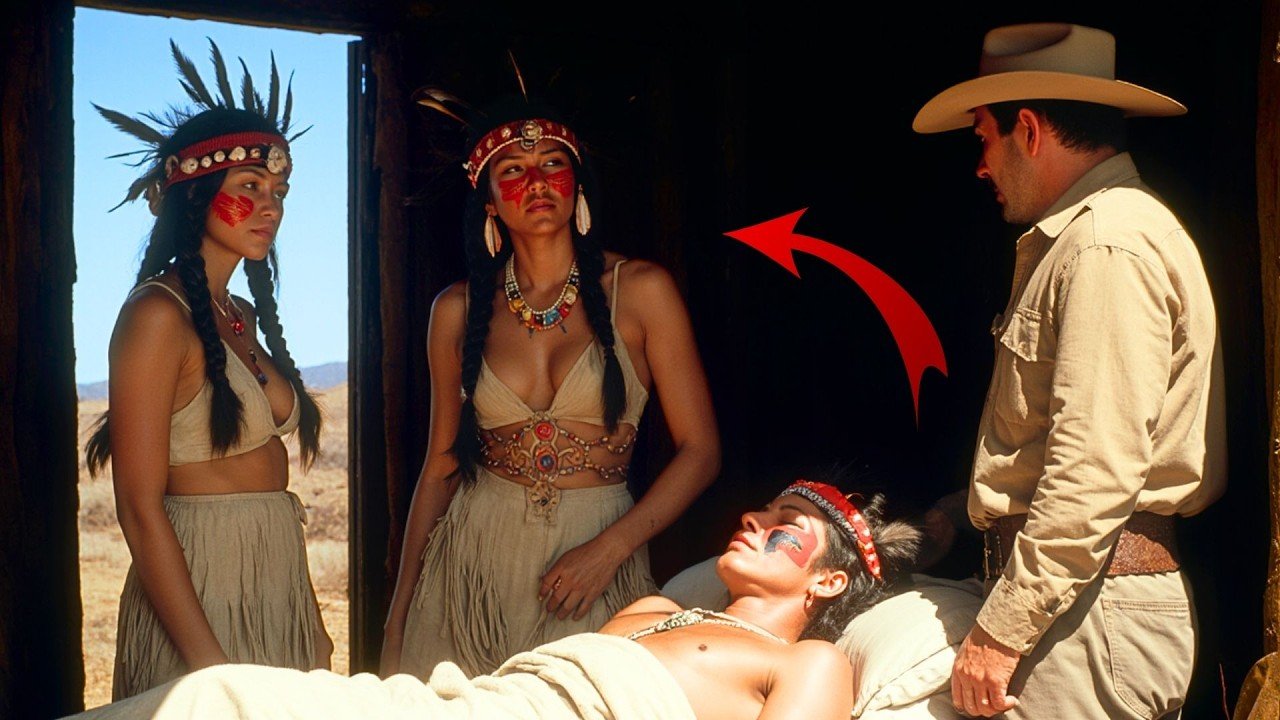
Reed Dawson meant to spend that morning trading coffee for gratitude, nothing more. He led Gray Hawk’s limping stallion through the canyon mouth, planning to hand over the reins, accept a nod, and ride back to the flat world of freight wagons and barter. Instead he found Gray Hawk lying by a dying fire, blood turning the sand beneath him to dark paste. Two women knelt at his side—one in crimson weave, one in soft buckskin—faces carved by grief and duty. The chief’s eyes still burned, but the flame fluttered.
“You saved my sons at the river,” Gray Hawk rasped, fingers clamping Reed’s wrist like a branding iron. “Now you will save what remains when I walk into the dark.” Reed tried to speak, to explain he was only passing through, but the words dried in his throat. Gray Hawk’s final breath left a promise where excuses used to live.
Among Apache people, a household does not scatter when the chief falls; it looks for new shoulders. If no son or brother stands tall enough, tradition allows an outsider who has proved courage to inherit the weight—horses, herds, elders, and sometimes wives. Reed knew the custom the way a man knows the shape of a rattlesnake: from distance, with respect, and never expecting it to strike him. Yet here it was, coiled around his wrist in the shape of a dying man’s grip.
The women rose as the drums began—slow, steady, the language of war moving down the ridge. Lark, the elder wife, spoke first, voice calm as deep water. “You did not choose this road, Reed Dawson, but it has chosen you.” Sani, the younger, added, “Crow Knife rides hungry. Without a shield, we become the meal.” Reed felt the canyon walls press closer, realizing inheritance was simply another word for battlefield.
They wrapped Gray Hawk’s body in blankets painted with mountain symbols, laid weapons beside him, and placed the bundle on a high ledge where wind could carry his name. Reed’s pulse hammered the whole time, not from fear of death but from fear of failing people who had already lost too much. When they descended, Lark handed him the chief’s spear. “Carry this like you mean to stay,” she said. He hefted it, felt the balance settle against his palm, and understood the land was now measuring him inch by inch.
At the narrow pass they prepared for Crow Knife—warrior who had served Gray Hawk and now wanted his chair. Reed set rifles among rocks, loosened boulders, and tried to steady his breath. Sani showed him how to read sign in bent grass and bird calls. Lark listed every man who owed Gray Hawk debt or grudge, speaking names like ammunition. Reed listened, because listening was the only weapon he had plenty of.
Crow Knife arrived at dawn, painted red, ten riders behind him. He laughed when he saw the cowboy holding the spear. “Gray Hawk’s ghost must be desperate,” he sneered. Reed answered with a question: “You here to fight or to lead?” The challenge rang off stone, surprising them both. They fought with spears, not bullets, honor against honor. Crow Knife moved like silk; Reed moved like stubborn. Dust rose, spears clacked, and when Crow Knife slipped, Reed planted the spear tip in the dirt beside his throat. “Get up,” he said. “Help guard what he loved, or ride away knowing you chased only spoil.” The warrior rose, eyes wide, and for the first time the canyon listened to Reed Dawson.
Weeks slid by. Reed learned the taste of spring water, the smell of coming storms, the sound of children laughing in a language he did not speak but somehow understood. Lark negotiated with traders, slicing through bluster with a smile sharp as obsidian. Sani taught him to track silence itself—how fear left footprints even when feet stood still. He fixed roofs, hauled wood, and told Gray Hawk’s spirit each night that the house still stood. Slowly, “we” replaced “I” in his thoughts the way grass replaces dust when rain finally comes.
One evening they climbed to the ledge where Gray Hawk rested. Stars spilled across the sky like flour from a torn sack. Reed set the spear point down and spoke to the darkness. “I didn’t ask for this, old man, but I’m learning the steps to your song.” Lark placed a hand on his shoulder, Sani mirrored her on the other side. No one spoke for a long time; the desert held its breath with them. In that hush Reed felt the word family settle on his skin, warm as sun-baked leather, permanent as brand.
Crow Knife now rides patrol on the southern rim, guarding the boundary he once meant to cross. Traders come lighter in goods and heavier in respect. Children chase Reed’s horse, daring each other to touch the tail of the cowboy who carried a chief’s promise. He still trades coffee, but gratitude tastes different—less like barter, more like bread shared at a table that keeps getting longer.
Some nights, when drums echo faint from distant ridges, Reed touches the scar on his wrist where Gray Hawk’s fingers dug in and remembers the moment the road chose him. He no longer wishes he had ridden away. The canyon is no longer Gray Hawk’s; it is theirs—Lark’s, Sani’s, his, and every voice that rises in laughter beneath the cottonwoods. And when the stars lean close, he swears he hears the old chief’s laugh rolling off stone, proud that the outsider learned the only treaty that matters: stay, listen, protect, and mean it.