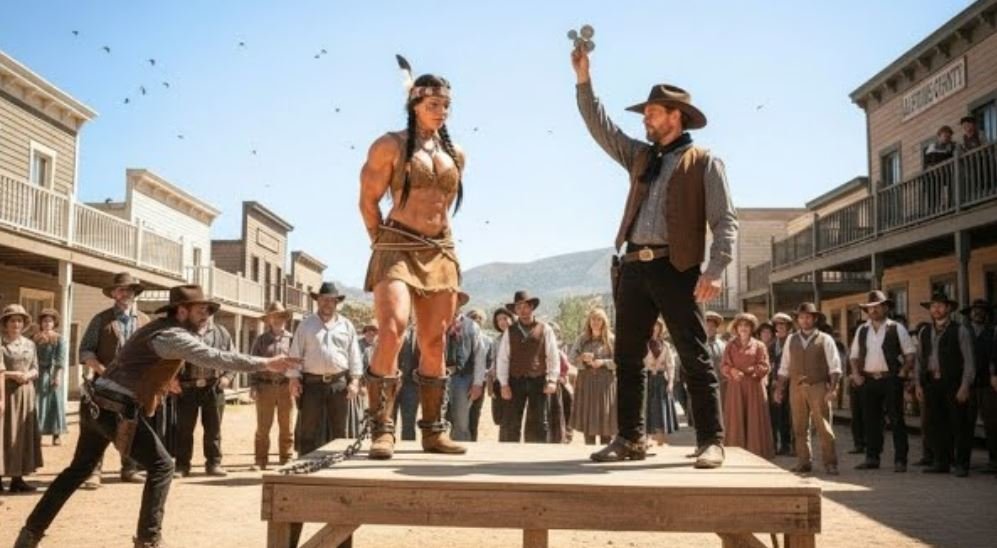
Dusk Creek stank of whiskey and spite the afternoon they dragged Naelli onto the auction block. The sun baked the planks until they sweated pine resin; the crowd sweated too, but for different reasons. Sheriff Ames bawled out the charges—raid on the Turner ranch, property loss, restitution due—while men licked their lips and counted coins. Naelli stood straight as a lodge-pole pine, ropes cutting her wrists, eyes black enough to swallow light. She did not lower her gaze when the catcalls started, nor when someone suggested “a closer inspection.”
Eli Tanner meant to buy flour, maybe a drink, then ride on. He’d seen plenty of cruelty in his years—stock towns from Texas to Wyoming specialize in it—but this felt different: a human being sold to pay for somebody else’s grief. His hand found the pouch at his belt before his brain caught up. The words shot out, sharp enough to cut the laughter short.
“Stop! You can’t sell her like she’s cattle.”
The sheriff turned, smirking. “Law says she’s property till restitution’s met. You meet it, cowboy?”
Eli dumped the pouch. Gold clinked, heavy and final. The sheriff cut the ropes. Naelli stepped down, whispering, “You’ll regret this.” Eli answered, “I’d regret doing nothing more.”
They rode out together—one free woman, one fool lighter by a season’s wages. Behind them the town swallowed the story like sour whiskey: fool cowboy, easy mark, let him feed the Apache girl while decent folk starved. Poison spreads fastest when truth is inconvenient.
Miles later they watered the horses at a trickle of creek. Eli expected her to bolt; instead she asked why he’d spent life-saving on a stranger. He shrugged. “Bought your chance to leave. That’s all.” She studied him the way a hawk studies a field mouse—curious, calculating, half amused. “My name is Naelli. It means ‘I am loved.’” Eli grinned. “Name’s Eli. Means ‘stubborn,’ according to my mother.” The creek chuckled between them; something not yet love, but no longer stranger, began to breathe.
Dawn brought gunfire. Five riders—faces masked, rifles gleaming—came to drag the purchase back. Eli rolled behind rocks, Winchester speaking steady. Naelli snatched a dropped revolver, moved like wind across sand. When the smoke cleared, three bodies cooled on the ground and two riders limped into heat-shimmer. Eli knelt, blood soaking his shirt. Naelli wrapped the graze, voice soft. “You could have ridden on.” He smiled through grit. “Can’t pretend I don’t see what’s happening here. Not anymore.”
They climbed into green mountains where Apache scouts watched from pine shadows. Naelli pointed beyond a ridge. “My people wait there.” Eli’s chest tightened; he nodded. She pressed a hand to her heart. “Debt of freedom binds two souls. I won’t forget.” Then she rode into sunrise, hair bannering behind her like a flag no army could lower.
Eli watched until horse and rider vanished. The desert felt wider than before, but lighter too— as if one good refusal had shifted the world a fraction toward honest. He turned his mare south, shoulder throbbing, purse empty, reputation shredded. Yet each step sounded like coins spent on something worth more than gold: the right to sleep without shame.
Weeks later, around campfires and saloon tables, men repeated the tale—how a fool cowboy threw away wages on a savage girl, how he fought off hired guns, how she walked free while he rode home alone. They laughed, called it madness, swallowed the story like poison and asked for more. Eli never corrected them. He knew the truth: sometimes madness is the only sanity left in a world that sells people by the pound. And sometimes one man’s foolishness is another woman’s first taste of freedom— a taste strong enough to echo across ridges, across years, across every town that learns to measure worth in coin instead of courage.
Let them laugh. Let them drink their poison. Eli Tanner sleeps easy beneath Wyoming stars, hearing distant drums that sound more like hope than war. And somewhere beyond the ridge, Naelli rides with his memory tucked against her heart—proof that even in Dusk Creek, one voice can refuse the sale, one hand can cut the rope, one fool can change the world— if only by the width of a single golden pouch tossed onto dusty planks.