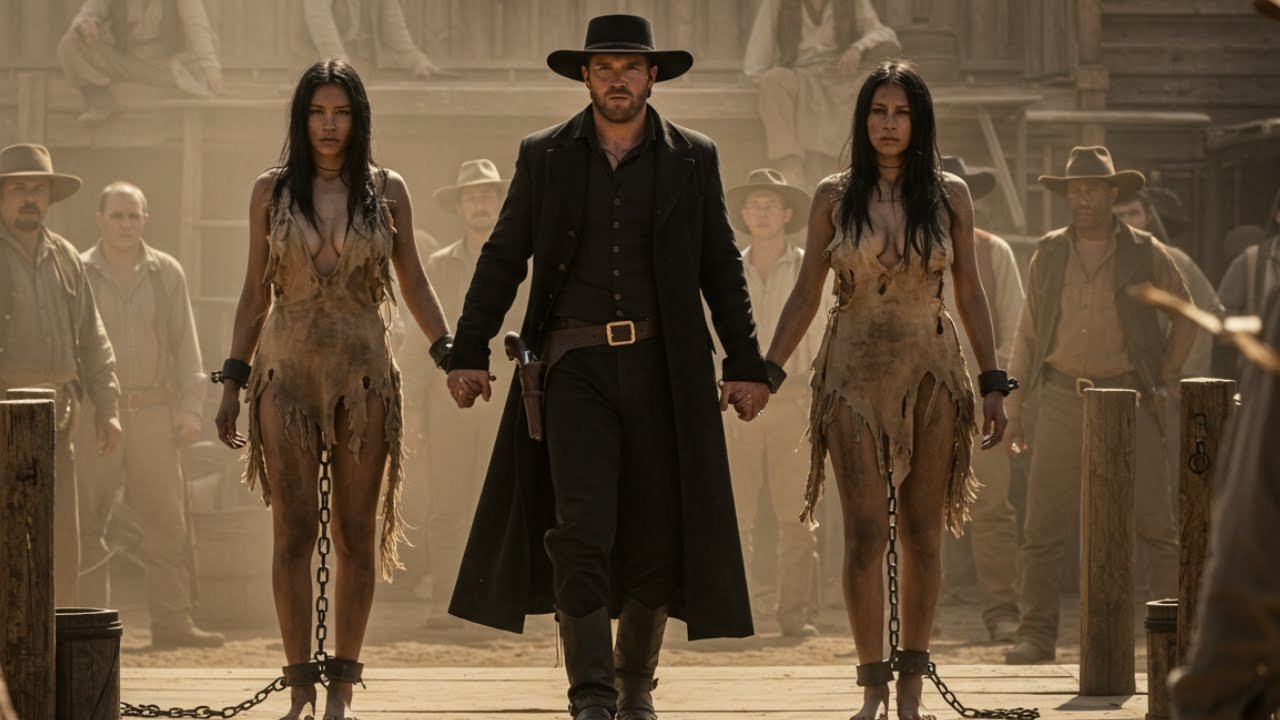
The auction block outside Tombstone stank of sweat and spite. Ezra Blackwood hawked human beings like livestock, voice slick as rendered fat. I stood in the crowd a broken-down ex-cavalry man named Cole Coleman, three years widowed, carrying nothing but ghosts and a thin pouch of coins. Then I saw them—two Apache sisters, backs straight as lodge-poles, eyes burning holes through the dust. The older one, Kaia, stared straight at me as if to say, “Do something or live with the stink of your own cowardice.” My hand rose before my brain caught up. Five hundred gold dollars—every cent I had—hit the planks. The ropes fell away; the crowd swallowed its tongue. Kaia whispered, “You’ll regret this,” and I answered, “I’d regret doing nothing more.”
I took them home to Red Canyon Ranch, a place built with my wife Sarah before consumption took her and the child she carried. The house had been a tomb; now it held voices again. I cut their bonds, showed them guest rooms, and said the word family aloud for the first time in years. Kaia listened like a wolf testing wind; little Ayana watched like a sparrow ready to bolt. I owed them honesty, so I gave it—stories of battles I fought against their people, of Nal Nish, the Apache who taught me parley before he died under a white flag. I told them I bought them because broken things can still be worth mending.
Spring came early that year. Kaia learned to read cattle the way others read books; Ayana filled the house with songs and the smell of corn cakes. My housekeeper Rosa scolded me for spending money I didn’t have, then taught the girls to sew curtains for windows that had stood bare since Sarah died. We settled into a rhythm—work, eat, talk, sleep—until the night three gunmen rode up demanding “the squaws” back. I met them in the yard with my rifle; Kaia met them with arrows that sang. Federal marshals arrived before blood dried; Ezra Blackwood left in chains. The sisters stayed.
Word traveled faster than kindness. Chief Joseph Nightwind came alone, unarmed, eyes sharp as obsidian. He listened to his nieces, listened to me, and laid his hand on my chest. “You are family now,” he said. “Betray that and I will come for you.” I believed him—and knew I would never sleep more soundly.
Summer brought a telegram that rattled the windows: a court in Washington had awarded Kaia and Ayana thirty-five thousand dollars for land stolen years earlier. More money than I had seen in my life. I told them to take it and build whatever future they wanted. They answered with a question: “Why leave home when we can make it larger?” We bought adjoining range, hired displaced Apache families, built cabins sturdy enough to outlast blizzards and bigotry. The ranch became a small nation where English, Spanish, and Apache mixed like rivers meeting in one bed.
On an October morning bright as polished brass, Kaia married me beneath red cliffs. Chief Nightwind sang the old songs; Doc Franklin spoke the legal words. Ayana stood beside us, smiling through tears that caught sunlight like glass. I slipped the emerald ring—Sarah’s once, now resized—onto Kaia’s finger and felt the past settle gentle as snow. We promised each other nothing perfect, only honest. That night, drums echoed off stone and coyotes sang harmony while we danced with children who would never know a world where buying people is business.
Years later, travelers still speak of the valley where the Gray Wolf rancher lives with the Moon-eyed warrior and her people. They tell of cattle fat as butter, of horses gentled by songs older than English, of a fence that keeps no one out and a gate that opens both ways. If you ride close at dusk, you’ll hear laughter floating above corral fires and know that sometimes the right thing is also the hardest thing—and the only thing worth doing. It began with three words: I’m taking you home. It ends wherever love decides family is bigger than blood, stronger than fear, and wide enough to hold us all.