“They Won’t Let Me Eat,” a 5-Year-Old Girl in a Wheelchair Whispered — So the Biker Made One Phone Call, Bought the Diner That Same Day, and Fired the Manager Who Tried to Throw Her Out
The first thing I remember about that morning was the sound of ceramic scraping against tile, a fork slipping from someone’s hand and clattering to the floor as if gravity itself had been startled, and then a small voice—fragile, breathy, almost apologetic—threading its way through the heavy Tennessee air inside Sunrise Diner.
“They won’t let me eat, Mommy.”
My name is Colton Reeves, and I had been riding with my brothers through eastern Tennessee for three straight days when we pulled off the highway near a town called Cedar Ridge, chasing nothing more ambitious than strong coffee and a stack of pancakes big enough to quiet the road in our bones. The bell above the diner door hadn’t even finished ringing when every instinct I’d sharpened over fifty-two years of living told me something in that room was wrong.
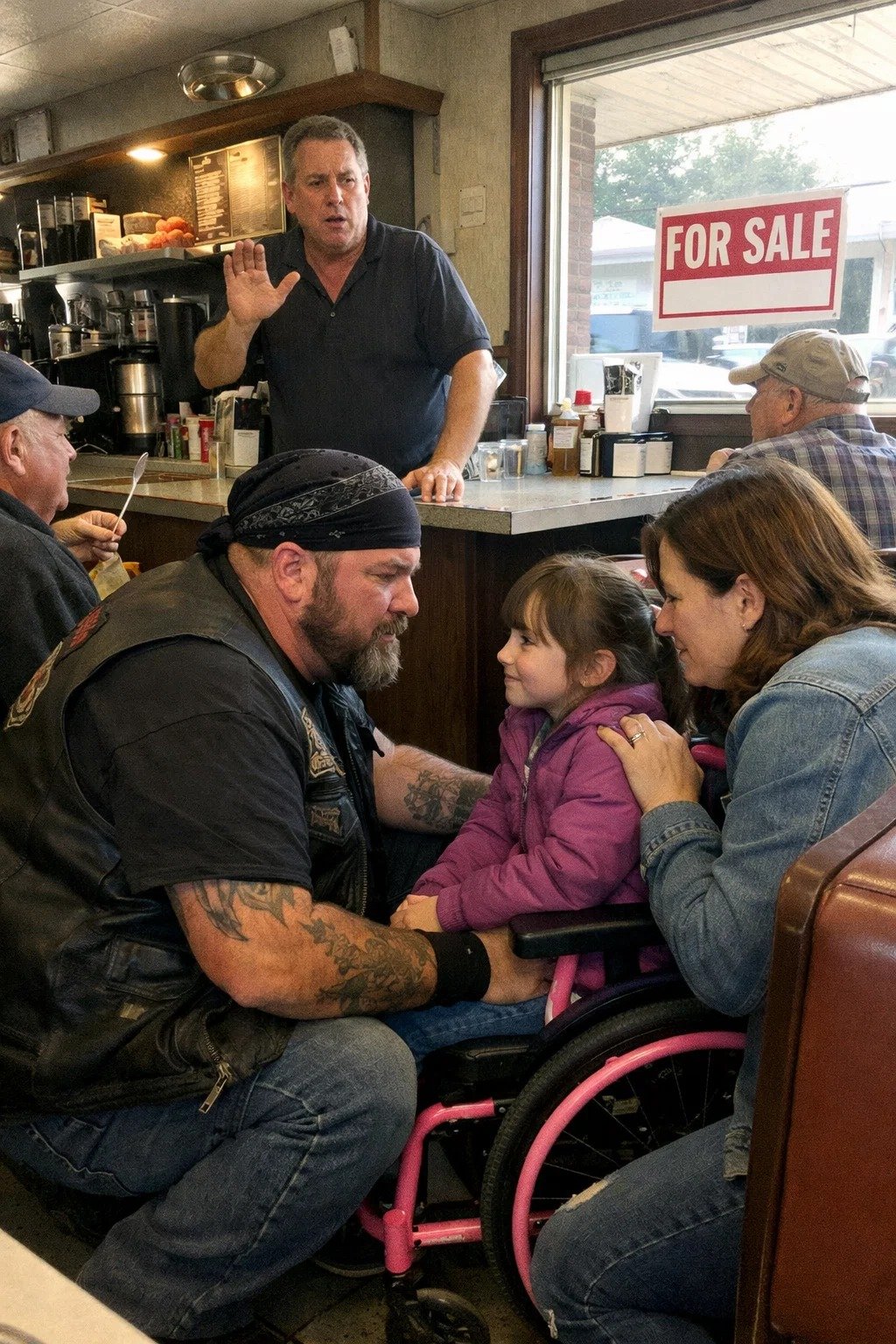
The girl sat near the window in a pink wheelchair decorated with peeling butterfly stickers, her legs tucked under a fleece blanket despite the late-summer heat, her strawberry-blonde hair caught in the sunlight like fine copper wire. Across from her sat her mother, a woman in her early thirties with tired eyes and a purse clutched so tightly in her lap that her knuckles had gone the color of chalk. On the table between them rested a single waffle, golden and untouched, slowly surrendering its warmth.
Behind the counter stood a man with the kind of polished smile that belongs in real estate brochures rather than diners, his name tag reading “Travis,” his tone clipped and loud enough to ensure that humiliation carried all the way to the back booths.
“Ma’am,” he was saying, straightening the stack of receipts as though they were trophies, “if your card doesn’t work, you can’t sit here. I’ve got paying customers waiting.”
The irony of that statement hovered thick in the air, because every paying customer in that room had gone silent.
I felt my brothers stop behind me. Wade, broad as a barn door and twice as steady, muttered something under his breath. Miguel, who rarely spoke unless he meant it, folded his arms across his chest. The jukebox in the corner clicked off mid-song, as though even it understood that this wasn’t a moment for music.
The little girl’s chin trembled, but she didn’t cry. She looked at her mother first, as if seeking permission to be disappointed, and then she whispered those words that froze the room.
“They won’t let me eat, Mommy.”
I’ve heard men beg for second chances. I’ve heard engines scream before a crash. I’ve heard doctors deliver news that changes the course of a life. None of those sounds have the power of a child trying to make sense of unfairness.
I walked toward their booth slowly, aware of how I must have looked—six-foot-four, leather vest, sunburned forearms inked with the map of a life spent on highways and hard lessons. People see the patches on our backs and assume they know the story. They rarely ask about the chapters that came before.
I knelt beside the girl’s chair so that our eyes met at the same level.
“Hey there,” I said gently. “What’s your name?”
She hesitated, glancing at her mother.
“It’s okay,” her mother murmured, her voice thin but brave. “You can tell him.”
“Madeline,” the girl whispered. “But Mommy calls me Maddie.”
“Well, Maddie,” I replied, keeping my voice steady, “why aren’t you eating that waffle? It looks like it’s about to miss you.”
She gave a tiny shrug. “The man said we have to go. Mommy’s card is broken.”
There are moments in a man’s life when something inside him locks into place with absolute clarity. I stood up slowly and turned toward the counter.
“You the owner?” I asked Travis, my tone even, not raised, not threatening, just direct.
“I manage the place,” he shot back, though I noticed his shoulders had tightened. “And I’m not running a charity. I’ve got rules.”
“Rules,” I repeated, letting the word sit between us. “Like not feeding five-year-olds?”
His jaw flexed. “Like not giving away food when people can’t pay.”
I glanced toward the front window where a faded “For Sale” sign hung crookedly, sun-bleached and ignored. “That sign been there long?”
He blinked, thrown by the shift. “Couple months. Owner’s retiring.”
“What’s he asking?”
Travis scoffed. “What does it matter to you?”
“It matters,” I said calmly, “because I’m asking.”
Behind me, Wade stepped forward, already pulling out his phone. “Want me to find the listing?” he asked.
“Yeah,” I said without breaking eye contact. “Let’s see what the future of this place looks like.”
The room was so quiet that the hiss of the coffee machine sounded like a warning.
Maddie’s mother finally found her voice. “Sir, please,” she said to me, her hand resting protectively on her daughter’s shoulder. “We don’t want trouble. I can take her somewhere else.”
“You shouldn’t have to,” I replied, softer now. “Not for breakfast.”
Wade walked back a minute later. “Owner’s name is Harold Jensen. Lives twenty minutes out. Property’s been sitting. Price dropped twice.”
“Call him,” I said.
Travis laughed, though it came out thinner than he intended. “You can’t just buy a diner because you’re upset.”
I looked at him evenly. “I’m not upset.”
That was true. I wasn’t angry in the explosive sense. I was clear.
Within ten minutes, Wade had Mr. Jensen on speaker. The elderly man’s voice crackled through the phone, weary but alert when he heard the word “cash.”
“You serious about closing quick?” Mr. Jensen asked.
“As serious as I’ve ever been about anything,” I replied. “I’ll put down twenty-five thousand today and wire the rest by Monday morning. No delays. No contingencies.”
Travis’s face drained of color. “You don’t even know if you can run a restaurant.”
“I know how to run a team,” I said. “And I know how to treat people.”
There are negotiations that take weeks, and then there are moments when the universe seems to lean forward and decide it has had enough of small cruelties. Mr. Jensen agreed to meet us that afternoon. Paperwork was drawn up faster than anyone expected. By three o’clock, Sunrise Diner had a new owner.
When I walked back in with the signed agreement in my hand, the staff stared as though they were watching a magic trick unfold in real time.
I stepped behind the counter and gently removed Travis’s name tag from his shirt.
“You’re relieved of your position,” I told him evenly. “Today.”
“You can’t just fire me,” he sputtered.
“I can,” I replied, setting the tag down on the counter. “Because as of an hour ago, this place belongs to me.”
He looked around for support, but the cooks were watching from the kitchen doorway with expressions that suggested relief rather than protest. The regulars in the booths avoided his eyes.
Travis grabbed his keys and stormed out, the bell above the door ringing with a final, indignant jingle.
I turned toward the kitchen. “Let’s start over,” I said. “Fresh batter. Real blueberries. Whipped cream that doesn’t come from a can.”
The cook, a middle-aged woman named Rita, grinned for the first time all day. “You got it, boss.”
I walked back to Maddie’s table and slid into the booth across from them.
“I owe you an apology,” I told her solemnly. “The previous management made a poor decision.”
Her eyes widened. “Are you the boss now?”
“Looks like it.”
She studied me for a moment, then asked, “Does that mean I can eat?”
“It means,” I said with a smile, “you can have the best waffle in Tennessee.”
When the new plate arrived—steaming, piled high with fruit and a generous swirl of cream—Maddie stared at it as though it were treasure. She took a cautious bite, then another, and then she smiled in a way that made every mile we’d ridden worth it.
Her mother introduced herself as Rebecca Lawson. She explained, quietly and without self-pity, that Maddie had been born with a spinal condition requiring multiple surgeries, that medical bills had outpaced insurance, that she worked two jobs, and that her card had declined because a payment had posted earlier than expected.
“I wasn’t trying to get something for free,” she said, her voice trembling. “I just needed a little time.”
“You don’t owe me an explanation,” I told her. “You owed that man nothing but basic courtesy, and he couldn’t even manage that.”
Over the next few weeks, my brothers and I did something none of us had planned when we first swung our legs over our bikes decades ago: we stayed put.
Sunrise Diner reopened the following Monday with a new sign in the window: “Family First.” The words were simple, but they carried weight. We kept the staff. We raised wages modestly. We started a policy that no child would ever be turned away over a payment issue. If someone truly couldn’t afford a meal, we created a discreet tab funded by a jar near the register labeled “Community Plate.”
The town watched, skeptical at first. Rumors travel fast in small places, especially when leather jackets are involved. But actions travel faster.
Maddie and Rebecca came back the next weekend, this time with a homemade thank-you card decorated in glitter. Maddie had drawn a motorcycle with exaggerated flames and a stick figure with a beard.
“That’s you,” she informed me proudly.
“I look taller in real life,” I teased.
Rebecca hesitated before speaking again. “I’ve been looking for steady hours,” she said. “If you ever need help—”
“We do,” I interrupted gently. “Rita could use someone up front who knows how to smile under pressure.”
Rebecca started the following Monday.
Word spread that Sunrise Diner was under new management and that something about it felt different. Farmers lingered longer over coffee. High school students came in after football games. A local contractor offered to repaint the exterior at cost. What had once been a place people tolerated became a place they chose.
As for Travis, I heard through town gossip that he’d tried to secure a position at another restaurant, but stories have a way of following you when you’ve been careless with your character. No one wanted a manager known for turning away a child over a waffle. He eventually moved two counties over, his reputation arriving before he did.
One afternoon, about three months after the diner changed hands, a black SUV pulled into the parking lot. A man in a tailored suit stepped out, surveying the building with a critical eye. He introduced himself as a regional franchise investor.
“I’ve heard about this place,” he said, glancing at the steady line of customers. “You’ve increased revenue significantly. Ever consider selling?”
I looked around at the crowded booths, at Rebecca balancing three plates with surprising grace, at Maddie near the counter proudly handing out crayons to other children.
“I didn’t buy this to flip it,” I replied. “I bought it to fix it.”
He nodded slowly, as though recalibrating his understanding of value.
That evening, after closing, Maddie rolled over to my booth with a seriousness that made me set aside my ledger.
“Mr. Colton,” she began, “when I grow up, I want to have a place where nobody gets told no for breakfast.”
I swallowed, struck by the weight of her ambition. “That’s a good goal,” I said. “You’ll run it better than I ever could.”
Rebecca watched us from the counter, her expression softer than it had been the day we first met.
The most expensive meal Travis ever served wasn’t the waffle he tried to deny; it was the loss of the diner itself, the job, and the standing he once enjoyed in town. Cruelty has a way of charging interest.
As for me, I found something I hadn’t known I was missing. The road had given me freedom, but Sunrise Diner gave me purpose. Each morning when I unlocked the door, the bell chimed not as a warning but as a welcome.
One year to the day after we walked in and changed the course of that little restaurant’s history, we held a community breakfast. Tables were pushed together. Pancakes stacked high. Laughter spilled out onto the sidewalk.
Maddie, now six, insisted on making a speech from her wheelchair near the counter.
“Thank you for letting me eat,” she declared proudly, her voice carrying across the room. “And thank you for letting everybody eat.”
The applause that followed wasn’t polite. It was grateful.
I looked around at the faces gathered there—farmers, teachers, mechanics, my brothers, Rebecca behind the counter wiping away tears she pretended were from the onions—and I realized that sometimes the loudest statement a person can make isn’t through intimidation or force, but through ownership of a choice.
We had walked into that diner as outsiders passing through. We stayed because a five-year-old girl reminded us that dignity should never be conditional.
And in the end, the good stayed good, the unkind learned that actions have consequences, and Sunrise Diner became exactly what it should have been all along: a place where a child could sit in the sunlight, take a bite of her waffle, and know without question that she belonged.