Part One: The Refrigerator
The city dump sat at the edge of Los Angeles like something everyone preferred not to think about.
Beyond the glittering towers, beyond the highways humming with Teslas and delivery trucks, past the last strip mall and the half-abandoned warehouses, there was a stretch of land that smelled like heat and rust and things no one wanted anymore.
Lupita knew it like a map.
She knew which mounds held copper wire. Which broken appliances might still have salvageable screws. Which piles attracted stray dogs. Which corners to avoid after noon.
She also knew when it was time to leave.
The morning sun was already rising higher than she liked.
More movement.
More engines.
More risk.
If anyone noticed her lingering near that refrigerator, questions would follow—and questions never ended well for girls like her.
She had just tugged open the door of the old industrial refrigerator when she heard it.
A cough.
Not a small one.
Not the sharp bark of dust in lungs.
This one was hollow.
Scraping.
Like something inside was trying to tear its way out.
Lupita froze.
The refrigerator door hung crooked on broken hinges. The inside was dark except for a thin sliver of light where the seal had torn.
She stepped closer.
Another cough.
Then a whisper.
“Help.”
She dropped the door.
Her first instinct was to run.
She had learned long ago that trouble attached itself to the poor faster than it attached to anyone else. Police didn’t ask who started things. They asked who was closest.
But the cough came again.
Dry.
Weak.
“Stay still,” she said quietly.
Her voice surprised her.
It was steady.
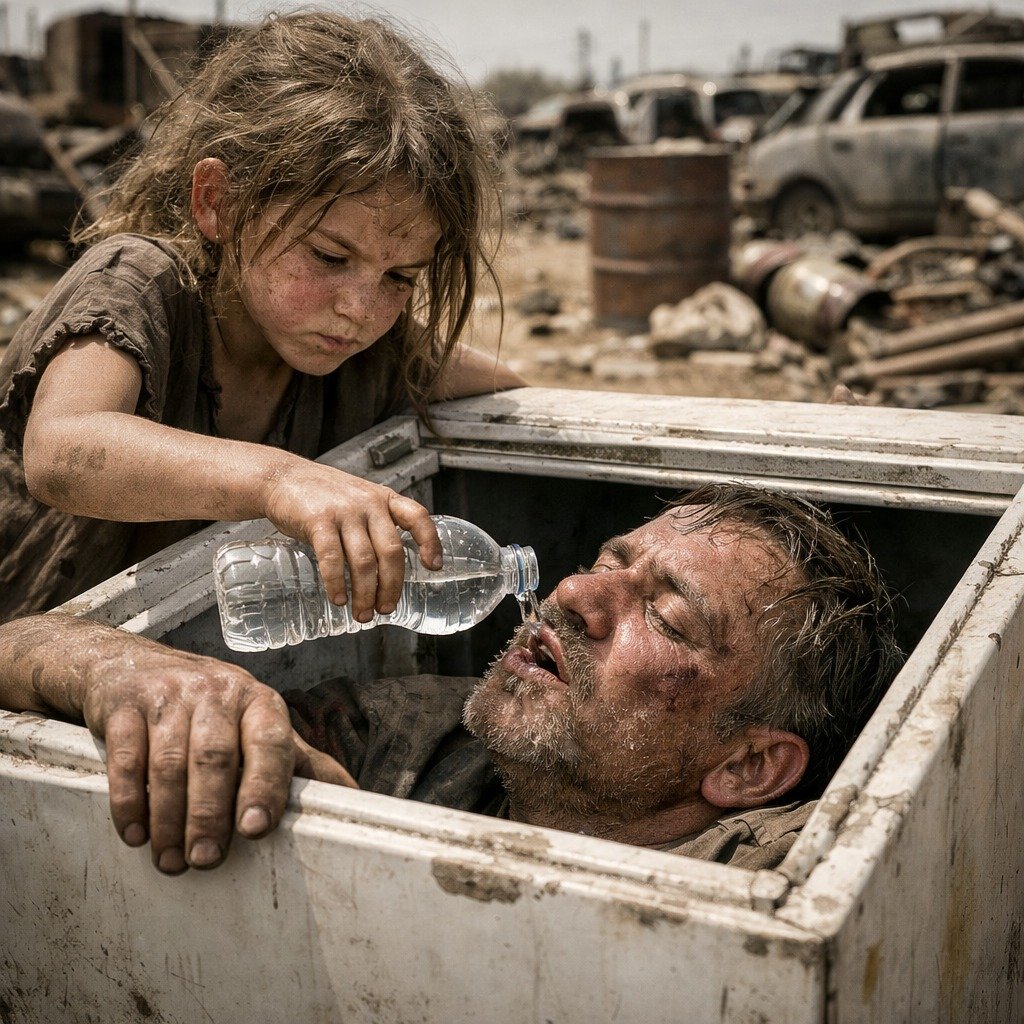
There was a man inside.
Thin.
Bearded.
Wrists tied with industrial plastic bands.
His eyes blinked against the sudden light.
He wasn’t old.
Mid-forties maybe.
He wore expensive clothes—wrinkled now, smeared with dirt, but unmistakably expensive.
“What is this place?” he rasped.
“The dump,” she answered.
He let out something between a laugh and a sob.
“Of course it is.”
Her thoughts went to the plastic bottle inside her bag.
Half a bottle.
Warm.
Cloudy.
But still water.
She knelt and slid it through the gap.
He drank like someone afraid the water would disappear if he swallowed too quickly.
When he finished, his hand remained near the opening.
Not grabbing.
Just trembling.
“I can’t cut you loose,” Lupita said.
Not yet.
If she did, and someone saw, she would be blamed.
“I don’t need that,” he whispered. “Just… don’t tell the wrong people.”
The word wrong didn’t need explaining.
There were always wrong people.
She studied him.
He didn’t look like the men who scavenged metal.
He didn’t look like the men who argued over cardboard.
He looked like he belonged in a place with glass walls and polished floors.
“Why are you here?” she asked.
He swallowed.
“Because I said no.”
To what, she didn’t know.
Didn’t need to.
She stood.
“Stay still.”
Then she ran.
She ran past the piles she recognized.
Past the overturned sofa where stray dogs slept.
Past the men who pretended not to see her because it was easier.
She didn’t stop until she reached the cracked road leading away from the dump.
At the corner, there was a small liquor store that doubled as a convenience shop.
The owner sometimes let her sweep for a few coins.
She pushed through the door, breathless.
“There’s someone in there,” she said.
The owner squinted.
“In where?”
“The dump. In a refrigerator.”
He stared at her like she had told him the moon was bleeding.
“Call the police,” she said.
He hesitated.
Then he reached for the phone.
She didn’t stay.
By midday, patrol cars rolled past the fence.
By late afternoon, the refrigerator was gone.
By night, Lupita sat on the curb outside the shelter where she sometimes slept, knees pulled to her chest, certain that this was the end of it.
That was usually how things worked.
You did something.
Then you disappeared back into your life.
No one came looking for you.
Three days later, a black SUV rolled to a stop near the alley behind the shelter.
It was clean.
Too clean.
A woman stepped out.
She wore a tailored navy suit. Her posture was calm, deliberate.
She knelt down so that her eyes were level with Lupita’s.
“We’re searching for a little girl,” she said gently. “Someone very brave. Very clever.”
Lupita said nothing.
She had learned silence early.
The woman smiled patiently.
“Daniel Harris asked us to find you.”
The name meant nothing.
But the eyes she had seen inside that refrigerator did.
The woman extended her hand.
“You’re not in trouble.”
That sentence felt more suspicious than reassuring.
But something in the woman’s voice—something steady—made Lupita stand.
They didn’t take her to a police station.
They took her to a hospital.
Hot water.
Clean clothes.
A bed that didn’t smell like bleach and exhaustion.
A shower that didn’t shut off because someone was pounding on the door.
She slept for twelve hours.
Daniel came the next day.
He looked different.
Clean-shaven.
Still thin.
Still pale.
But upright.
He didn’t embrace her.
He didn’t cry.
He knelt in front of her hospital bed and said, “You saved my life.”
She stared at him.
People didn’t usually say things like that to her.
“I just called,” she said.
“You ran,” he corrected gently.
“And you didn’t tell the wrong people.”
She shrugged.
“What were you doing in that refrigerator?”
He exhaled slowly.
“I own a company,” he said. “Or I did. Logistics. Shipping. Warehousing.”
She didn’t know what those words meant.
“Some people wanted me to move things that shouldn’t be moved,” he continued. “I refused.”
“And they put you in the trash?”
He almost smiled.
“Something like that.”
Silence settled between them.
“You don’t have to adopt me,” Lupita blurted suddenly.
He blinked.
“I’m not asking you to,” he said softly.
“I don’t want to be on TV.”
“You won’t be.”
“I don’t want cameras.”
“There won’t be any.”
He leaned back slightly.
“I just want to make sure you’re safe.”
She didn’t believe him immediately.
But she didn’t walk away either.
Daniel followed through.
Not loudly.
Not publicly.
He arranged for her to move into a transitional housing program—not the shelter, but a supervised apartment complex for youth without guardians.
He paid for her schooling.
He hired a tutor.
He didn’t show up with reporters.
He showed up with notebooks.
Every week.
Same day.
Same time.
No promises about forever.
Just consistency.
Lupita learned multiplication from textbooks instead of counting scrap metal.
She learned street names instead of trash piles.
She learned that when someone said they would come at four, they came at four.
That part felt the strangest.
One afternoon, months after the refrigerator, she asked him, “Why are you doing this?”
He considered the question carefully.
“Because someone once helped me when I had nothing,” he said. “And I didn’t forget.”
Years passed.
Lupita grew taller.
Stronger.
Less wary.
She didn’t become rich.
She didn’t become famous.
She became steady.
When she turned eighteen, she made a choice.
She didn’t ask Daniel for more money.
She didn’t ask for a car.
She asked for tuition support for social work.
“I want to work with kids like me,” she said.
He nodded.
“That sounds right.”
She returned—not to the dump, but to the neighborhoods around it.
She worked with children who read danger in faces.
Children who thought hunger was just part of life.
Children who hid food under pillows.
And sometimes, when someone asked her how she kept going, she smiled.
“Because once,” she would say, “I found a man locked inside a refrigerator.”
“And?”
“And I realized something.”
“What?”
“That no matter how little you have… you can still save someone.”
Years later, Daniel attended the opening of a small community center built on land not far from the old dump.
Lupita stood at the podium.
She didn’t mention refrigerators.
She didn’t mention fear.
She talked about second chances.
About showing up.
About the quiet power of doing the right thing when no one is watching.
After the speech, she found him near the back.
“You didn’t have to do all that,” she said.
He smiled.
“You didn’t have to run.”
They stood together for a moment, watching children play basketball where scrap metal once lay.
In the distance, the city shimmered.
Clean.
Bright.
Unaware of how close it had come to losing one of its own.
And Lupita understood something clearly.
Sometimes you save someone from a refrigerator.
Sometimes they save you from the life you were building around fear.
Either way—
It begins with staying.