The first thing to know about that courtroom is that gentleness had no place there. It was a room designed for rigid posture and impeccable suits, for crisp objections and calculated pauses. It belonged to seasoned men who could turn silence into a weapon and women who could dismantle a lie with nothing more than a lifted brow. It was never meant to hold a three-year-old girl in scuffed Mary Janes, clutching a stuffed rabbit under her arm—nor was it prepared for a kind of truth that arrives without formalities or legal framing.
By the time the hearing opened that Tuesday morning, the story had already dominated headlines for two straight weeks. The city followed every update obsessively: the violent attack on prominent gallery owner Serena Vale, discovered unconscious in her kitchen with a broken wrist and a concussion severe enough to erase entire days from her memory. The man accused was her fiancé, Darren Kessler—a venture capitalist with a magazine-ready smile and what appeared, at least on paper, to be an unshakeable alibi. His attorneys maintained he had attended a private investors’ dinner across town. Receipts matched. Witnesses confirmed. Even valet timestamps aligned. The narrative fit together almost too perfectly—and from my experience, when things fit that neatly, it’s usually a cue to scrutinize more closely, not to relax.
The case’s most delicate element was this: the only other person present in the apartment that night was Serena’s daughter, three-year-old Norah Vale. Since paramedics carried her mother out on a stretcher, Norah had not spoken a single word. Not to doctors. Not to investigators. Not to the child psychologist appointed by the district attorney’s office. Silence had wrapped around her like a second skin.
Presiding over the trial was Judge Miriam Calder, known for her steady temperament and the thoughtful way she clasped her hands before issuing a ruling, as though weighing not only the law but its consequences. Yet even she appeared unsettled the morning Norah was due in court. It showed in the brief pause before she called the room to order. The benches behind the defense were packed with reporters, bloggers, and legal interns—drawn by the sense that something significant might occur, though no one could say exactly what.
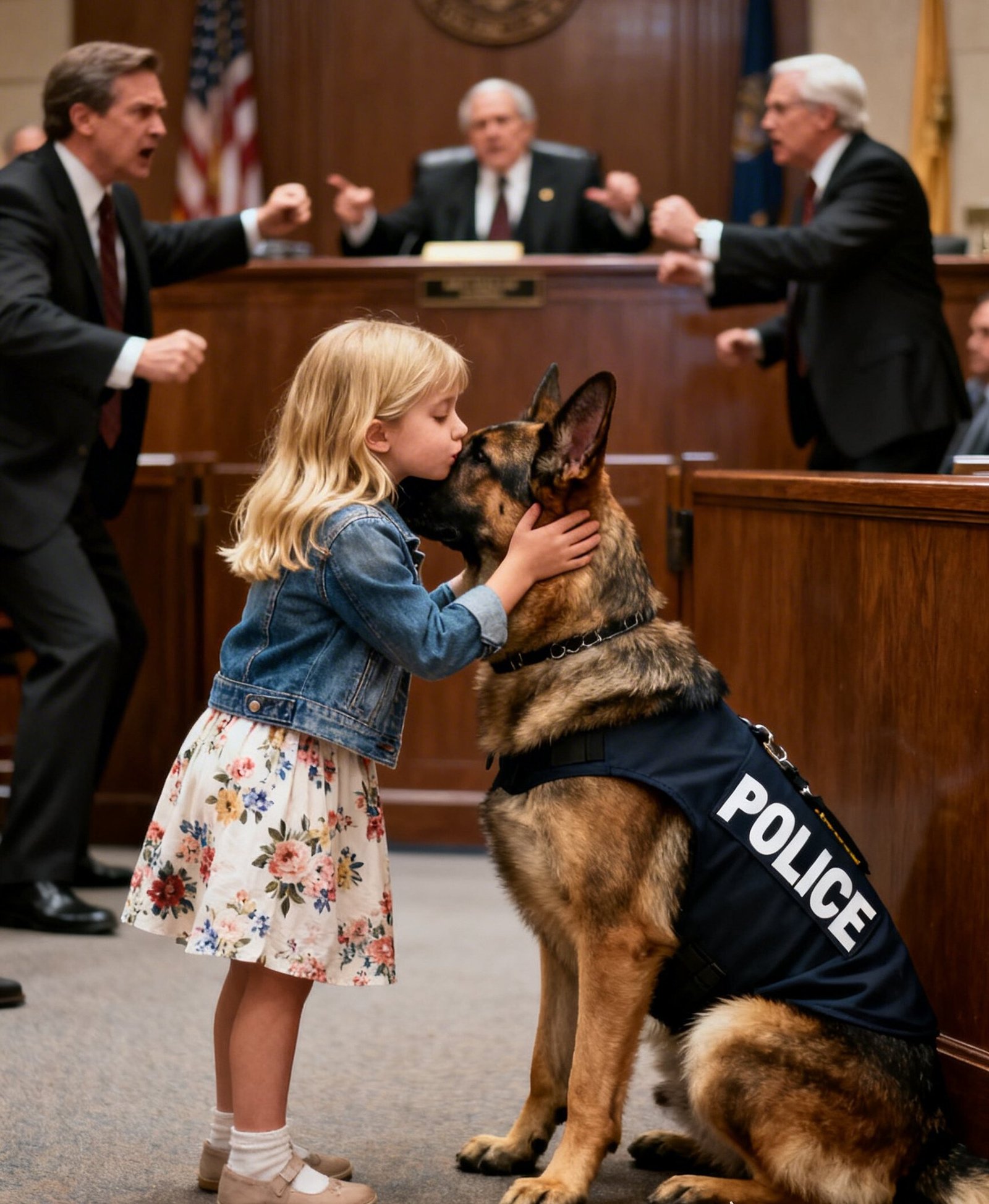
The prosecution, led by Assistant District Attorney Leah Moreno, had requested an unusual accommodation: the presence of a certified K-9 support dog during Norah’s time in the courtroom. Not a household pet or a casual comfort animal, but a trained police therapy dog named Atlas—a large sable German Shepherd with sharp, intelligent eyes and a reputation for remaining calm in environments that unsettled even veteran officers.
When the courtroom doors opened at the back, the atmosphere shifted almost tangibly. Norah entered holding the hand of her temporary guardian, Serena’s older sister, Camille Vale. She wore a pale yellow cardigan slightly too large for her, sleeves covering her hands, and carried a well-worn plush rabbit by one ear. Her brown curls were gathered loosely into a ponytail already beginning to slip free. She avoided the crowd, avoided the judge, keeping her eyes fixed on the floor as though counting each tile.
Atlas followed behind her. His paws made a gentle clicking sound against the polished surface—strangely more reassuring than any whispered comfort in the room. He wore a navy vest labeled POLICE K-9 SUPPORT in bold white lettering. His handler, Officer Grant Hollowell, guided him forward, issued a quiet command, and stepped aside. Atlas lay down beside the witness chair without hesitation.
Norah paused near the aisle, frozen in place. Her grip on Camille’s hand tightened until her knuckles paled. Then, slowly, she looked at Atlas. The shift in her expression was subtle but undeniable. Her shoulders lowered slightly. She released Camille’s hand and walked toward the dog.
She didn’t immediately take the witness seat. Instead, she crouched beside Atlas and pressed her forehead gently into the thick fur at his neck. The courtroom fell silent—not the formal hush of legal decorum, but a deeper stillness, the kind that seems to hold its breath.
Leah Moreno knelt a short distance away, careful not to overwhelm her. “Hi, Norah,” she said softly. “Do you remember me?”
There was no response.
Norah’s fingers tangled into Atlas’s fur. She leaned close to his ear and whispered something so faint it seemed meant for him alone. Atlas remained steady, unflinching. His ears stayed relaxed. Only the tip of his tail tapped once against the rug.
The defense attorney, Martin Halpern, let out an audible sigh. “Your Honor,” he began, “we object to this display. The child is clearly not competent to testify.
Judge Calder lifted a hand. “Competency will be determined through observation, Mr. Halpern. Please be seated.”
At last, Norah allowed Camille to help her into the witness chair, though she sat sideways, her small frame angled toward Atlas so one hand could remain buried in his fur. Her legs dangled above the floor. The microphone was lowered to her height.
Leah softened her tone even further. “Norah, can you tell us who Atlas is?”
Silence.
Leah adjusted her approach, turning slightly toward the dog. “Atlas, can you help Norah feel safe?”
A faint smile flickered across Norah’s face. She leaned down and whispered again into Atlas’s ear—this time not shielding her mouth from the room.
“He knows,” she said quietly.
The words were barely audible, but the microphone carried them. A ripple passed through the gallery.
Leah’s heart gave a visible jolt—anyone watching closely could see it in the sudden stiffness of her shoulders. “What does he know, sweetheart?” she asked gently.
For the first time, Norah lifted her eyes. They drifted slowly across the courtroom until they settled on the defense table. Darren Kessler sat there in a perfectly tailored navy suit, hands neatly folded, his expression carefully blank. He held her gaze without blinking.
Norah didn’t point. She didn’t cry. She simply leaned closer to Atlas and said, a little clearer now, “He’s the loud one.”
The words landed with more force than a shout ever could.
Martin Halpern shot to his feet. “Objection! Leading and prejudicial.”
“Sustained as to form,” Judge Calder replied, though doubt flickered across her face. “The jury will disregard the characterization.”
But anyone who has served on a jury understands that some statements linger, no matter what instructions follow.
Leah resisted the urge to press further. You don’t chase courage that fragile. Instead, she asked softly, “Norah, do you remember the night Mommy was hurt?”
Norah’s lower lip quivered. She shook her head once—not in denial, but as though trying to clear away a haze. Then she reached into her cardigan pocket and pulled out a folded sheet of paper. Camille looked startled; she hadn’t realized Norah had brought anything.
Carefully, Norah unfolded it. A crayon drawing. A crooked table. A tall figure surrounded by jagged red lines around its arms. A smaller figure beneath what looked like a scribbled countertop.
Leah accepted the drawing with both hands, almost reverently. “Can you tell me about this?”
Norah bent toward Atlas again, whispering in his ear. Then she straightened and spoke into the microphone, her voice thin but steady. “Table broke.”
A murmur rippled through the gallery.
Leah held up the drawing. “Is this you?” she asked, indicating the smaller figure.
Norah nodded.
“And who is this?” Leah asked, gesturing toward the taller one.
Norah didn’t offer a name. She didn’t need to. Her eyes flicked back to Darren. Then she whispered, “He said Mommy was stupid.”
Serena’s sister covered her mouth with her hand.
Halpern rose again, sharper now. “This is emotional manipulation. The child is being coached—by a dog.”
At that, Norah turned toward him, brow knit in confusion. “No,” she said simply. “Atlas listens. He doesn’t talk.”
The clarity of it sliced through the tension.
Judge Calder called for a brief recess. As chairs scraped and people filtered out, Norah remained in her seat, fingers still knotted in Atlas’s fur. Leah stepped aside, her pulse racing. She hadn’t anticipated so much, so soon.
During the break, Detective Rowan Pierce approached Leah, holding a tablet. “You’re not going to believe this,” he murmured. “Remember the neighbor’s security camera we thought was useless?”
Leah nodded. It had captured only muffled street audio that night—nothing visually incriminating.
“We enhanced the audio again,” Rowan said. “Listen.”
Static crackled. A man’s raised voice. A crash. Then, faintly, a child’s whisper: “Don’t be loud.”
Leah felt her throat tighten. The timing matched Norah’s account exactly.
When court resumed, Leah requested permission to introduce the enhanced recording. Halpern objected fiercely, but Judge Calder allowed it, instructing the jury to weigh it carefully.
The room went still as the clip played. The crash echoed. A man’s voice barked something indistinct. Then the whisper.
Norah didn’t flinch. She stroked Atlas’s ear, as though reassuring him instead.
Leah turned back to her. “Norah, were you under the table when you said that?”
Norah nodded.
“Why did you say ‘don’t be loud’?”
Norah looked puzzled for a moment, then leaned into Atlas’s ear once more. When she straightened, her eyes were wet but steady. “Because loud makes him mad.”
That was when the first fracture appeared in Darren Kessler’s composure. His jaw tightened. His hand twitched against the table.
But the true turning point hadn’t even arrived yet. It came the next morning in a way no one anticipated.
Rowan had spent the night reviewing phone tower data. Darren’s phone had indeed pinged near the investors’ dinner—but only until 8:12 p.m. After that, it went dark. No calls. No data. No movement. Until 9:41 p.m., when it reappeared just two blocks from Serena’s apartment.
Darren had insisted he never left the dinner.
When Leah presented the data in court, Halpern’s objections lacked their earlier force. Darren maintained it was coincidence—a technical glitch.
Then Norah did something no one had prepared for.
As Leah spoke, Norah slipped down from the witness chair and walked—not toward Darren—but toward the back of the courtroom. Atlas followed instantly, close enough that his shoulder brushed her leg. Norah stopped in front of a man seated quietly in the second row. He had attended every session without speaking.
It was Evan Drake, Darren’s business partner.
Norah looked up at him. “You were there too,” she said softly.
The air seemed to turn cold.
Leah’s thoughts raced. Evan had provided Darren’s alibi. He had testified under oath that Darren never left the dinner.
“Norah,” Leah asked carefully, “how do you know that man?”
Norah twisted her fingers into Atlas’s fur. “He smells like Daddy’s office,” she said. “He came before.”
It sounded childish at first. But Rowan moved quickly, pulling up property records on his phone. Serena’s gallery had recently rejected a partnership proposal from a firm co-owned by Darren and Evan Drake. There had been tension—heated emails, financial strain.
Within hours, new warrants were issued. Evan’s phone data revealed he, too, had gone dark that night—reappearing in the same vicinity as Darren’s.
Under questioning, the cracks widened. By week’s end, confronted with phone records and mounting inconsistencies, Evan confessed. Darren had left the dinner early, enraged after Serena threatened to expose irregularities in a shared investment. Evan drove him to the apartment “just to talk.” The argument escalated. The table broke when Serena tried to pull away. Darren panicked. Evan helped construct the alibi.
On the day of the verdict, the courtroom felt different from that first morning. Not lighter—justice in cases like this rarely feels light—but steadier.
Darren Kessler was found guilty of aggravated assault and witness intimidation. Evan Drake accepted a plea agreement for conspiracy and obstruction.
When it was over, Norah didn’t grasp the legal terminology. She only understood that her mother would soon come home from the hospital. She sat on the courthouse steps beside Atlas, drawing again. This time, the table in her picture stood upright. The red lines were gone. The tall figure had been replaced by a sun.
Leah crouched beside her. “You were very brave,” she said.
Norah shrugged in that uniquely three-year-old way. “Atlas helped,” she replied.
And that, more than anything, was true.
The lesson from that courtroom isn’t about spectacle or surprise. It isn’t even about the novelty of a child speaking to a dog. It’s about listening in places we rarely expect clarity. We underestimate children because their sentences are short and their drawings uneven. We underestimate silence because it doesn’t argue for itself. But trauma surfaces when it is given safety—and sometimes safety has four paws and steady eyes rather than a law degree. Justice, at its core, is not only about evidence and procedure; it is about making room for the smallest voice in the room to speak without fear.
If you ever doubt that, remember the three-year-old girl who whispered to a police dog in a courtroom full of adults—and changed the outcome of a case many believed was already decided.