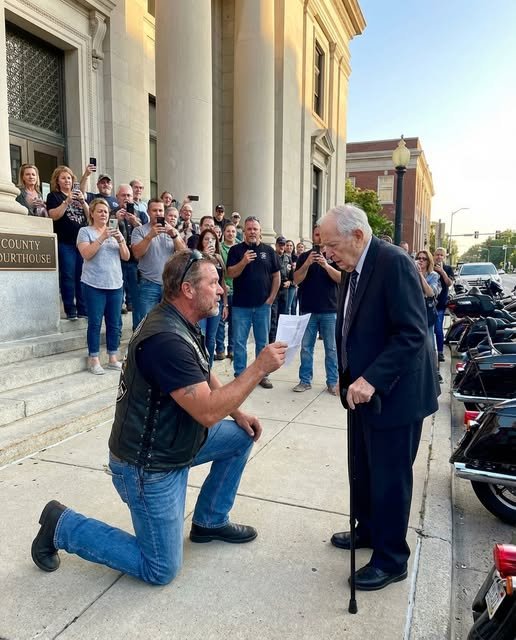
I dropped to one knee in front of the man who sent me to prison twenty years ago, and the crowd immediately assumed the worst — that I was begging the judge who destroyed my life. It was 11:42 a.m. outside the Franklin County Courthouse.
Late autumn sun. Cold wind across the courthouse steps. The kind of ordinary morning where nothing unusual is supposed to happen.
Endfield
Endfield – Enter A New Tactical Frontier
Learn more
Except fifteen motorcycles were parked along the curb.
And a line of bikers stood quietly at the base of the stairs.
People noticed that part first.
Leather vests.
Boots.
Gray beards.
Scarred knuckles.
The kind of men most people cross the street to avoid.
A reporter whispered, “What’s going on?”
Another person said, “Maybe a protest.”
Then the courthouse doors opened.
And Judge Thomas Harlan stepped outside.
Eighty years old now.
Thin. White hair. Walking slowly with a cane.
He had been one of the toughest criminal judges in Ohio back in the 90s.
The kind of judge whose courtroom was silent even when it was full.
The moment people recognized him, the curiosity turned into tension.
“What are the bikers doing here?”
I stepped forward.
Boots echoing against the stone steps.
Every camera in the crowd swung toward me.
The judge looked up slowly.
He didn’t recognize me.
Not yet.
To him I was just another man in a leather vest walking toward him with purpose.
And when I stopped in front of him, something happened that no one expected.
I dropped to one knee.
Gasps rippled through the crowd.
Someone shouted, “Is he threatening him?”
Another voice said, “Call security!”
Phones lifted higher.
People whispered the same assumption over and over.
A biker kneeling before a judge must be begging.
Begging for mercy.
Begging for forgiveness.
Begging for something.
But I wasn’t begging.
I was remembering.
Twenty years earlier, inside a courtroom that smelled like old wood and fear, that same man had looked directly at me and said something that changed my life.
Words that sounded like punishment at the time.
Words that sounded like twenty years stolen from me.
And the crowd watching on those courthouse steps had no idea that the sentence they thought ruined my life…
Was the reason I was still alive.
The judge looked down at me.
Confused.
Studying my face carefully.
And then he asked the same question everyone else was thinking.
“Do I know you?”
The moment the judge asked that question, the crowd leaned closer.
People love confrontation.
Especially when they think it’s about to happen between a judge and a biker.
Security guards moved toward us from the courthouse doors.
Two deputies stepped down the steps carefully.
One of them rested his hand near his radio.
“Sir,” he said to me, “you’re going to need to stand up.”
I didn’t move.
Not yet.
From the outside, it looked wrong.
A biker kneeling in front of a retired judge.
Leather vest.
Tattooed arms.
Fists resting on his thigh.
The kind of posture people associate with intimidation.
Someone in the crowd muttered, “He’s threatening him.”
Another voice said, “This is revenge.”
That word — revenge — spread through the whispers like gasoline.
Because people love that story.
Criminal gets out of prison.
Finds the judge who locked him away.
Comes back to settle the score.
And from the way it looked…
That story fit perfectly.
The judge’s eyes narrowed slightly.
“You should stand up,” he said calmly.
Not angry.
Just firm.
The same tone he used decades earlier in his courtroom.
Behind me, the engines of my brothers’ motorcycles ticked quietly as they cooled in the autumn air.
None of them moved.
None of them spoke.
That silence made the tension worse.
The deputies took another step closer.
“Sir,” one of them said, “this isn’t appropriate.”
The judge raised a hand.
“Wait.”
The deputy stopped.
The judge studied my face again.
Something about memory was trying to surface.
Not quite there yet.
He had sentenced thousands of men in his career.
Most of them forgettable.
Most of them angry.
But a few cases stay buried somewhere in the mind.
And sometimes they come back unexpectedly.
He looked at my vest.
Then my face again.
Then the scar across my eyebrow.
A scar I got in a bar fight the year before my trial.
The year everything fell apart.
The year the judge told me something I didn’t understand until much later.
I finally spoke.
Quietly.
“You told me something when you sentenced me.”
The judge frowned slightly.
“What did I say?”
I looked up at him.
And the memory came back all at once.
The courtroom.
The jury.
My mother crying behind me.
The moment the judge leaned forward and said something that sounded cruel at the time.
But turned out to be the truth.
I repeated the words slowly.
“You said prison might be the only place left that could save my life.”
The crowd went silent.
The deputies stopped moving.
And for the first time…
The judge’s expression changed.
Recognition was beginning to appear.
But the crowd still believed the same story.
That a biker had come back after twenty years…
To settle a score with the judge who locked him away.
They didn’t know the real reason I had come.
And the most surprising part of that reason…
Hadn’t even happened yet.
For a few seconds after I repeated those words, no one spoke.
The courthouse steps — a place normally full of echoing footsteps and impatient conversations — suddenly felt heavy with silence.
Judge Harlan stared at me.
Not angry.
Not afraid.
Just… searching.
Like someone digging through twenty years of memory trying to find the right file.
Behind him, one of the deputies leaned closer to another and whispered something I couldn’t hear.
But I could guess.
To them, I was still the same thing the crowd believed.
A former criminal confronting the judge who locked him away.
One of the deputies stepped forward again.
“Sir, we’re going to need you to stand up now.”
His tone was polite.
But there was steel under it.
The kind that says things are about to escalate.
Behind me, I heard boots shift slightly on stone.
My brothers hadn’t moved.
But they were watching.
Every movement.
Every word.
The crowd sensed it too.
A few people began backing away.
Others leaned closer with their phones raised higher.
Someone muttered, “This is about to go bad.”
The judge lifted his hand again.
“Hold on.”
His voice wasn’t loud.
But it still carried the authority of a courtroom that had once been under his control.
The deputy stopped.
The judge kept looking at me.
“Twenty years,” he said slowly.
“You said I told you prison might save your life.”
I nodded.
A long breath passed between us.
Then someone in the crowd shouted something that changed the mood instantly.
“Yeah right. He’s lying.”
A man in a business suit stepped forward.
“Judge, you don’t have to stand here and listen to this.”
Another voice joined him.
“Throw him out!”
A third voice said the thing people had been thinking since the moment I knelt.
“This is intimidation.”
That word rolled through the crowd again.
Intimidation.
Threat.
Revenge.
The deputies took another step closer.
One of them reached for his radio.
The tension began to tighten like a rope being pulled too far.
And I could feel something familiar rising in my chest.
Not anger.
That used to be my problem.
But this time it was something else.
The weight of being misunderstood again.
Twenty years earlier I had stood in front of that same man in chains.
Back then, everyone in the courtroom had already decided who I was.
A violent man.
A lost cause.
A statistic waiting to happen.
Now the same thing was happening again.
Different place.
Different crowd.
Same assumption.
The judge finally said something quietly.
“What was your name?”
I looked at him.
“Daniel Mercer.”
For a moment nothing happened.
Then the judge’s expression shifted slightly.
Like a light turning on in a dark room.
But the crowd didn’t see that.
All they saw was the deputies moving closer.
And the moment looked exactly like the beginning of an arrest.
So I did the only thing I could think of.
I reached into my vest pocket.
The movement triggered immediate reaction.
“Hands where we can see them!” one deputy barked.
Phones jerked upward.
Someone shouted, “He’s got something!”
But I ignored the panic.
And pulled out something small.
A folded piece of paper.
Old.
Yellowed at the edges.
I held it out.
The judge hesitated.
Then slowly took it.
He unfolded it carefully.
The wind lifted the paper slightly as he read.
And as his eyes moved across the page…
His entire posture changed.
The crowd couldn’t see what was written there.
But the judge could.
And whatever he was reading…
It was bringing twenty years of history back to life.
The crowd waited.
The deputies waited.
Even the wind seemed to quiet for a moment.
And then, somewhere down the street…
A sound began to rise.
Low.
Distant.
But unmistakable.
The deep rumble of motorcycle engines.
At first the sound was faint.
Just a distant vibration rolling through the cold air.
But anyone who has spent time around motorcycles knows that sound.
The slow thunder of multiple engines moving together.
The crowd heard it too.
Heads turned down the street.
The deputies glanced toward the intersection.
The rumble grew louder.
Closer.
Then the first motorcycle appeared.
Black.
Old.
A Harley with chrome catching the sunlight.
Then another.
And another.
Within seconds an entire line of bikes turned onto the courthouse street.
Not speeding.
Not aggressive.
Just moving slowly in formation.
The kind of formation that comes from years of riding together.
The kind of formation that makes people step aside without being told.
Someone in the crowd whispered, “More bikers…”
Phones swung toward the road.
The engines rolled closer until the entire street vibrated softly beneath our feet.
One by one the motorcycles parked along the curb.
Engines shut off.
Silence returned.
But it was a different silence now.
The kind that happens when people realize something bigger than they expected is unfolding.
The riders stepped off their bikes.
Men.
Women.
Older.
Younger.
Some with gray hair.
Some barely past thirty.
Every single one wearing the same simple patch on their vest.
Second Mile Riders.
A name most people in the crowd had never heard before.
But the judge recognized it immediately.
His eyes lifted from the letter.
Slowly.
Then moved toward the street.
His voice came out softer than before.
“Is this… about the program?”
I nodded once.
Behind me, the bikers who had been standing quietly on the courthouse steps shifted slightly to make space.
Not aggressive.
Not threatening.
Just present.
The riders from the street walked toward the stairs.
One by one.
Calm.
Disciplined.
No shouting.
No gestures.
Just boots on stone.
The crowd that had been yelling minutes earlier suddenly stepped backward.
Not because anyone told them to.
But because something about the scene had changed.
The balance of the moment had shifted.
One woman whispered, “They’re not here to fight…”
Another person said quietly, “Then why are they here?”
The answer stood right in front of them.
The judge still held the paper.
The old letter I had carried for twenty years.
His eyes moved back to me.
Then to the riders walking up the steps.
And something like recognition — not just of me, but of everything that had happened after that sentence long ago — spread across his face.
The deputies lowered their hands slightly.
Not relaxed.
But no longer preparing for confrontation.
Because the scene didn’t look like revenge anymore.
It looked like something else.
Something the crowd still didn’t understand.
One of the riders stopped beside me.
An older man with a beard white as snow.
He nodded once.
Then looked at the judge.
“We’re here for Daniel,” he said calmly.
The judge looked down again at the paper.
Then back at me.
And for the first time since I knelt in front of him…
The confusion in his face began to disappear.
But the crowd still didn’t know the truth.
Not yet.
They still believed the moment they were watching was about anger.
Or humiliation.
Or confrontation.
They had no idea that the kneeling biker in front of the courthouse…
Was about to say something that would make the entire crowd go silent.
Again.
For a long moment, no one moved.
Judge Harlan still held the old paper in his hand.
The wind lifted the corner of it slightly as he read the last line again.
Then he looked up at me.
Not like a judge looking at a criminal.
But like an old man finally recognizing a story he once helped begin.
“You kept it,” he said quietly.
I nodded.
“Every day.”
The crowd shifted uneasily.
They still didn’t understand what they were watching.
To them it still looked like something strange — a biker kneeling, an old judge holding a piece of paper, a street full of motorcycles.
But to me, that moment had started twenty years earlier.
Back in a courtroom that smelled like old wood and tired air.
The judge lowered the paper slowly.
“You were twenty-three,” he said.
“Angry. Drunk half the time. Fighting every weekend.”
A few people in the crowd murmured.
The judge continued.
“You stood in front of me after the third assault charge in two years.”
He paused.
“And I told you something.”
I finished the sentence for him.
“If I didn’t send you away, someone would bury you within five years.”
The judge nodded.
“That’s exactly what I said.”
Silence rolled across the courthouse steps.
I slowly stood from my knee.
For the first time, I noticed how many cameras were pointed at us.
But the story those cameras expected was gone.
They had been waiting for confrontation.
Instead, they were hearing something else.
I spoke carefully.
“Two of the guys I ran with back then are dead.”
The crowd didn’t move.
“One got shot outside a bar in Cleveland.”
“Another overdosed in a motel in Dayton.”
I glanced down the street at the motorcycles.
Then back at the judge.
“And the only reason I wasn’t with them… was because you locked me in a place where I had time to stop being that man.”
The judge didn’t say anything.
But his eyes softened.
I continued.
“In prison I met a chaplain who started a program.”
“Motorcycle mechanics.”
A few people in the crowd looked surprised.
“That program turned into a garage when I got out.”
I gestured toward the riders behind me.
“Then it turned into a group.”
The older biker with the white beard spoke quietly beside me.
“We help men who come out of prison learn something other than how to go back.”
The judge looked at the patch on our vests again.
Second Mile Riders.
I said the words slowly.
“You didn’t just sentence me, Judge.”
“You gave me the years I needed to become someone else.”
The crowd that had once whispered about revenge was completely silent now.
I reached forward.
Not aggressively.
Just gently.
And shook his hand.
“Thank you.”
The judge held my hand longer than I expected.
For a moment, his eyes looked wet.
Then he said something so quietly only the people closest could hear.
“I hoped you would survive.”
I stepped back.
My brothers turned toward their bikes.
Engines started one by one.
The deep rumble rolled down the street again.
As I swung my leg over the seat, I looked once more at the courthouse steps.
The judge was still standing there.
Holding the old paper.
Watching the motorcycles pull away.
And the crowd that had come expecting a story about revenge…
Was left with something far quieter.
A man kneeling to thank the person who saved his life by punishing him.