The Arizona sun had no mercy, but the man on the narrow horse had seen worse. He rode without a plan except to find water before dark, his coat faded, his name left behind in places he never wanted to see again. Years of drifting had taught him to keep his shadow to himself and his heart locked up tight. Then a barefoot boy burst from the brush like a frightened deer, ribs showing through a torn shirt, eyes wild with the kind of fear that cannot be faked. “They left my mama to die,” the child gasped, pointing back toward a pale rock standing alone in the dust.
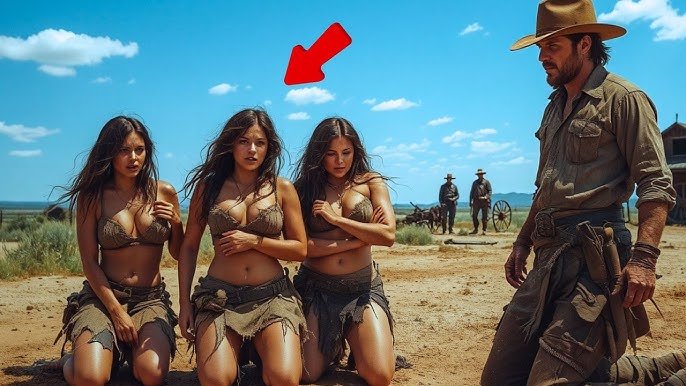
The cowboy’s first thought was trap—outlaws used kids as bait, and a soft heart could get a man buried. But the boy’s voice cracked like dry wood, and something inside the rider that had been sleeping for years stirred and growled. He swung down, boots hitting hard ground, and told the child to show him the way. They climbed a short rise, the kid stumbling, the man scanning every ripple of heat for rifles that might be waiting. What they found was not an ambush but a woman tied to the stone, hair plastered to her face, skin burned by hours of sun, rope biting deep into wrists that had fought and lost.

He cut her loose before the sun could finish the job, catching her as she folded toward the dirt. Her weight felt light, as if the desert had already begun to carry her off. He carried her to the thin shade of a mesquite, poured water over cracked lips, and watched her eyes open slowly—dark eyes that carried more stubbornness than fear. The boy pressed against her side, whispering in Apache, words too quick and soft for the man to catch, but the tone was clear: Mama, come back, we are not alone anymore.
Feeding them from his own scant supply, he gave the best pieces to the boy and the woman before he took any for himself, the way his mother had once taught him when company showed up hungry. The woman watched every move, reading him the way a trapped bird studies a cat, but she did not flinch when his hand came close. He cleaned the rope burns with stream water, tore a strip from his shirt to wrap the worst of them, and felt her pulse steady under his fingers. Trouble would follow—trouble always followed kindness in this country—but the decision had already been made when he lifted her off that rock.
They moved at dusk, him walking while the boy and woman rode his horse, hooves soft on the sand. He led them into a canyon where cottonwoods promised water and cover, where firelight would not advertise their place in the dark. Coyotes sang and the stars burned overhead, and for the first time in years he set a watch not only for himself but for two others who now depended on the set of his shoulders. The woman asked him once, in rough English, why he stopped. He thought of all the graves he had ridden past, of men he could not save, of the empty place inside that had grown colder each year. “Because leaving you there would have left me no better than the ones who tied the rope,” he said. The answer hung in the night air like a vow.
Morning found them by a trickle of creek, rabbit roasting on a spit, the boy learning to handle a knife under his guidance, pride flickering across the child’s face like new flame. The woman’s gaze softened when she watched them, and later she took the needle he offered, stitching the tear in his coat while he shaped a crutch from cedar so her ankle could heal. Days rolled into one another, measured by miles of careful travel and nights shared around small fires that never dared grow big enough to signal danger. Tracks of horses appeared once, pressed into dry mud, but the cowboy turned their little party west into high pine where scent vanished and shadows swallowed prints.
When they finally crested a ridge that looked down on a quiet valley green with late summer grass, the woman placed her hand on his sleeve. No words passed, yet he understood: this was the place she would try to build what had been stolen from her. He could ride on, leave them to the new start, but the boy had already claimed his horse’s mane like a younger brother afraid of waking to find the older one gone. The woman’s eyes held the same question, softer but no less urgent. He swung down, boots settling beside theirs, and felt the last iron band around his heart crack and fall away.
Some men become heroes by standing in front of a bullet; others do it by choosing not to ride away. The town that had written the woman off as trash would never know how close they came to keeping their cruelty unchallenged. The cowboy never asked for thanks, never gave his old name, but the boy learned to copy his quiet walk, and the woman learned to smile when dawn lit the peaks. Years later, when travelers spoke of a small spread tucked safe in the pines, they told of a steady man who taught a boy to shoot straight and a woman to trust the world again, and of the day a drifter decided the empty place inside him could hold more than ghosts if he let the right people in.