Barnaby’s ribs showed through his fur like the bars of the cage he cowered in. The veterinary clinic’s fluorescent lights had been dimmed for the night, but his trembling kept the kennel awake. At two in the morning the building was silent except for the beep of monitors and the soft clatter of Barnaby’s teeth. He had been rescued from a backyard where kicks were greetings and food arrived if he was lucky, so the kindness of strangers felt like a trick he was waiting to see reversed.
Jessica, the night-shift vet tech, was on her third coffee of the shift when she passed his run and heard the tiny, broken whine. She had seen plenty of scared dogs—tails tucked, ears flat, eyes darting—but Barnaby’s fear was different; it had weight, like a second dog sitting on his chest. Protocol said she could note the anxiety in the chart, turn out the light, and grab a few hours of sleep before morning rounds. Instead, she pulled a blanket from the supply closet, folded a pillow in half, and stepped inside the kennel.
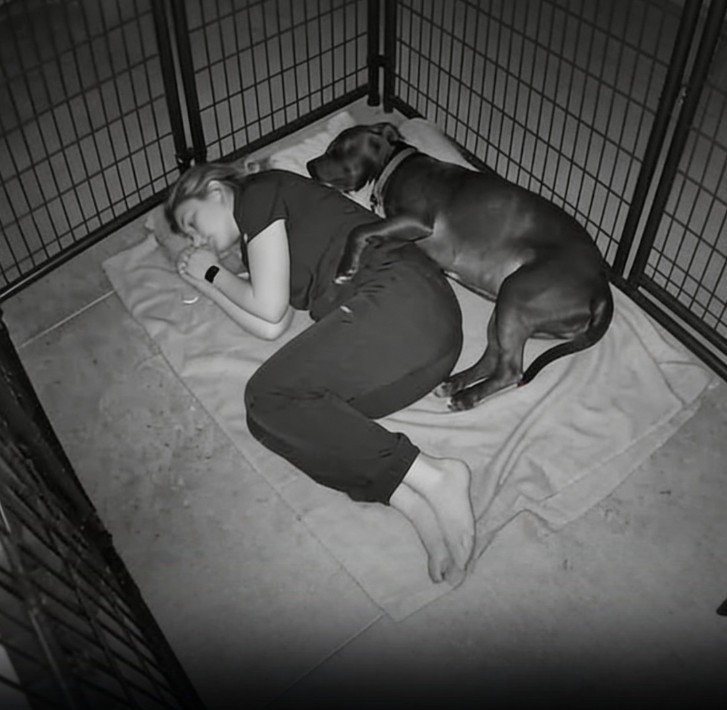
The concrete was cold against her hip as she lay down, leaving a two-foot gap between them. Barnaby froze, nostrils flaring, unsure whether this was the start of a new punishment. Jessica stayed still, eyes half-closed, breathing slow and steady the way she’d learned in yoga classes she never had time for. Minutes crawled by. A clock ticked. Somewhere a radiator clanked. Then, inch by inch, Barnaby scooted forward until his bony shoulder brushed her back. When she didn’t flinch, he exhaled a shuddering sigh and lowered his head against her spine. The trembling stopped. For the first time in his life, warmth was offered without a price.
Security cameras captured the scene: woman and dog sharing a thin blanket, both asleep by 3 a.m. The clip never went viral—no dramatic music, no rescue team bursting through doors—yet the overnight supervisor watched it three times the next morning, eyes wet. Because what happened in that kennel was rarer than a miracle: trust forming in real time, molecule by molecule, breath by shared breath.
When Jessica woke at dawn, Barnaby was still pressed against her, one paw draped over her arm like a child claiming a parent. She stayed long enough for him to stir, then left before he could panic at her absence. Day-shift staff found him standing at the front of the run, tail low but wagging once—twice—when anyone said his name. That small motion was a revolution. The dog who had snapped at every offered hand now leaned into gentle fingers, searching for the comfort he had tasted in the dark.
Recovery did not happen overnight. Barnaby flinched at sudden sounds, cowered when men in work boots walked past, and refused to step onto grass because the open sky felt too large. But each evening Jessica repeated her quiet ritual: blanket, pillow, thirty minutes of simply being. Other techs began to copy her. Volunteers sat beside different kennels reading paperback novels, their voices soft background music. A teenage volunteer brought a ukulele and strummed it outside the runs. The clinic started calling it “Blanket Time,” and shift schedules were rewritten so every dog got at least twenty minutes of human presence without needles, clippers, or restraint.
Barnaby’s body healed faster than his spirit. Gains showed first in his eyes—brown pools that began to hold light instead of shadow. One afternoon he tentatively licked the chin of a tech who had been crying over a breakup. Another day he accepted a treat from a small girl wearing a superhero cape during an adoption event. Each breakthrough was tiny, but to the staff they felt like constellations forming: separate dots connecting into something bigger than themselves.
Weeks later a quiet couple arrived looking for a dog “who needs extra patience.” They sat on a bench while Barnaby was brought out on a loose leash. He hesitated, scanned the parking lot for danger, then walked over and rested his head on the woman’s knee. She stroked his ears and whispered, “We’ve got all the time in the world, buddy.” Adoption papers were signed with a pen that had once written his intake date—the day he was labeled “unadoptable, severe fear aggression.”
When Barnaby left, Jessica helped load his new bed into the back of a Subaru. He glanced back once, tail wagging in a slow, uncertain arc, then jumped inside. No heroic music played, no cameras filmed the goodbye. Just the soft sound of a closing door and tires crunching gravel. Inside the clinic, staff went back to treatments and phone calls, but the blanket stayed folded on a shelf, ready for the next trembling creature who needed proof that the world could be gentle.
Months afterward, the couple sent a photo: Barnaby stretched across a sunlit couch, belly up, eyes closed in pure bliss. Beneath the image they wrote, “He snores louder than my husband.” Jessica smiled, saved the picture, and remembered the night she lay on cold concrete so a broken dog could learn that safety has a heartbeat. She has never slept on a kennel floor since, yet a piece of her warmth still travels with every dog who finds the courage to step out of the corner and toward a hand that waits without demand.