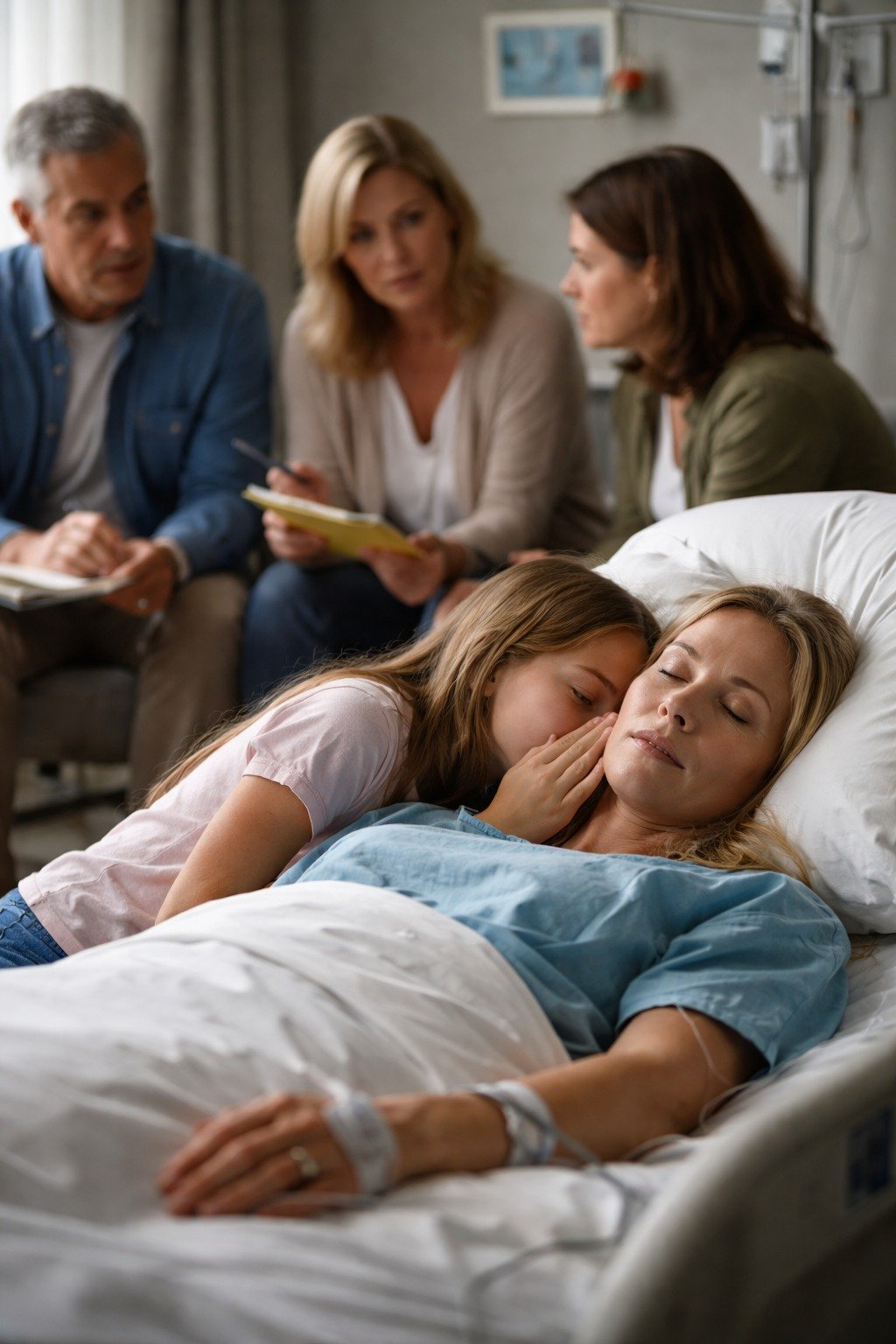
PART 1: THE SILENCE THEY THOUGHT WAS DEATH
Lying in a hospital bed, I learned something no doctor could diagnose and no machine could detect: how quickly love turns into calculation when people believe you can no longer hear them.
The room smelled like antiseptic and stale coffee. Machines hummed softly beside me, steady and patient, as if they were the only ones still hoping I’d stay. My eyelids were heavy, my body weak, but my mind was painfully clear. I wasn’t asleep. I wasn’t unconscious. I was trapped inside my own body, listening.
Footsteps approached. Familiar ones.
I recognized my daughter’s perfume before I heard her voice. Lavender. The same scent she wore to my birthday dinner last year, when she laughed too loudly and hugged me too tightly, as if already practicing goodbye.
She leaned close to my ear and whispered,
“Mom… don’t open your eyes yet.”
Her voice trembled, but not with fear. With urgency.
I wanted to scream. I wanted to move my fingers, to let her know I was awake. But my body betrayed me. I lay still, breathing shallowly, the perfect picture of a woman slipping away.
Another voice joined hers. My son-in-law, Daniel.
“She can hear, right?” he asked quietly.
“No,” my daughter replied too quickly. “The doctor said she’s not responsive. It could be hours. Or days.”
Or never, she didn’t say.
A chair scraped against the floor. Someone sat down, too comfortably for a hospital room. Papers rustled.
“So,” Daniel said, lowering his voice, “about the house.”
My heart slammed against my ribs.
The house.
The one I bought after my husband died. The one I paid off with thirty years of teaching, night classes, and summer jobs. The one with the oak tree out front and the blue door I painted myself.
My daughter sighed.
“If Mom doesn’t wake up… it’s going to probate unless we act fast.”
There it was.
Not grief. Not hope. Strategy.
“She always said the house would be mine,” my daughter continued. “I just didn’t think it would happen like this.”
Daniel chuckled softly.
“Well, timing is timing. We should talk to a lawyer. Maybe sell it. Split the money.”
Split.
As if I were already gone.
As if lying in a hospital bed erased decades of motherhood, sacrifice, and love.
I felt a tear slide down my temple, unnoticed.
Then my daughter said something that froze my blood.
“We just need to make sure she doesn’t wake up before we sort things out.”
PART 2: WHEN A MOTHER HEARS HER OWN EULOGY
Lying in a hospital bed, I listened to my life being summarized into square footage and market value.
They talked for a long time. Long enough to forget I was a person. Long enough to forget I was a mother.
Daniel spoke first.
“If we sell within three months, we can avoid heavy taxes.”
My daughter nodded. I could hear it in the movement of air.
“The house is worth at least six hundred thousand now. More if we renovate.”
Renovate.
They were already imagining walls torn down, my furniture gone, my memories boxed up and discarded.
“What about your brother?” Daniel asked.
My daughter scoffed.
“He moved to Oregon years ago. He won’t fight it. Besides, Mom always said I was the responsible one.”
Responsible.
I remembered the nights I stayed up sewing her prom dress because we couldn’t afford one. The mornings I skipped meals so she could have lunch money. The years I delayed my own happiness so hers could arrive sooner.
My chest tightened.
At some point, a nurse came in. The room fell silent instantly.
“She’s stable,” the nurse said, checking my vitals. “No change.”
No change.
That was their cue to continue.
When the nurse left, my daughter leaned close again.
“I hate this,” she murmured, pressing her hand to my arm. “I wish she’d just… you know.”
Finish it.
I wanted to open my eyes then. I wanted to look straight at her and ask where I went wrong.
But something stopped me.
Anger.
A cold, clarifying anger that cut through the fog in my head.
If lying in a hospital bed had taught me one thing, it was this: people reveal their true selves when they think you can no longer hold them accountable.
They left shortly after, talking about realtors and paperwork. The door clicked shut. The room returned to its mechanical hum.
That night, I made a decision.
If they thought I was already gone, I would let them believe it a little longer.
PART 3: THE DAY I OPENED MY EYES
Lying in a hospital bed for three more days, I listened to everything.
Phone calls. Lawyer appointments. Arguments about furniture. Plans about “when it’s over.”
On the fourth day, my son arrived.
Ethan.
The one they hadn’t mentioned.
He stood quietly at the foot of my bed, saying nothing for a long time. Then he whispered,
“Mom… I know you’re still here.”
My finger twitched.
Just barely.
He inhaled sharply.
“I heard what they’re doing,” he said softly. “And I’m so sorry.”
That was when I opened my eyes.
My daughter screamed when she saw me awake. Daniel dropped his phone. Nurses rushed in. Chaos filled the room.
But I was calm.
Very calm.
Later that day, when the room was empty again, I asked for a lawyer. A different one. My own.
Two weeks later, I was discharged.
And three weeks after that, I invited my daughter and Daniel to my house.
My house.
They sat at the dining table, smiling nervously, waiting for forgiveness.
Instead, I handed them documents.
A trust.
The house was no longer part of my personal estate.
It belonged to a foundation.
In my husband’s name.
A foundation that funded scholarships for children of single mothers.
My daughter’s face drained of color.
“You… you can’t do that,” she whispered.
I smiled.
“I already did. While lying in a hospital bed, listening to you decide my life was over.”
Silence.
“I’m not cutting you out because I’m angry,” I continued. “I’m doing it because I finally see clearly.”
They left shortly after.
I kept the house.
I kept my dignity.
And I learned that sometimes, the greatest awakening doesn’t happen when you open your eyes—
But when you hear the truth whispered beside what they believe is your deathbed.