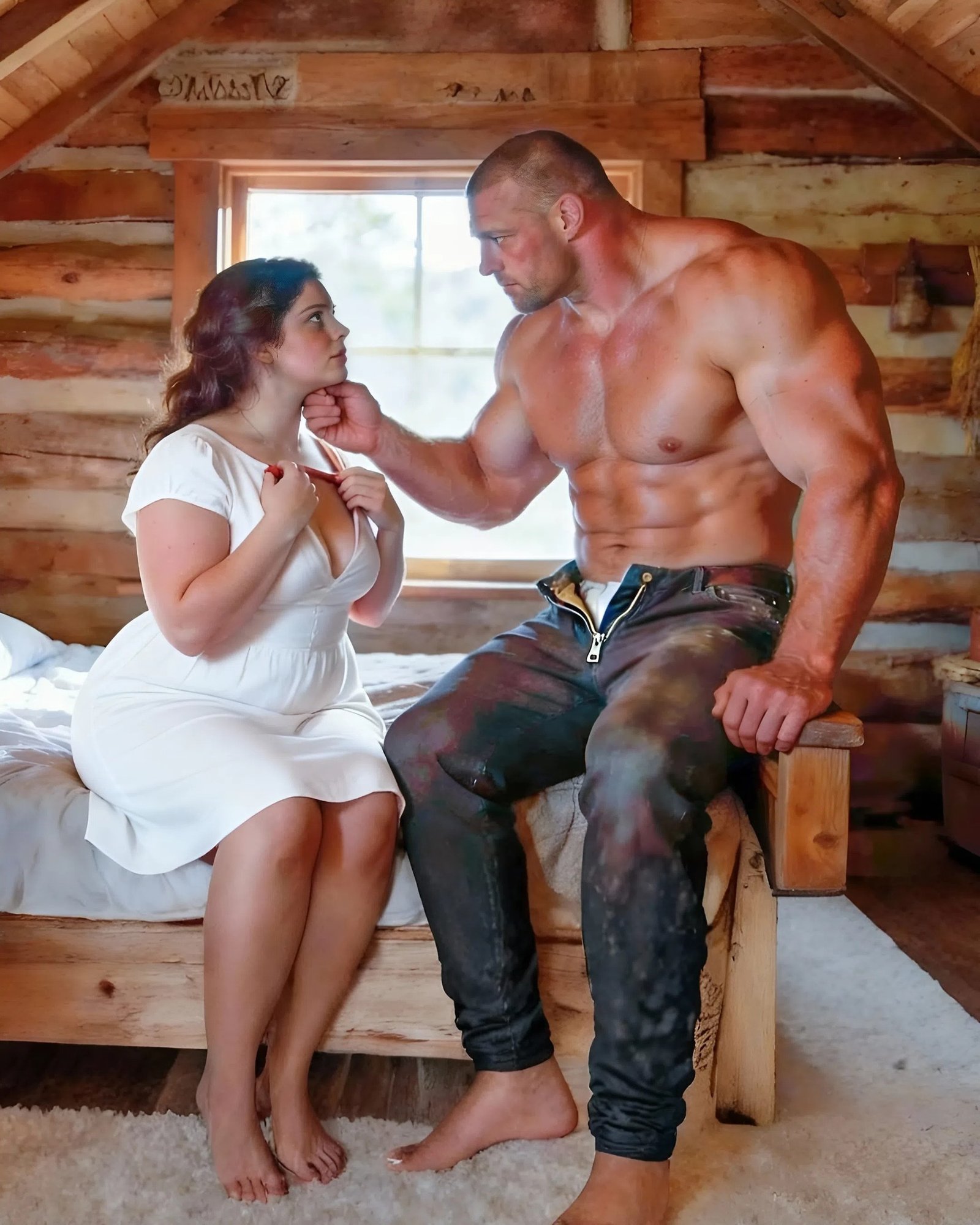
“Take everything off,” he said, and his voice cut through the silence of the cabin like an inescapable command, freezing Ileana in place, her fingers trembling over the first button.
In her mind, it could only mean the beginning of a disaster, because that enormous man, marked by a brutal scar, had just paid for her as if she were merchandise.
In the unforgiving vastness of the Carpathian Mountains, a pact born of desperation was about to rewrite the fate of two souls crushed by others.
He was the man of the mountains, famous for a reputation of hardness that traveled through the valleys, and she was the woman people pointed at with cruelty, reducing her to a mockery.
The Bear Inn smelled of sour brandy, old sweat, and fear, as if the walls themselves had learned to breathe the anguish of those with no way out.
Ileana felt that smell stuck to her wrinkled dress, a second skin that reminded her of her place in the world with every glance and every whisper.
There stood her father Ion, gripping her arm with a force that was not protection but ownership, as if his hand declared that she belonged to the debt.
The men looked at her with a mix of mockery and curiosity, not as a woman, but as an object they could talk about without shame.
Ion, consumed by misery and gambling, saw his daughter as the last lifeline, and he did not care that this lifeline had a heart.
He owed money to Vlad Corvin, the dark master of the area, a man with a slippery smile and cold eyes, who collected with humiliation before gold.
Ion raised his voice and offered Ileana as if he were offering a strong horse for the plow, swearing she could cook, sew, and work, as if love could be bought from a catalog.
Ileana felt shame burn, but her face remained still, because she had learned to build a wall of silence to survive everyday cruelty.
No one moved, and the room filled with a restrained laughter that sounded like a blade, a confirmation that to them she was only a joke.
Ileana wished to disappear beneath the filthy wooden floor, and in that instant the door creaked, announcing a presence that changed the air.
The man entered like a storm, tall as an ancient oak, with broad shoulders that seemed carved from stone, and a calm more frightening than shouting.
He had a dark beard, long hair, and a deep scar crossing his eyebrow and running down his cheek, like a map of violence etched into his skin.
His glacial blue eyes swept the inn without hurry, and people lowered their gaze as if that blue could cut shame from the air.
He spoke to no one until he stopped before Ileana, and his look carried not contempt but a strange attention, almost analytical, as if searching for truth.
The man stepped forward and planted himself before Ion, making him seem small, and spoke in a deep voice that sounded like rock rolling down a slope.
“How much,” he said, and it was not a question but a demand, as if the price were no longer negotiable.
Ion stammered, mentioned the debt to Vlad Corvin, and the man did not hesitate for a second, reaching into a leather pouch.
Α heavy sack of coins struck the counter with a dull sound, and the entire place went still, as if even the smoke were afraid to move.
There was far more than Ion had named, a small fortune, and from a table Vlad Corvin narrowed his eyes, with cold rage and poisonous ambition.
Vlad did not want her as a wife, but as a collection, as power, as a piece that humiliates, and the idea of losing her to that giant burned him inside.
“The deal is done,” said the mountain man, his tone allowing no argument, as if the world itself had to obey him for a moment.
Then he turned to Ileana and extended a huge hand, not as a threat, but as a silent invitation to a future she could not imagine.
Ileana searched for her father with her eyes and found him counting coins with feverish shine, without farewell, without guilt, without a single word to defend her.
She placed her trembling hand in the man’s and felt rough, strong skin, but a surprisingly steady pressure, almost careful, like an anchor.
He did not drag her, did not display her, he simply led her out, away from the stares, as if the air of the inn were a prison he had just broken.
Outside waited two horses, one black and imposing for him, and a gentler mare for her, as if he had considered her fear before mounting.
He helped her up easily, lifting her as if weight did not exist, and that gesture contradicted everything Ileana expected from a man who had paid coins.
The road into the mountains was long and silent, and the silence frightened her more than insults, because it held every imagined threat.
Αs they climbed, the air grew cold and pure, and the smell of pine and wet earth replaced the stench of the inn, as if the world had changed languages.
The peaks clawed at the sky, the forests swallowed the light, and Ileana felt her old life remain below, though she did not know whether that was freedom or loss.
Night fell as they reached a solid log cabin in a clearing, with a breathtaking valley and smoke rising from a stone chimney.
The house was well kept, which contradicted the idea of a soulless savage, and that detail mixed Ileana’s fear with confusion.
He closed the door and the bolt sounded like a final blow, and Ileana felt her fate trapped beneath that roof, without witnesses, without rescue.
The fire in the great hearth lit a sturdy table, benches, simple utensils, and clean order, but order did not ease the tightness in her chest.
He looked at her for a long time, then spoke again in that same deep voice, saying the words she believed would destroy her, because they came from a man who had “bought” her.
“Take everything off,” he repeated, and the phrase fell like a stone in water, making Ileana feel her blood freeze and tears rise unbidden.
She brought her fingers to the first button, more from panic than obedience, convinced the world taught men like him only one kind of power.
Then he took two steps forward and covered her hands with his own, stopping her firmly but without violence, as if breaking a mistake before it grew.
“Not like that,” he said, and for the first time his tone softened, pointing to the dress, the petticoats, the fine shoes, everything the city demanded of her.
“That city clothing is a prison,” he added. “It does not work here,” and the word prison sounded like a judgment against the world, not against her.
He went to a wooden chest and took out sturdy trousers, a thick wool tunic, and soft lined boots, practical, warm, dignified clothing.
He laid them on the bed and looked at her again, as if offering an exit no one had ever offered her, a new way to breathe without hiding.
“Here, a person’s worth is not in fitting into a dress,” he said. “It is in what they can do, in the strength to survive the mountain.”
“I watched you for months,” he confessed. “They saw weakness. I saw strength,” and those words struck Ileana harder than any mockery at the inn.
He spoke of her broad shoulders as an advantage, her endurance as a treasure, her body as a tool for life and not a cause for shame.
Ileana was left breathless, because everything that had been humiliation, he named as capability, as future, as something that could hold her up.
“I did not bring you here to humiliate you,” he said, and an old bitterness entered his voice. “Civilization took everything I loved, and solitude weighs heavy.”
“I need a companion on this path,” he added, “someone strong to share this life,” and the word companion sounded different from ownership, dangerously good.
He repeated the order again, but now with new meaning, asking her to remove what suffocated her and throw the city’s past into the fire.
Ileana understood he did not want to expose her, but to free her movement, and with steady hands she began to remove the outer layers carefully and deliberately.
There were no humiliating details, no devouring stare, because he respected her space, and she let the dress and worn fabrics fall like an old burden.
The garments went into the fire, and watching them burn, Ileana felt something loosen in her chest, as if the mountain accepted her name for the first time.
She dressed in the trousers and tunic, and the change was immediate: she could breathe, she could move, she could exist without the cage of appearance.
The man observed her, approving with a minimal gesture, and served two bowls of steaming stew, saying work would begin the next day.
The following days immersed her in a hard but honest life, without theater, without poisonous laughter, only survival, learning, and the simple truth of the mountain.
He, whose name was Codrin, spoke little but taught patiently, showing her trails, traps, plants, fire, water, and the silent language of the forest.
Ileana discovered her strength was a gift. She cut wood, carried buckets, lifted logs for fences, and the respect she saw in Codrin was not charity.
One afternoon a storm soaked them and she laughed with unexpected joy, and Codrin answered with an almost-smile, asking what was funny.
In the city, Ileana said, getting wet was shame, stained clothes, ruined shoes, but here it was just water, life, and for the first time not punishment.
Codrin replied that even destruction has purpose, and those words touched something deep, until Ileana looked at his scar and dared to ask.
Codrin’s expression hardened. He said some storms leave only desert, and the past was better left where it had burned.
That night the air grew tense and sleep did not come, until Ileana heard Codrin groan, as if the darkness were biting him.
He murmured a name, Liana, struggling in a dream of fire, and Ileana crossed the cold floor and touched his shoulder to wake him.
Codrin opened his eyes in panic and shame, shouted for her to leave, that he needed no help, and the rejection hurt her, but did not make her retreat.
Ileana, already changed by the mountain, asked firmly who Liana was, and Codrin broke enough to answer with contained pain.
“She was my wife,” he said, “and they killed her along with our unborn child,” and the confession filled the cabin with a silence sharp enough to cut.
He told how they wanted his land, how he refused to sell, and one night they attacked, burned his house, left him scarred, and forced him to live with that image.
Then he spoke the name of the man who orchestrated it: Vlad Corvin, and Ileana’s stomach froze as she understood the connection to her father’s debt.
Vlad was the same man who looked at her at the inn with serpent eyes, the same who wanted to buy her, the same who believed every body was a trophy.
Codrin confessed that was why he acted quickly, because he would not allow Vlad to touch another life, and his “purchase” was also a rescue and a challenge to the monster.
Ileana took Codrin’s hand and this time he did not pull away, and the gesture was small but final, like a bridge built over an ancient abyss.
Outside, the storm faded, but both knew the real tempest was not rain, but Vlad Corvin, patient, vengeful, ready to reclaim.
When morning came, light entered softly through the cracks, and Ileana understood she was no longer the girl sold for another’s debt.
She was an ally, a living shield, and Codrin, the scarred man, was not her jailer, but a wounded guardian who had brought her to save her.
Codrin told her she did not have to carry the weight of Liana, but Ileana answered that if they were to share a life, she had to know his story and his war.
Codrin admitted Vlad would come, because he hated being defied, and that they must prepare to survive, together, without ever handing their fate to anyone again.