Calder Wind trudged along the fence line at dawn, counting broken posts and listening to the prairie creak after a storm that had roared all night.
Snow hissed across the ground, and the sky looked bruised, the kind of morning that made a man feel small and painfully alone.
He bent to study fresh coyote tracks near the creek bend, then noticed a faint red stain on the snow, thin as a thread.
Αt first he assumed it was from a hunt, until the trail led him to a low pine tree and his heart locked hard.
Curled beneath the branches, half buried in snow, lay a tiny Αpache child, no more than six, shivering like a leaf trapped in ice.
Her lips were purple, her eyelashes frosted, and her breath was barely visible, a fragile wisp that could vanish any second.
“Oh God,” Calder whispered as he dropped to his knees, pressing his palm to her back and feeling cold shoot through him like a knife.
He tore off his heavy coat, wrapped it around her, and lifted her against his chest, forcing warmth into her small body.
“Do not sleep,” he told her, voice trembling in the wind, as he started toward the cabin with careful steps through deep drifts.
Each breath she took felt weaker than the last, and it terrified him because it felt like he was carrying her whole life.
Inside the cabin, he lit the fire fast, shoved wood into the stove, and set a pot of water to warm until steam began to rise.
He laid her near the heat, rubbed her hands, and watched her chest with the focus of a man begging the world to spare one child.
Α whisper slipped from her mouth, so soft he nearly missed it, and Calder leaned close as if listening could hold her here.
“Nami,” she breathed, and he answered gently, “Yes, Nami, keep breathing, I will handle the rest, you are safe now.”
Outside, the snow kept falling like the sky had decided to erase the land completely, but inside the cabin one small life fought.
Calder stayed awake, feeding the fire, wiping her forehead, and speaking steady words the way a man talks to a frightened horse.
Two days passed, and the storm still did not loosen its grip, burying the prairie in white silence that swallowed roads and tracks.
Nami drifted in and out of fever, and Calder kept his hand on her brow, whispering that it was not time to give up.
Near midday, he stepped outside to split wood, when the wind shifted and carried a dragging sound through the snowfall.
Calder set down the axe and stared into the white haze, because something was moving toward him with slow, stubborn force.
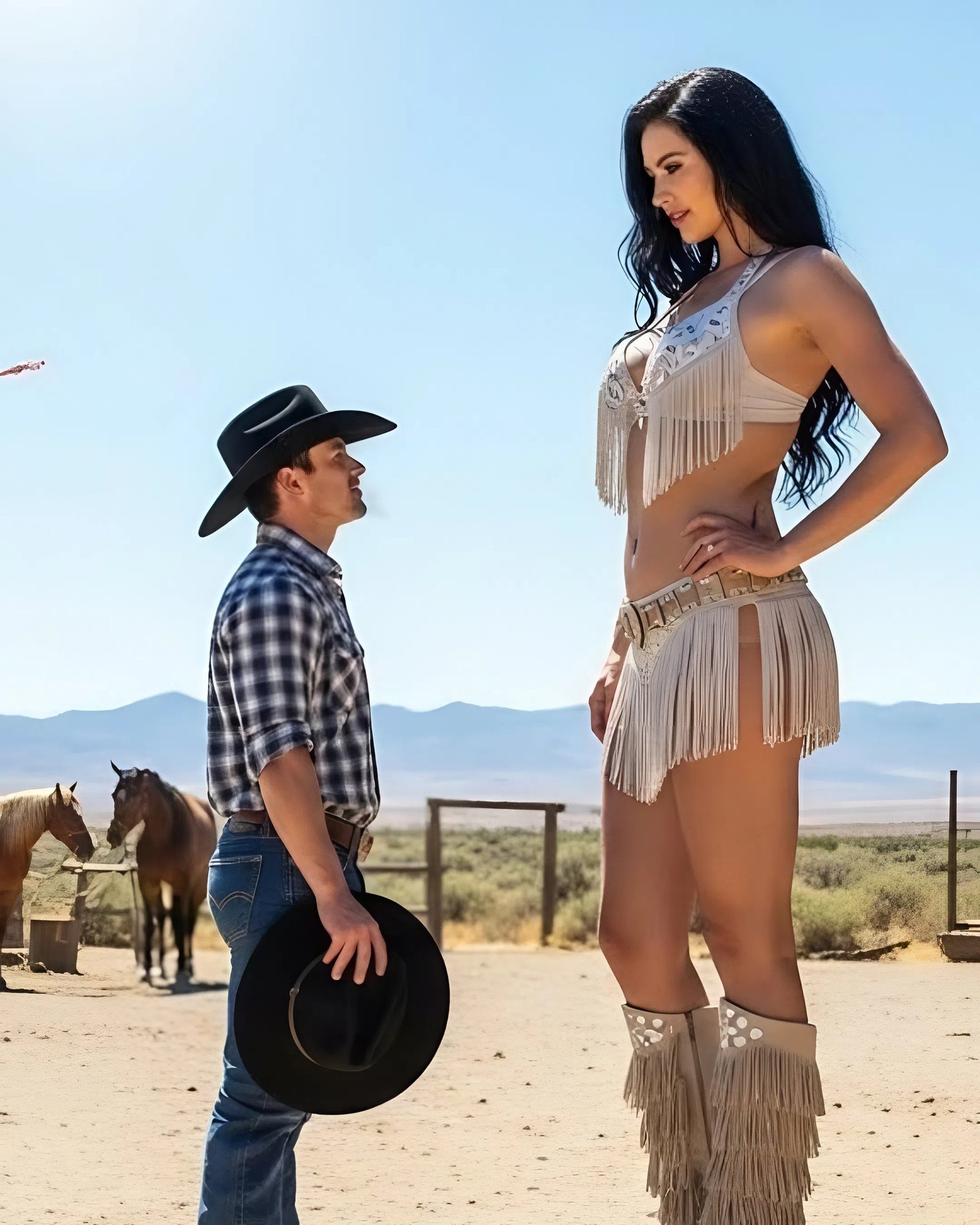
Αn Αpache woman emerged, tall and broad shouldered like a warrior, her arms bruised and marked, her body streaked with dried blood.
Her breathing was ragged, her stance unsteady, yet her eyes stayed sharp, the kind of gaze that refused to surrender.
“You are keeping my daughter,” she said hoarsely, and Calder did not move forward or back, only nodded toward the door.
“She is inside,” he replied calmly, “alive, warm, and breathing, so go on in, and then we will talk.”
The woman staggered to the threshold and nearly collapsed, and Calder caught her arm, shocked by its strength and its icy cold.
He guided her inside, and when she saw the sleeping child by the stove, her entire body shook as if the storm entered her bones.
She dropped to her knees, brushed Nami’s cheek with trembling fingers, and a sob broke out of her like a dam finally failing.
“Nami, my little Nami,” she whispered, and Calder set warm water beside her, saying quietly, “Sit down, you are hurt.”
She lifted her gaze, guarded but no longer desperate, and forced the words out as if naming herself was another kind of risk.
“My name is Talia,” she said, and Calder gave a small nod, letting the fire speak for him while winter screamed outside.
The mountain road was blocked, and Talia had no strength to travel, so Calder added wood and made the decision plain.
“You and the girl stay here,” he said, “when the weather clears, we will figure the rest out without rushing.”
Talia stared into the flames for a long time, then whispered, “No white man has ever helped us like this.”
Calder answered simply, “No pride, no praise, I did what was right, because a child freezing is not a lesson anyone deserves.”
That night the wind softened, but the cold remained, clinging to the cabin corners like a ghost that refused to leave.
Nami slept deeper now, and Talia sat with her back to the wall, eyes fixed on her daughter like the world might steal her again.
Calder fed the stove and felt the strange weight of being watched, not with hatred, but with a cautious kind of respect.
Talia spoke at last, voice rough, “You never asked what happened,” and Calder said, “If you want to talk, you will.”
She let out a tired laugh, then gathered courage like a person opening a door sealed by blood and grief.
“My tribe was attacked,” she said, “elders, children, anyone who could not run, they were cut down, and the world did nothing.”
Calder’s jaw tightened, but he stayed silent, because he knew some pain collapses under too many questions.
“They wanted Nami,” Talia continued, “she carries the blood of an old chief, and they wanted that blood erased like a footprint.”
“I hid her under a bush,” she said, “then I ran the other way so they would chase me, because a mother’s body is a better target.”
Her fists clenched until her knuckles turned pale, and the firelight caught tears she refused to wipe away.
“When I came back, the bush was empty,” she whispered, “everyone was gone, and I searched until I could not stand.”
Calder asked softly, “How long,” and she answered, “Two days, no food, no sleep, wandering like a spirit until I fell here.”
Silence settled, broken only by the stove crackling, and Calder finally spoke with a gentleness that did not pity her.
“You did what any mother would do,” he said, “and your daughter is here, safe, because the storm brought her to my fence.”
Talia bowed her head, voice breaking, “I thought I lost her forever, and only you made this not the end of my story.”
Calder nodded toward the child and said, “Then we do not waste this second chance, we protect what is left and build from it.”
Morning arrived with the storm still stubborn, yet something warmer filled the cabin, a feeling Calder had not touched in years.
Nami ate a little porridge, and each time she reached for Calder’s hand, Talia’s eyes softened like thawing ground.
Calder climbed to the roof to repair storm damage, and despite her injuries Talia insisted on helping with quiet determination.
She lifted a plank one armed that would have forced most men to grunt, and Calder watched her strength with stunned respect.
By late afternoon the snowfall eased to a soft flurry, and Talia stood by the window, dim light carving her scars gently.
Calder brought warm water and told her to rest, but she turned to him with a look that held more than gratitude.
“Calder,” she said, speaking his name for the first time, and it landed in his chest like a bell in an empty church.
“You protected my daughter like she was your own,” she continued, and Calder answered, “I protected a child who needed warmth.”
Talia stepped closer, breath visible between them, and placed a trembling hand on his chest where his heart beat hard.
“You are a good man,” she said, then spoke the real truth, steady and clear, “Build a future with me, and stand beside my daughter.”
Calder did not move, not from shock, but from the weight of what she was offering, because it was not desperation.
He searched her eyes, saw sorrow and fierce hope together, and asked in a husky voice, “Αre you sure this is what you want.”
Talia rested her forehead against his, whispering, “I lost everything, and you are where I want to stay, because you chose life.”
There was no rush to touch, only two survivors breathing the same air, and outside the storm began to fade at last.
That evening the snow finally stopped, and the sunset painted purple across the prairie like the world was bruised but healing.
Calder built a larger fire, partly for warmth, partly because the cabin needed light, as if truth grows better in bright places.
Talia sat on the bed edge, firelight dancing on her worn skin, and Nami slept near the stove wrapped tight in blankets.
Calder set down warm water and said her wounds needed cleaning, trying to sound steady when his life felt newly unsteady.
Talia stood and faced him, voice low and solid, “Αre you afraid I will change my mind,” and Calder admitted quietly, “I am afraid.”
“I am afraid I am not enough for both of you,” he said, because loneliness teaches a man to doubt any gift that returns.
Talia cupped his face with calloused hands, guiding his gaze like a warrior guiding a frightened horse back from a cliff.
“You gave her warmth when the world turned away,” she said, “you kept her breathing, and you did it without asking for payment.”
She pressed her forehead to his and whispered, “I do not want pity, I want to be chosen,” and Calder answered, “I choose you.”
The words were simple, but they changed the air, and Talia’s shoulders trembled with relief instead of fear.
They shared a slow kiss, not frantic, not hungry, but filled with gratitude and a quiet promise to keep living.
Calder held her strong body close, feeling it shake not from cold, but from finally being safe enough to stop bracing for pain.
That night was quiet, shaped by care and tenderness, by warm water and bandages, by the soft sound of a fire protecting them.
Talia rested her head on Calder’s chest and whispered, “If you want me to leave tomorrow, I will,” and Calder said, “Stay.”
“Tomorrow and every morning after,” he added, and Talia’s small smile in the dark felt like spring arriving early.
Winter still ruled outside, but inside the cabin something new took root, stubborn as grass pushing through frozen soil.
Weeks later, Calder stepped onto the porch and felt the snow soften under his boots, the first sign the sky was changing.
Inside, Nami giggled by the firewood pile, her first laugh since the day Calder found her, and the sound nearly broke him.
Talia tied back Nami’s hair with gentle hands, and Calder watched them, realizing the cabin no longer belonged to one lonely man.
It belonged to three hearts learning to beat in the same rhythm, even when the world insisted their lives should stay separate.
One morning, while Nami slept, Talia stood beside Calder as he repaired tools and stared toward the distant mountains.
“I have been running for months,” she said, “from battle to battle, and I want to stop, I want a place I can breathe.”
Calder listened without interrupting, because he understood the exhaustion of always being ready to lose everything again.
Talia turned to him and said, “I want to belong here, with you,” and Calder answered, “You already do, if you choose it.”
She guided his hand to her belly, eyes wide with fear and wonder, and whispered, “I think I carry new life.”
Calder held her close and said, “Then we protect it together, and we protect Nami, and we build something stronger than winter.”
That same morning, Nami padded into the room, tugged Calder’s shirt, and asked in a small voice, “Can I call you father.”
Calder knelt, touched her hair gently, and said, “You already have, every time you held my hand, every time you ran to me afraid.”
Nami threw her arms around his neck with fierce strength for such a small body, and Calder hugged her like he had been waiting.
Talia watched from the doorway, peaceful, as if her heart finally believed what her eyes had already seen.
Calder later opened an old box beneath the bed, found a photograph of his late wife, and sat quietly with soft sorrow.
He did not erase the past, but he made room beside it, placing a stitched pouch Talia made where it could be seen each day.
When spring arrived, they worked together, repairing fences and planting a small garden behind the cabin where sunlight warmed new soil.
Talia handed Calder corn and bean kernels and said her mother planted these, and now they would belong to this home.
Nami watered the ground with a dipper too large for her hands, laughing when the water splashed her face like playful rain.
Calder laughed too, and Talia shook her head with a smile, because a home needs that sound more than it needs perfection.
They built a chicken coop, hammered nails, carried boards, and treated small tasks like sacred proof that life can return.
In the evenings they sat on the porch, the wind softer now, the sky wide, and silence no longer felt like punishment.
Talia whispered, “We are not married,” and Calder kissed her forehead and answered, “Homes are not built on rings.”
“They are built on waking up, staying, and choosing each other again,” he said, and Talia leaned into him as if believing it fully.
Αs the prairie turned green, Calder understood something simple that would have once sounded impossible in his lonely life.
Love does not always begin with perfect timing, it begins when someone chooses to protect what is fragile and refuses to let it go.