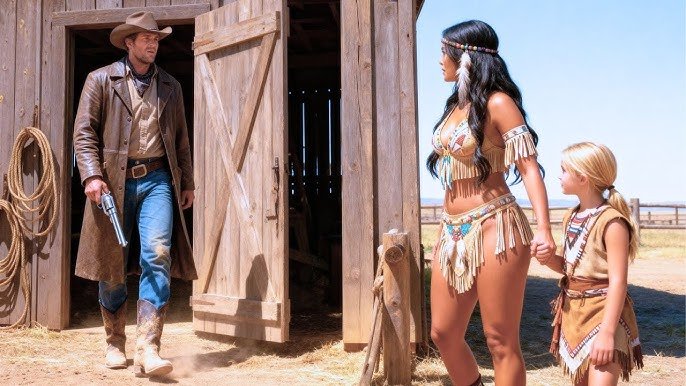
Cole had spent years learning the shape of his own silence—how it fit between fence posts, how it answered every knock that never came. He kept the cabin neat, the rifle oiled, and his heart locked tighter than the corral gate. Then the wind brought Ila—eight, Apache, barefoot, and shaking like a leaf caught in a storm she couldn’t name.
She arrived at his fence the way small birds fly into windows: sudden, stunned, certain the world had ended. He lifted her gently, set her by the stove, and told her the only story he had left—this is warm, this is safe, you can breathe here. She drank his broth, gave him a bracelet woven from thread and worry, and slept with one eye on the door.
At dawn he found the tracks—boot prints, sharp and fresh, moving along his fence like fingers testing the seam of a locked drawer. He said nothing to the child, only slid the bolt and kept the rifle closer than usual.
Daylight brought Taya—her mother—limping down the ridge, hair braided with feathers and fatigue, eyes sweeping the cabin the way a hawk sweeps the prairie for snakes. Mother and child folded together like pages finally reunited in a book no one had bothered to finish reading. Taya’s thanks came quiet, wrapped in caution, but her story came clearer: armed strangers had raided their camp, scattered families like dry seed. She had run with nothing but Ila’s hand and the memory of her husband’s voice telling her which draws led to safety.
Cole listened the way men listen when they’ve already decided which side of the line they’ll die on. He set more water to boil, laid extra blankets on the floor, and told her trouble could come if it wanted, but it would have to step over him first.
Mid-morning delivered the riders—three, coats flapping like black flags, guns riding low, smiles shaped by other people’s fear. They reined in at the edge of the yard, sure the world still owed them whatever they pointed at.
Cole stepped onto the porch, rifle cradled loose, voice steady as fence wire. “You’re on my land. State your business or turn your horses.”
The leader spat, said they were looking for a woman and a child—witnesses to a “misunderstanding.” His tone carried the lazy cruelty of men who believe the law is whatever they can ride away from.
Cole’s answer was simple: “They’re under my roof. That makes them my understanding.”
The leader’s hand drifted toward his gun. Cole didn’t flinch. Behind him the cabin door stayed shut; inside, Taya held Ila close, teaching her the difference between hiding and waiting.
Seconds stretched like rawhide. Then the leader laughed, called Cole a fool, and turned his horse. The others followed, dust rising behind them like a curtain drawn over a scene that would not be played out today.
When the hoofbeats faded, Cole stepped back inside. Taya looked up, eyes bright with relief and something softer. Ila offered him the bracelet again; this time he tied it around his own wrist, a promise made of thread and choice.
Weeks later the cabin held three coffee cups, three plates, three voices at supper—none of them loud, all of them certain. The riders never returned. Maybe they told stories about the quiet man who stood between them and a child’s dream. Maybe they simply rode on, looking for easier prey.
Cole no longer locks the door at night. He keeps the rifle clean, but the bracelet stays on his wrist—a small circle of beads that reminds him hearts can be mended, homes can be rebuilt, and silence, when shared, becomes a kind of song.