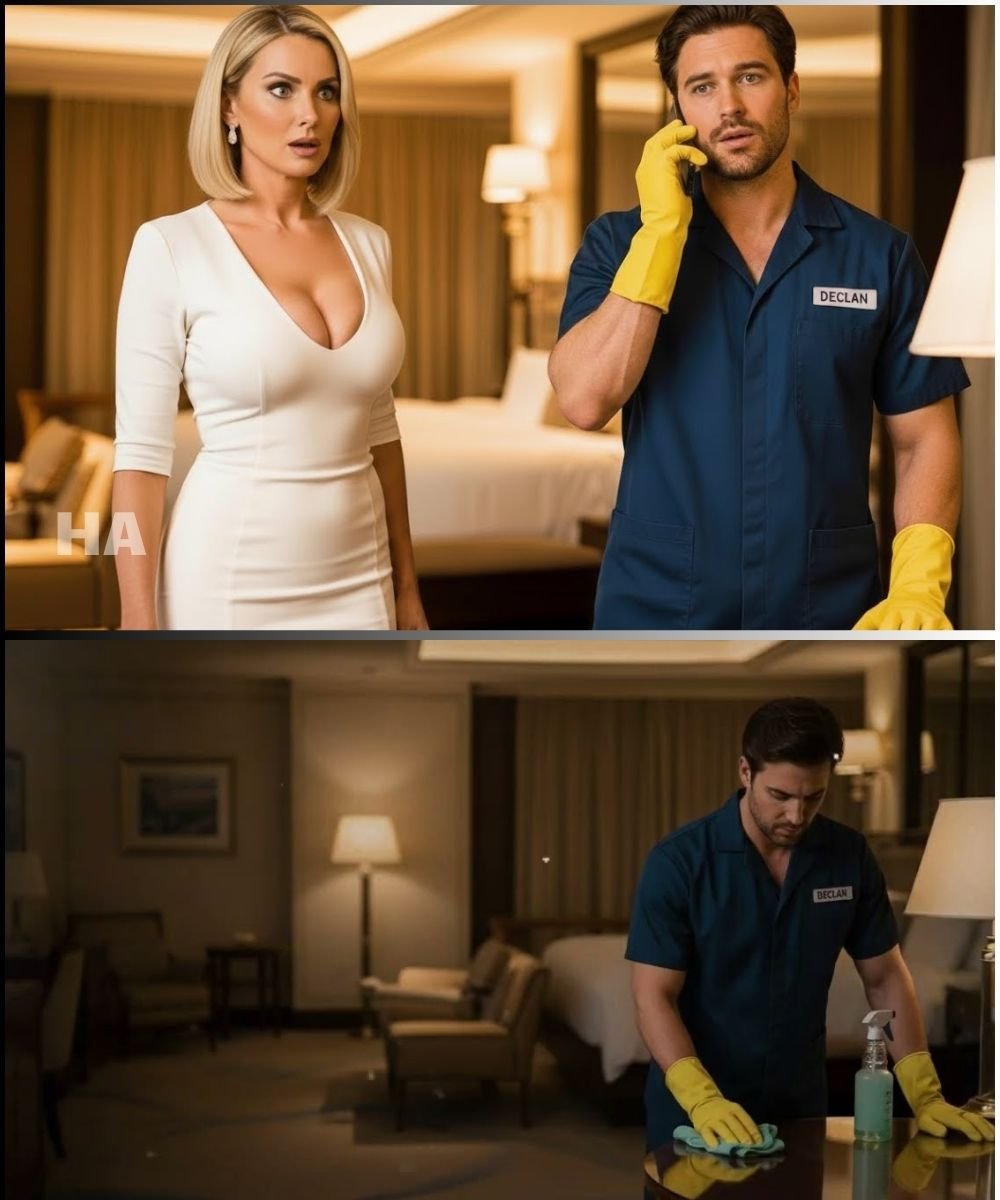
The marble floor of the Grand Meridian Hotel didn’t just shine. It judged.
Under the chandeliers, the lobby looked like a cathedral built for money. Gold-trimmed columns rose like sermons, and the air smelled faintly of citrus polish and expensive perfume that clung to the velvet chairs long after the guests were gone.
Ethan Cole moved through it with a mop the way a man moves through a storm with an umbrella that’s already broken.
Steady strokes. Left to right. Wring. Repeat.
11:47 p.m.
In thirteen minutes, his shift would end. In twenty-five, if the bus behaved, he’d be home. In thirty, he’d be leaning over his daughter’s bed, making sure Maya’s blankets were tucked tight, her stuffed butterfly still in the crook of her arm like a secret she needed to sleep.
Ethan had learned to measure his life in minutes because minutes were the only thing that belonged to him.
His phone buzzed against his thigh.
He froze, mop hovering. Staff rules were clear: no personal calls on the floor, no phones out, no exceptions. Those rules weren’t just policies. They were traps dressed up as professionalism. They existed to keep people like him in their place.
But when he glanced down and saw the number, something in his ribs tightened.
International. The Netherlands.
Amsterdam.
For a second he couldn’t breathe.
The hospital.
His hand moved before his fear could organize itself into good judgment. He angled toward the wall, away from the concierge’s lazy gaze, and slid the phone out like it was contraband.
“Met Ethan Cole,” he whispered.
The voice on the other end came fast, strained, Dutch pouring through the speaker like rain through a cracked window. His uncle had fallen. There were complications. They needed consent for emergency surgery. Family history. Decisions. Now.
Ethan swallowed and answered in perfect Dutch, not the careful textbook stuff tourists used in gift shops, but the native cadence that carried the narrow streets and canal bridges inside it. He asked about allergies, medication reactions, blood pressure, the kind of questions you ask when you’re terrified but refusing to act terrified.
His words came out steady.
His hands did not.
What he didn’t know, what he could not have known, was that fifteen feet behind him, Vivien Hart had stopped walking.
Vivien Hart, billionaire owner of the Hart Meridian Hospitality Group. Seventeen luxury hotels across three continents. A woman who built empires the way other people built excuses.
She’d come downstairs to follow up on a complaint about incomplete cleaning schedules, the kind of small operational rot she hated because it was always a symptom of something bigger.
But now she stood absolutely still, Louis Vuitton heels silent on the marble, staring at the janitor speaking fluent Dutch as if his life depended on it.
Because it did.
Ethan ended the call and exhaled shakily. The doctors would operate. His uncle would likely make it through the night. The relief hit him so hard it left him hollow, like someone had scooped out his insides and replaced them with air.
“Excuse me.”
The voice came from behind him: crisp, controlled, and not at all pleased.
Ethan spun, shoving the phone into his pocket so fast his fingers snagged on the fabric.
The woman in front of him wasn’t just dressed well. She was constructed well. Perfectly tailored black suit, hair pinned with intention, eyes sharp enough to shave with.
Vivien Hart.
Ethan felt his throat tighten. “I’m sorry,” he stammered. “It was an emergency. My uncle…”
“You speak Dutch,” Vivien said.
It wasn’t a question.
Ethan blinked, off-balance. Of all the reprimands he’d expected, this one landed like a stranger’s hand on his shoulder.
“Yes,” he managed. “I do.”
“Where did you learn it?”
He should have lied. He should have kept it simple. He should have been small.
But something about the way she looked at him, like he was a math problem that didn’t add up, made him straighten in his borrowed dignity.
“I lived in Amsterdam for two years during my master’s program,” he said. “Linguistics. University of Amsterdam.”
Vivien’s eyebrow lifted. “Your master’s program.”
The skepticism stung more than it had any right to. Ethan had worn worse judgments like wet clothes for years, but this one came from the top of the building, from the person who signed the memos that decided people’s lives without ever seeing their faces.
“I graduated six years ago,” he added quietly.
For a moment, the lobby went cavernous around them. Elevator hum. Hidden jazz. The distant clink of glass somewhere behind a closed door.
Vivien pulled out her phone. “Full name.”
“Ethan Cole.”
Her thumbs moved with quick certainty. Thirty seconds. A minute.
When she looked up, something had changed in her eyes. Surprise, yes. But also calculation, the kind that was either a rescue rope or a noose.
“You applied for a translator position here three years ago.”
Ethan felt the memory flare like a burn. Twelve applications over eighteen months. Translator. Conference coordination. Guest relations. International partnerships. All rejected. All unanswered except for the automated emails that sounded polite the way locked doors sounded polite.
“Yes,” he said.
“And before that, other roles.” She scrolled, jaw tightening. “Fourteen applications. All rejected at the first screening.”
Ethan’s fingers clenched around the mop handle. “I needed a job,” he said simply. “I have a daughter. Rent doesn’t wait for perfect opportunities.”
As if summoned by the word daughter, a door across the lobby slammed open.
Gerald Moss strode in with the confidence of a man who mistook proximity to power for power itself. Night operations manager. Loud tie. Loud voice.
“Ms. Hart,” Gerald boomed, already smiling in apology. “I’m so sorry for this disturbance. I’ll handle this employee immediately.”
“This employee?” Vivien repeated, her tone turning the air colder.
Gerald faltered mid-stride.
Vivien’s gaze didn’t leave Gerald’s face. “He speaks fluent Dutch. Did you know that?”
“I… what?”
“I’m asking if you were aware that one of your janitors holds a master’s degree in linguistics,” Vivien said, each word placed like a chess piece. “And speaks, Ethan?”
“Six languages,” Ethan said quietly. “Fluently.”
Gerald’s face went through colors like a failing traffic light. “Ms. Hart, I assure you, phone use during—”
“I’m not interested in your phone policy.” Vivien’s voice was ice with a smile painted on it. “I’m interested in why a polyglot with a graduate degree has been cleaning floors for three years while we outsource translation services.”
Ethan watched Gerald’s expression flicker. Confusion. Recognition. Panic, shoved quickly behind professional outrage.
“With all due respect,” Gerald said carefully, “we have hiring protocols. Background checks revealed gaps in Mr. Cole’s employment history. Reliability concerns.”
“Gaps,” Vivien repeated.
“Single parent,” Gerald continued, warming to the story he’d clearly rehearsed in other rooms. “Young child. History of calling out for childcare emergencies. We couldn’t risk placing someone unreliable in a client-facing position.”
The words hung in the air like poison perfume.
Ethan gripped the mop harder, knuckles whitening. He’d heard versions of this speech before, from HR reps who pretended kindness was the same thing as fairness.
“I’ve called out twice in three years,” Ethan said, voice steady on sheer will. “Once when my daughter had pneumonia. Once when my childcare provider quit without notice. I’ve worked every holiday, every weekend, every shift you’ve asked me to cover.”
Gerald’s jaw tightened.
Vivien’s eyes sharpened. “Show me the paperwork. Every application. Every rejection. Every decision point. Tomorrow morning. Eight a.m.”
“Ms. Hart, I really don’t think—”
“That wasn’t a request, Gerald.”
Gerald went pale. He nodded stiffly, then retreated, tossing Ethan one last venomous glance before disappearing through the staff entrance.
Vivien turned back to Ethan. Her expression softened, but only slightly, like a door opening just enough to show you there’s still a chain lock.
“What other languages?” she asked.
“Spanish. French. German. Mandarin. English.” He paused. “Enough Italian and Portuguese to survive business conversations.”
“And you’re cleaning floors,” Vivien said, not an accusation, but it landed heavy anyway.
“I’m feeding my daughter,” Ethan replied. “There’s no shame in honest work.”
Vivien nodded once. “No. There isn’t.” Then: “But there’s plenty of shame in a system that buries talent because it’s inconvenient.”
She slid her phone into her pocket. “Do you have childcare tomorrow afternoon?”
Ethan blinked. “My neighbor watches Maya after school.”
“Good,” Vivien said. “I want you in a meeting tomorrow at two. Fourth floor. Conference room B. Dutch, German, Mandarin speakers. Our translator called in sick.”
Ethan’s pulse hammered. It felt like standing on the edge of a bridge, looking down at water that might be a landing or might be a grave.
“I can be there,” he said.
“Wear what you’d wear to a professional meeting,” Vivien added, then seemed to reconsider when she looked at his uniform. “Do you have…”
“I have a suit,” Ethan said. “From before.”
Before his wife died. Before his life shrank into midnight shifts and grocery math and a child’s small hand on his shoulder asking why he made noises in his sleep.
Vivien nodded. “Then I’ll see you tomorrow at two. Don’t be late.”
She turned to leave, then stopped.
“And Ethan,” she said, almost gently, “your uncle. Is he going to be okay?”
The kindness hit him in a place that hadn’t been touched in years.
“Yes,” he managed. “Thank you.”
Vivien walked away, and Ethan stood alone under the chandeliers, mop still in hand, heart doing strange, hopeful violence against his ribs.
Tomorrow at two p.m., he would enter a room as something other than invisible.
The thought terrified him.
But not as much as staying invisible forever.
The next morning, Ethan woke at five to Maya’s small hand shaking his shoulder.
“Daddy,” she whispered, hair a wild halo, unicorn pajamas wrinkled with sleep. “You were making noises again.”
He sat up, disoriented. The dream was already dissolving, but the feeling lingered: being trapped in a glass box, speaking languages nobody could hear.
“Sorry, sweetheart,” he murmured. “Did I wake you?”
“It’s okay.” She climbed into bed beside him with the practiced ease of a child who had learned to share her father with his worries. “Are you worried?”
Maya had the unsettling gift of seeing him the way adults never did.
“Just thinking about work,” he said.
“The mopping work or the other work?”
Ethan laughed once, soft. “There might be other work today. We’ll see.”
They moved through the morning routine like a choreography built from necessity. Cereal. Toast. Lunchbox. French braid, learned from a YouTube tutorial at two a.m. months ago, hands clumsy at first and now almost sure.
At 7:15 they walked to Monroe Elementary, four blocks of crisp October air. Maya skipped, talking about butterflies migrating thousands of miles.
“How do they know where to go?” she asked.
Ethan looked down at her, small and fierce and trusting. “Maybe they remember,” he said. “Maybe it’s written in them.”
At the school gate, she hugged him tight. “You’re picking me up today, right? Not Mrs. Patterson.”
“I’ll be there,” he promised, and felt the promise tighten around the afternoon meeting like a knot.
After drop-off, he rode the bus back to his tiny apartment and pulled the suit from the back of his closet. Navy. Slightly outdated. Still good fabric, the kind of thing you buy when you believe the world will meet you halfway.
He put it on and stared at himself in the bathroom mirror.
The man looking back didn’t look like furniture.
He looked like someone who could walk into a room and matter.
Ethan arrived at the Grand Meridian at 1:45 p.m., early enough to breathe. The lobby buzzed now with daylight life. Guests checking in. Bellhops wheeling luggage. Executives with phones welded to their hands.
The elevator ride to the fourth floor felt like a confession.
Conference room B had glass walls, the kind that made sure everyone could see who belonged inside. People were already seated: a woman in a gray suit, two men in expensive blazers, and at the head, Vivien Hart.
Ethan checked his watch. 1:58 p.m.
He knocked.
Vivien glanced up, gestured him in. “Right on time.”
“Everyone,” she said, voice clear and effortless, “this is Ethan Cole. He’ll be handling translation for today’s meeting.”
The Dutch woman extended a hand. “Anouk van der Berg. Hoffade Group.”
Ethan shook her hand. “Aangenaam,” he replied, Amsterdam inflection slipping into place like a remembered song.
Her eyebrows rose. “Your accent is excellent.”
“Two years in Amsterdam,” Ethan said.
The German man introduced himself as Klaus Becker. The Chinese executive as Li Wei. The meeting began.
For the first hour, Ethan moved between languages like he’d been holding his breath for three years and finally got oxygen. Dutch concerns about regulations. German manufacturing timelines. Mandarin investment structures. He anticipated needs, smoothed misunderstandings before they could sharpen into offense.
Then Klaus slid a contract addendum across the table.
Dense German legal text.
Ethan’s stomach tightened as he began translating aloud, line by line, keeping pace.
And then he hit a phrase that made the room tilt.
The English version on the document read like a standard liability waiver. But the German, the real German, carved out exceptions that the English didn’t reflect at all.
Natural disasters were covered.
Supply chain disruptions were not.
If Li Wei signed this, his company would take on millions in risk without realizing it.
Ethan cleared his throat. “Excuse me. I need to flag something.”
All eyes turned.
Vivien leaned forward. “Go on.”
“The translation here is incomplete,” Ethan said, steadying his voice like you steady a tray of glasses. “The German text excludes supply chain disruptions from force majeure protections. The English version doesn’t reflect that. Mr. Li, if you sign this as written, your company assumes full liability for supply chain failures, even those beyond your control.”
Silence.
Klaus frowned, pulling the document closer. “That cannot be correct. Our legal team handled—”
“Then your legal team missed a nuance,” Ethan said calmly. “Or someone in the translation chain did. But the discrepancy is there.”
Li Wei’s expression cooled. “You are saying this contract would expose my company to significant unplanned risk.”
“Yes, sir,” Ethan said. “Potentially several million.”
Vivien’s gaze sharpened. “Ethan. You’re certain?”
“Completely.”
For twenty minutes, the meeting dissolved into controlled chaos. Klaus confirmed Ethan’s interpretation. Li Wei’s confidence shifted to skepticism. Anouk suggested postponing.
“No,” Vivien cut in. “We’re not postponing.” She turned to Ethan. “Go through every line. All three languages. Find every discrepancy.”
Ethan blinked. “That could take hours.”
“Then we’ll be here for hours,” Vivien said, as if time was a thing she could purchase in bulk. “This is a fifty-million-dollar partnership. We’re not letting it die because someone got lazy with words.”
So Ethan read.
He found seven discrepancies. Not small ones, but the kind that grew teeth later in courtrooms. Intellectual property clauses misaligned in Mandarin. Liability language softened in English. A timeline that shifted by months depending on which page you believed.
By six p.m., the executives looked shaken.
Vivien looked furious.
“We’ve paid Langbridge Solutions over four hundred thousand dollars in two years,” Vivien said, tapping the marked-up contracts. “And if Ethan hadn’t been here, we would have signed something that could have poisoned this partnership before it began.”
The meeting ended with an agreement to reconvene after corrected documents were prepared. The executives left with new respect for the man they’d assumed was an accessory.
When the door closed, Ethan and Vivien stood alone in the glass-walled room, Chicago’s skyline burning softly beyond the windows.
“You just saved this company from a catastrophic mistake,” Vivien said.
Ethan shrugged, exhausted. “I did what any qualified translator would do.”
Vivien’s eyes narrowed. “No. Any translator might catch two or three errors.” She paused. “You caught all seven. And you spoke up.”
The praise felt unfamiliar, like trying on shoes that fit but still feel strange.
Ethan checked his watch. 6:23 p.m. His stomach dropped. “I need to pick up my daughter,” he said.
“Of course,” Vivien replied, immediate, practical. “But tomorrow, ten a.m. My office.”
His heart jumped. “About…?”
“About why you’ve been invisible,” Vivien said. “And what we’re going to do about it.”
Vivien’s office was all glass and global ambition. Photographs of properties in Paris, Dubai, Tokyo. A desk that looked like it had never known clutter.
Ethan sat across from her, hands clasped, feeling like he’d wandered into a room meant to decide other people’s futures.
Vivien didn’t waste time. “I went through your file. Every application. Every rejection.”
She turned her monitor so he could see.
A list of rejection approvals.
Again and again, the same name.
Gerald Moss.
Ethan frowned. “Gerald doesn’t work in HR.”
“No,” Vivien said. “But he has friends who do. And he’s been very invested in keeping you exactly where you are.”
Vivien’s voice sharpened. “We hired six people for roles you were qualified for. Want to guess what they have in common?”
Ethan shook his head.
“They’re connected to management,” Vivien said. “Nephews. Sons-in-law. Friends. We’ve been running a nepotism ring.”
The room felt too small. Too warm.
Ethan thought of the nights he’d scrubbed floors, telling himself he just had to be patient, to prove himself, to keep submitting applications like prayers.
All along, the system had been rigged.
Vivien leaned forward. “I’m going to fix it. But I need your help.”
She explained the Global Hospitality Summit, two weeks away. Fifteen hundred attendees. Forty countries. The previous coordinator, Gerald’s nephew, had resigned. Conveniently.
“What are you asking me to do?” Ethan asked, already knowing.
“I’m asking you to take over international coordination,” Vivien said. “Translation services. Cultural protocols. Foreign delegations. Everything.” She named a temporary salary that made Ethan’s throat tighten. “Eight to five. Paid childcare for any evening work. You report to me.”
Ethan thought of Maya. School pickup. Bedtime. Promises he’d made with no one else there to make them.
“I can’t work around the clock,” he said carefully.
“You won’t,” Vivien replied. “Not if we want you to succeed.”
Ethan stared at her, trying to understand why this powerful woman cared about a janitor’s life.
Then Vivien said quietly, “Your problem isn’t skill, Ethan. It’s that you’ve been invisible so long you started believing you deserved it.”
The words hit like a door opening to a room he’d forgotten existed.
“When would I start?” he asked.
Vivien’s smile arrived, brief but real. “Right now.”
Within two pages of the previous coordinator’s folder, Ethan’s stomach sank.
It wasn’t mediocre. It was dangerous.
Seating charts that ignored geopolitical tensions. A keynote scheduled through prayer times. Welcome packets only in English. Dietary notes that marked halal as “vegetarian.” A wine tasting scheduled like it was mandatory fun instead of an exclusion trap.
At the first planning meeting, the team stared at Ethan like Vivien had set a stranger at the steering wheel of a car already sliding on ice.
Ethan swallowed the fear and used the only thing stronger: truth.
“Asia isn’t a monolith,” he said, tapping the seating chart. “And if you seat the Japanese delegation beside the Korean delegation without considering active disputes, you’re manufacturing a diplomatic incident for dessert.”
A woman named Susan Mitchell looked like she might faint.
Ethan kept going, calm and relentless, because calm was how you held a knife without cutting yourself. He canceled ice sculptures. Reallocated budget to interpretation equipment. Reopened catering contracts. Built multilingual welcome materials. Added a reflection room. Adjusted sessions for religious observance. Scheduled cultural briefings for staff.
Vivien gave him authority and then backed it with her presence like a shield.
And for a few days, it worked.
Then the sabotage began.
A vendor claimed they never received updated specs, despite Ethan’s timestamped confirmation. Interpretation equipment delivery got mysteriously rescheduled for after the summit started. International attendees received emails “from Ethan” telling them their requests couldn’t be accommodated.
Ethan started triple-checking everything, building a paper trail so thick it felt like armor.
The threats moved from subtle to direct.
An unknown number texted: You should quit while you’re ahead. Some battles aren’t worth fighting.
Ethan deleted it.
Then Susan burst into his office pale. “The German delegation is threatening to cancel.”
Ethan read the email they’d received.
It wasn’t his corrected schedule.
It was the old, disastrous one.
And the email originated from a terminal in the facilities department.
Gerald’s territory.
Ethan called Klaus Becker, switching to German mid-sentence the way some people switched gears.
“This is sabotage,” Ethan said. “And I can prove it.”
He shared headers. Security logs. Evidence.
Klaus studied him for a long moment, then said, “You are either very brave or very foolish.”
Ethan’s throat tightened. “I’m a single father who spent three years mopping floors because men like this decided I wasn’t worth their time. I’m done being quiet.”
Klaus nodded slowly. “We will attend. But I will hold you to your promise.”
After the call, Ethan compiled every act of sabotage, every misdirection, every fingerprint of Gerald’s little kingdom, and sent it to Vivien with a subject line that didn’t bother with politeness:
WE NEED TO TALK ABOUT GERALD NOW.
Vivien called thirty seconds later. “My office. Bring everything.”
The emergency meeting felt like a tribunal.
HR. Legal. Operations. Vivien at the head like a judge who didn’t need the robe. Gerald across the table, expression composed, eyes venomous.
Gerald presented his complaint first: Ethan was “disruptive.” “Harassing.” “Exceeding authority.”
Vivien didn’t blink. “Which decisions?”
Gerald tried to inflate his words into legitimacy. “He canceled contracts without authorization. Restructured budget without approval.”
“I approved it,” Vivien said flatly.
Ethan presented his evidence. Email headers. Badge access logs. Vendor correspondence. Every sabotage attempt traced back to Gerald’s access points.
Helen Jang from HR looked up from her laptop. “The systems require badge access. Gerald, your badge was used at 11:47 p.m. Tuesday, fifteen minutes before the email to Germany was sent. And again Wednesday morning during the delivery reschedule.”
Gerald’s face went ashen. “I was doing routine checks.”
“At midnight?” Vivien’s voice was quiet. “Gerald, I’m going to give you one chance to be honest.”
The room held its breath.
Gerald’s shoulders sagged. “I was protecting this company,” he snapped. “You put an inexperienced janitor in charge of the most important event we host all year. I was trying to make you see that before he destroyed everything.”
Vivien leaned forward, eyes like winter. “Everything you’ve built? Your little kingdom where connections matter more than competence?”
Gerald started to protest, but the evidence had weight. The kind that collapsed lies.
Helen closed her folder. “Based on the pattern of retaliation, discrimination, and sabotage, I recommend immediate termination for cause.”
Gerald shot up. “You can’t do this. I have friends on the board.”
Vivien’s expression didn’t change. “Then you should have behaved like someone worth defending.”
Security arrived. Gerald was escorted out with a cardboard box, avoiding everyone’s eyes as if looking at them might remind him they were human.
Ethan sat very still, hands trembling, not from fear now but from the sudden absence of a pressure that had lived in his bones for years.
Afterward, Vivien said softly, “Go home. Take the day. Be with your daughter.”
Ethan did.
He picked Maya up early. They got ice cream in the park. She talked about her science fair butterfly project, about migration and transformation.
Halfway home, Maya looked up at him, serious. “Daddy, you look different.”
“Different how?”
“Lighter,” she said. “Like when you swing me and you’re not afraid you’ll drop me.”
Ethan swallowed hard. “I think things are getting better,” he told her. “I think we’re going to be okay.”
The summit arrived with crisp November clarity, as if Chicago itself had decided to cooperate.
The Grand Meridian transformed into something more than luxury. It became welcoming.
Six-language signage. Registration organized by language clusters. Staff wearing discreet badges of languages spoken. The reflection room prepared with prayer mats and quiet corners. Catering labeled precisely. Interpretation booths tested.
Ethan stood in the lobby at six a.m., coffee warming his palms, watching people who used to be invisible step into roles that made them shine. Maria, a housekeeper with fluent Mandarin, greeting executives like she’d always belonged. David, a parking attendant with international relations training, guiding delegations with confidence. Tom, a security guard with a Marine sergeant’s calm, running logistics like a mission.
Fifteen hundred attendees arrived from forty countries.
And it worked.
All morning, it worked.
Ethan fixed small things before they became big. A missing dietary card. A delayed interpreter. A confused delegate looking for a session in a language they didn’t see on the board. Each problem was a spark he caught before it became flame.
Vivien opened the keynote with welcomes in multiple languages. The room softened, surprised into trust.
Then Ethan noticed a cluster of men in the back corner: old-guard managers, faces tight, whispers sharp.
And later, in a smaller conference room, Gordon Hastings from finance cornered Japanese delegates, interrogating them with the smugness of a man who thought “normal” was a virtue instead of a habit.
Ethan stepped into the room and felt something settle inside him: not anger, not fear, but a clean, cold certainty.
“Mr. Hastings,” Ethan said. “Step outside.”
Gordon’s smile was condescending. “I’m in the middle of a conversation.”
“And I’m in charge of making sure our guests are treated with respect,” Ethan replied.
In the hallway, Gordon sneered, “I don’t take orders from a janitor playing dress-up.”
Ethan didn’t argue. He called Vivien. Put Gordon on speaker.
Vivien’s voice came through the phone like a guillotine lowering. “You have two choices. Go to your office and stay there, or be escorted out and face formal review.”
Gordon went to his office.
And the summit kept working.
The gala that night glowed elegant, not gaudy. A quartet played music that moved between traditions with grace. Place cards appeared in native languages. People laughed across cultures, the interpretation system making room for connection.
Klaus Becker found Ethan during dessert. “This is the finest international conference I’ve attended in twenty years.”
Li Wei introduced him to Jang Mei, a hotel CEO with forty-three properties across Asia.
She spoke in Mandarin. Ethan replied without missing a beat.
She smiled, delighted. “We need someone like you.”
Vivien stepped in smoothly, protective and proud in a way Ethan still didn’t know how to receive.
The keynote speaker, a former UN ambassador, spoke about the power of being understood. Ethan stood at the edge of the ballroom and looked around at fifteen hundred people who weren’t being forced to fit into one language, one culture, one narrow idea of “professional.”
They were being met where they were.
And that, Ethan realized, was what dignity looked like when it had a budget.
The final test came at midnight, when the last delegates drifted out and the ballroom finally exhaled, and Ethan stood alone under the chandelier that used to judge him. He stared at his own reflection in the polished floor, not in the marble, but in the lives he’d just helped make easier.
**His phone buzzed with a message from Vivien: Monday. 9 a.m. My office. Permanent role. Ethan’s chest tightened, and the unforgettable truth landed in him like thunder that doesn’t need an echo: Being seen can save a life, but building a system that sees everyone can save a thousand. **
Ethan whispered into the empty ballroom, to the ghosts of every rejection he’d swallowed: “Not invisible anymore.”
Monday morning, Ethan walked into Vivien’s office and found HR and operations there too. Formal. Serious.
Vivien started with numbers: partnership inquiries, projected revenue, feedback scores. Proof that respect wasn’t just morally right, it was profitable.
Then she gave him a choice.
A permanent director role, embedded in leadership, with authority to reshape the company’s international relations and talent systems. Or a consulting role, flexible, high-paying, safer from politics.
Ethan thought of the mop handle in his hands. The automated rejection emails. The three years of being treated like he didn’t exist.
He thought of Maria and David and Tom and Susan. People full of skill, buried by convenience.
“If I take the director role,” Ethan said carefully, “I want conditions.”
He demanded a talent identification program to find overlooked employees. Mandatory cultural competency training for management. Real accommodation policies for caregivers, with consequences for discrimination.
Vivien didn’t hesitate. “Done.”
“And I leave at five,” Ethan added. “My daughter comes first.”
Vivien’s smile softened. “Agreed.”
He signed the contract with hands that barely trembled.
That afternoon, he presented to the board. He told them the truth: three weeks ago he’d been mopping the lobby. He had a master’s degree. He spoke six languages. He’d been rejected fourteen times because the system preferred comfort over competence.
The board voted to implement reforms.
Over the next months, Ethan built a department from the invisible.
Promotions. Training. Policy changes with teeth.
And one evening, he found a housekeeper near the lobby entrance, hesitant, eyes carrying old storms.
“I heard you help,” she said in accented English. “I have degree. Engineering. Syria. But here… I clean rooms. They say no.”
Ethan handed her his card like it weighed something.
“What’s your name?”
“Amamira.”
“Email me your resume,” Ethan said. “Tell me what you can do. Don’t worry about perfect English. Just tell the truth.”
Amamira’s eyes filled. “Thank you,” she whispered, clutching the card like it was proof the world still had doors.
That night, Maya came home glowing with her science fair ribbon, butterfly project held like treasure. She talked about metamorphosis and migration maps hidden inside wings.
Ethan listened, fully present, and realized he wasn’t just changing a company.
He was changing the story his daughter would grow up believing about what happens to people who work hard, who learn, who hope.
A year later, Ethan stood in the lobby again as delegates arrived for the second annual summit. Two thousand attendees. Fifty-five countries. A staff that looked like the building’s true heart finally had a microphone.
Vivien approached him, watching the flow of languages and greetings like music.
“This,” she said quietly, “is what it looks like when talent gets recognized.”
Ethan smiled, thinking of the marble floor that used to judge him. Thinking of the mop. Thinking of the phone call that cracked the glass box open.
“This,” he corrected gently, “is what it looks like when the system changes.”
When he got home that night, Maya was asleep. But on the kitchen table she’d left a note in careful, seven-year-old handwriting:
Daddy, I’m proud of you. Love, Maya.
Ethan sat down and let the quiet settle around him like peace. Not the fragile peace of “nothing bad happened today,” but the sturdy kind you build when you stop surviving and start shaping the world.
He turned off the kitchen light, checked on Maya one last time, and felt the weight of the day land gently instead of crushing him.
Some battles were worth fighting.
Not for victory.
For transformation.
THE END