The Texas heat does not merely exist; it presses against you. It is a physical weight, thick and suffocating, rising from the asphalt of the Fort Garrison parade field in shimmering waves that distort the horizon. Standing at the edge of the VIP seating area, I felt the familiar prickle of sweat beneath the heavy wool of my navy-blue dress uniform. I didn’t mind the discomfort. It grounded me. It reminded me that I was alive, a fact that three years ago, my brother-in-law had done everything in his power to change.
I reached up, my gloved fingers brushing against a small, irregular piece of metal pinned just above my rows of ribbons. It wasn’t a standard military decoration. It was a jagged, fire-scorched piece of a dog tag. Specialist Miller. It was charred black, smelling faintly of old brass and phantom smoke. I had dug it out of the sand in the Korengal Valley after the medevac finally arrived—three hours late, because Lieutenant Colonel Andrew Hayes had ordered our support element to retreat to cover his own command post. He had left us to die, falsified the after-action report to make himself the hero who called in the air support, and ridden that fabricated valor all the way to a Brigade Command.
And now, here we were. His change of command ceremony.
“Stop staring at my husband.”
The voice was coated in sugar but laced with venom. I turned my head just a fraction. My sister, Claire, stood beside me, radiating an effortless, magazine-cover perfection. Her blonde hair was pinned back immaculately, defying the humidity. She wore a tailored white dress and pearls that cost more than a junior enlisted soldier made in a year.
Claire deliberately raised her voice just enough for the front rows to hear. It was loud enough for my mother to close her eyes in embarrassment, loud enough for three colonels, two congressmen, and hundreds of soldiers standing across the field to turn toward me. I didn’t flinch. I let my eyes slide past her sparkling bracelet, keeping my attention on the officer standing beneath the American flag.
Andrew.
He held the command guidon with the relaxed, arrogant confidence of a man who believed he was untouchable. For six years, he had convinced my family that my PTSD made me unstable, that my accusations against him were the ravings of a broken woman who couldn’t handle combat. He had isolated me from my own blood. He had no idea that beneath the rigid posture of my dress uniform, I carried the original, un-redacted mission logs.
Claire leaned closer, her sweet smile firmly in place. “You look pathetic, Emily,” she whispered, her breath hot against my ear. “He chose me. Let it go.”
I looked at her, truly looked at her. Claire had always possessed the kind of beauty that people rewarded without question. Growing up, she could break a vase, point a trembling finger at me, and receive comforting hugs while I was sent to my room.
“I’m not here for your husband, Claire,” I said, my voice eerily calm.
“Mom said you promised not to make this weird,” she hissed.
Before I could correct her, the master of ceremonies stepped to the microphone.
“Ladies and gentlemen, please rise for the arrival of the official party.”
Hundreds of chairs scraped against the pavement as the audience stood together. When Andrew turned with the official party to face the crowd, his eyes immediately found Claire, flashing that photogenic, proud-husband smile.
Then, his gaze shifted one seat over.
The smile didn’t just fade; it shattered. For a single, suspended second, Lieutenant Colonel Andrew Hayes forgot how to breathe. His eyes hadn’t just found me; they had locked onto the scorched, jagged piece of metal pinned above my heart. He recognized it. I saw the swallow in his throat, the sudden, violent tremble in his fingers where they gripped the flag.
He knew. And as the chaplain stepped to the podium to begin the invocation, the color entirely drained from Andrew’s face, leaving him looking like a corpse propped up by a uniform.
He’s going to run, I thought, feeling a cold, dark satisfaction coil in my chest. But there is nowhere left to hide.
The ceremony proceeded with the mechanical precision expected of the United States military. The outgoing commander praised the brigade, senior leaders spoke about the unit’s accomplishments, and polite applause rolled across the field.
We took our seats. My father, who had barely looked at me since I stepped off the plane, sat on my left. His jaw was tight, his eyes fixed firmly on Andrew with a glowing pride I had never, not once in my thirty-four years, seen directed at me.
As the Division Commander began a long-winded speech about Andrew’s “unwavering integrity under fire,” I felt a sudden, bruising grip on my left wrist.
My father’s fingers dug into my skin, right over the raised, puckered scar tissue of an old shrapnel wound. I didn’t wince, though the pain was sharp. I slowly turned my head to look at him.
His eyes were hard, devoid of any paternal warmth. He leaned in, his voice a low, gravelly threat meant only for my ears. “If you dare do anything to ruin this day for your sister,” he snarled, his grip tightening until my fingers went numb, “if you so much as open your mouth to start your crazy, jealous ranting during his speech, I will personally call the military police and have you dragged out of here and thrown back into a psychiatric ward. Do you understand me?”
A fault line cracked open inside my chest, but it wasn’t from heartbreak. It was the final snapping of a tether. I looked down at his hand, then back up to his face.
“Let go of me,” I whispered, my voice carrying the absolute, zero-degree chill of a high-altitude jump. “Or you will regret it for the rest of your life.”
He hesitated, seeing something in my eyes that he couldn’t quite categorize. Slowly, he released his grip, though he kept his hostile glare fixed on my profile.
“You always have to prove something,” he muttered in disgust, turning his attention back to the stage.
I rubbed my wrist under the table, my eyes scanning the perimeter of the VIP tent. I wasn’t looking at the marching band or the rows of polished boots. I was looking at the fringes. I noted the placement of the flags, the second microphone near the stairs, and the military police officer positioned unusually close to the staff tent.
Most importantly, I found her.
Standing quietly near the media area, obscured by the shadow of a grandstand, was a woman in a dark, sharply tailored business suit. She wasn’t part of the ceremony. She was CID—Criminal Investigation Division. Three days ago, I had handed her a decrypted hard drive containing Andrew’s deleted communications, the ones he thought he had wiped from the server in Bagram.
The woman in the suit caught my eye. She gave a single, almost imperceptible nod.
The snare was set.
Claire nudged my arm, breaking my concentration. “You’re doing it again.”
“What?”
“Staring blankly,” she sneered softly. “God, Emily. Just because your career stalled out doesn’t mean you have to sit there looking like a serial killer. Try to be happy for us. It’s a big day.”
“Oh, I know,” I replied, a genuine smile finally touching my lips. “It’s going to be unforgettable.”
The master of ceremonies returned to the microphone, his voice booming over the speakers. “Ladies and gentlemen, it is a time-honored military tradition to present flowers to the families of the outgoing and incoming commanders. A bouquet of yellow roses is presented to the outgoing commander’s spouse, representing the joy and friendship shared with the unit.”
Claire sat up straighter, smoothing her white dress, preparing for her moment in the sun.
But as the adjutant stepped forward holding the flowers, I noticed something that made the hair on my arms stand up. The script was about to diverge, and the collision was going to be spectacular.
The adjutant, a young, sharp-looking Captain, marched forward with rigid precision. In his left arm rested a beautiful, sprawling bouquet of yellow roses. In his right arm, a slightly smaller, yet striking bouquet of deep, blood-red roses.
Protocol dictated that the yellow roses went to the outgoing spouse—Claire—and the red roses went to the incoming commander’s family to welcome them.
Claire gracefully rose from her chair, bathing in the polite applause of the crowd. She stepped to the edge of the seating area, extending her hands with that practiced, radiant smile, ready to accept the yellow flowers.
The Captain stopped in front of her. He saluted, handed her the yellow roses, and said something polite that was lost to the wind. Claire beamed, turning slightly so the base photographer could capture her perfect profile.
She then looked around, expecting to see the wife of the incoming commander step forward to receive the red roses. But no one moved from the VIP section. The seats reserved for the new commander’s family were conspicuously empty.
Claire frowned slightly, her smile turning brittle as the Captain did not return to his post. Instead, he executed a crisp about-face, the red roses still in his arm, and marched directly toward our row.
My father furrowed his brow. My mother leaned forward, confused.
The Captain marched past the division commander. He marched past the colonels. He stopped directly in front of my chair.
He didn’t offer the flowers to my mother. He didn’t offer them to my father.
The young Captain snapped a salute so sharp it could have cut glass. He held it for a full three seconds, staring straight ahead, before extending the red roses directly to me.
“On behalf of the Brigade, ma’am. Welcome.”
The silence in our section of the tent was sudden and absolute. It was the kind of quiet that precedes a detonation. I slowly stood, my movements deliberate, and took the red roses.
“Thank you, Captain,” I said softly.
He saluted again and marched away.
Claire was staring at me, her mouth slightly open, the yellow roses trembling in her hands. The color had drained from her perfect face. “What… what is this?” she stammered, her voice losing all its sugar. “Why did he give those to you? Where is the new commander’s wife?”
My father half-stood, his face flushing dark red. “Emily, what kind of sick joke did you pull with the staff? I told you—”
“Sit down, Dad,” I commanded. It wasn’t a request. It was an order, delivered with the voice I used when mortars were falling. He blinked, stunned by the sheer force of it, and slowly sank back into his chair.
Claire, however, was incapable of letting the spotlight shift. She stepped into my personal space, her eyes blazing with a mixture of confusion and fury. “You always have to ruin everything!” she hissed, the mask completely off. She looked toward the stage where Andrew was sweating profusely, shifting his weight from foot to foot. “Look at him. Look at the man you will never have. He’s a hero. You are nothing but a broken—”
The microphone popped loudly, cutting through the heavy Texas air and silencing the crowd.
The master of ceremonies cleared his throat.
“Ladies and gentlemen,” the voice boomed across the vast expanse of the parade field, echoing off the distant barracks. “Please direct your attention to the center of the field for the passing of the guidon, signifying the transfer of command.”
Claire smirked at me, stepping back. “Watch him shine, Emily.”
The announcer took a breath. “From the outgoing commander, Lieutenant Colonel Andrew Hayes…”
A pause. A rustling of papers over the microphone.
“…To the incoming commander of the 4th Brigade Combat Team.”
The words hung in the air.
“Colonel Emily Carter.”
If a bomb had gone off in the VIP tent, the reaction could not have been more catastrophic.
My father dropped his reading glasses; they shattered on the concrete, a tiny, crisp sound in the echoing silence. My mother gasped, a sharp intake of air as if she were choking.
Claire physically stumbled back. Her yellow roses slipped from her grasp, scattering petals across the dusty ground. She stared at me, her eyes wide, wild, and utterly uncomprehending. Her brain simply refused to process the words that had just echoed across the military installation.
“No,” Claire whispered, shaking her head. “No, that’s… that’s a mistake. They read the wrong name.”
I didn’t look at her. I didn’t look at my parents. I handed my red roses to the stunned two-star general sitting to my right.
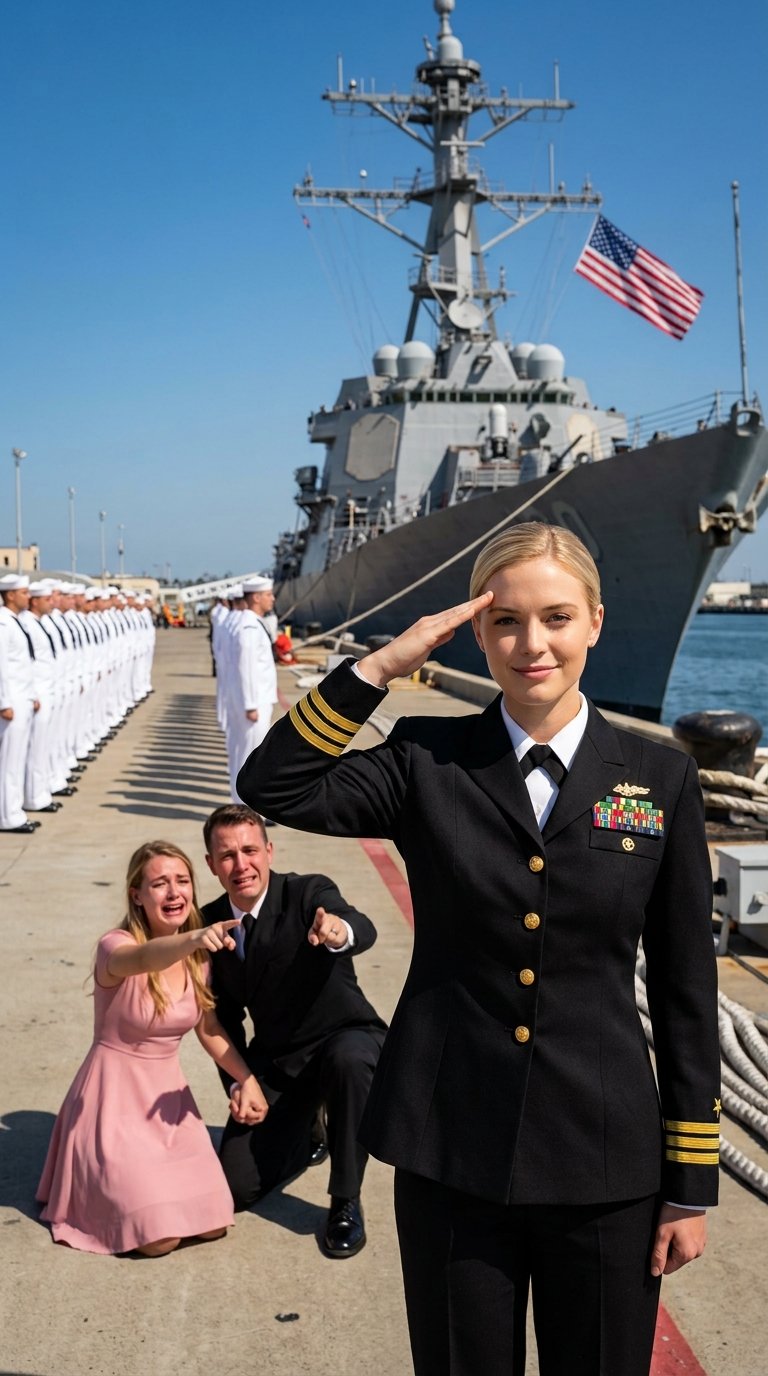
I stepped out from the row of chairs, my boots hitting the asphalt with a heavy, rhythmic thud. I marched out of the shadow of the tent and into the blinding Texas sun, stepping onto the grass of the parade field.
Thousands of eyes were on me. I felt the weight of them, but it didn’t crush me; it armored me. I marched toward the center of the formation, where the Division Commander, the Command Sergeant Major, and Andrew stood waiting.
As I approached, I could see Andrew unravelling.
His dress uniform, normally pristine, was visibly soaked with sweat under the arms and down his back. His hands, gripping the wooden staff of the unit’s guidon, were shaking so violently that the heavy flag fluttered out of rhythm with the wind. His eyes were wide, panicked animal eyes, darting from my face, to the charred metal pin on my chest, and then toward the edges of the field.
He was looking for an exit. There were none.
I stopped three paces from him and executed a perfect salute to the Division Commander.
“Sir, Colonel Carter reporting for command.”
The General returned the salute, his face solemn, though I caught the faintest glimmer of steel in his eyes. He knew exactly what was about to happen.
The Command Sergeant Major stepped forward, taking the guidon from Andrew. It was time for the physical transfer. The Sergeant Major handed the flag to Andrew, who was supposed to hand it to the General, who would then hand it to me.
Andrew took the flag. He looked at me, just inches away. His pristine, heroic facade had completely melted. He looked small. He looked like the coward who had scrambled onto a helicopter while my men bled out in the dirt.
“Emily… please,” he whispered, his voice cracking. It was so quiet only I and the General could hear it. “Please. Don’t do this. Don’t ruin Claire.”
My jaw tightened. The anger I had carried for three years crystallized into pure, diamond-hard focus.
“This isn’t about Claire,” I whispered back, my eyes locking onto his terrified gaze. “This is about Specialist Miller. This is about Sergeant Davis. This is about Private First Class Jenkins.”
I spoke the names of the dead like a curse. With every name, Andrew flinched as if he had been struck.
“You left them in the sand, Andrew. You traded their blood for that oak leaf on your chest.”
“I had to make a tactical decision!” he hissed frantically, tears pooling in his eyes. “You know how it is in the valley, you know—”
“I know you falsified the radio logs,” I cut him off, my voice cold and flat. “And I know you missed the backup drive in the comms tent. The one I dug out of the wreckage.”
Andrew stopped breathing. The guidon slipped slightly in his sweaty palms.
The General cleared his throat, a sharp sound of impatience.
Trembling, Andrew handed the flag to the General. The General turned and thrust it toward me.
I reached out and wrapped my leather-gloved hands around the polished wood. I gripped it tight. I didn’t just take command of the brigade; I ripped the legacy out of his hands.
As the announcer declared the transfer complete, I locked eyes with the woman in the dark business suit standing by the media tent.
I gave her a single, definitive nod.
The master of ceremonies leaned into the microphone to invite the new commander to speak.
Before I could take my first step toward the podium, the woman in the dark suit moved. She didn’t walk; she advanced with the terrifying, inevitable momentum of an avalanche. Flanking her were two massive Military Police officers, their white brassards stark against their dark uniforms, hands resting casually but purposefully near their duty belts.
They marched straight onto the parade field, ignoring all ceremonial protocol. A murmur ripped through the crowd, a low wave of confusion that quickly escalated into a tense, vibrating hum. Soldiers in formation shifted their eyes, though discipline kept their heads facing forward.
In the VIP tent, I saw my father stand up, his mouth opening in a silent shout. Claire was clutching the pole of the tent, looking as though the earth was crumbling beneath her high heels.
The CID agent bypassed me entirely and stepped directly into Andrew’s personal space.
“Lieutenant Colonel Andrew Hayes,” she said. She didn’t shout, but her voice carried a crisp, authoritative snap that cut through the ambient noise of the crowd.
Andrew took a step backward, raising his hands in a pathetic, defensive gesture. “Wait. Not here. Please, not in front of—”
“You are under arrest by the United States Army Criminal Investigation Division,” she continued, her voice devoid of emotion, reading from a small card. “You are being charged under the Uniform Code of Military Justice with dereliction of duty resulting in death, falsification of official records, and conduct unbecoming an officer.”
“No!”
The scream tore from the VIP tent. It was Claire. She was fighting past a stunned colonel, trying to run onto the grass, her white dress flying. “Andrew! What are they doing? Get your hands off him!”
My father grabbed her arm, finally realizing the magnitude of the disaster, pulling her back before the perimeter guards could tackle her. He looked at me, standing tall with the guidon, and then at Andrew, who was crumbling. For the first time in my life, I saw my father look at me with something other than disappointment. I saw fear.
The two MPs stepped forward. Without an ounce of gentleness, they grabbed Andrew’s arms, twisting them behind his back. The sharp, metallic click-click of handcuffs echoed loudly over the still-live microphone on the podium.
It was the most beautiful sound I had ever heard.
Andrew’s knees gave out. The MPs had to haul him up by his armpits, dragging his polished shoes across the grass. He didn’t look at his wife. He didn’t look at his commanding general. He looked at me. His face was a mask of utter devastation, his fabricated life disintegrating into dust in front of thousands of his peers.
As they dragged him past me toward a waiting black SUV that had quietly pulled up to the edge of the field, he sobbed.
The SUV doors slammed shut. The vehicle drove away, leaving behind a silence so profound it felt heavy.
Three thousand soldiers stood in perfect formation. Hundreds of guests sat frozen in their chairs. The wind snapped the American flag overhead.
The Division General stepped up to the microphone. He looked out at the stunned crowd, then looked at me.
“Colonel Carter,” he said, his voice steady. “Take charge of your Brigade.”
I walked to the podium. I adjusted the microphone. I looked at the VIP tent, where my mother was weeping into her hands, where my father was staring at the ground, and where my sister was sinking to her knees, clutching a crushed yellow rose.
Then, I looked out at the soldiers. My soldiers.
“I am Colonel Emily Carter,” I projected, my voice ringing clear and strong across the field. “And today, we begin again.”
The aftermath of an explosion is always quieter than you expect.
An hour later, the parade field was empty. The grandstands were being disassembled by a work detail. I stood in my new office at Brigade Headquarters, staring out the window at the sprawling expanse of Fort Garrison. The heavy oak desk behind me was clear, save for the blackened piece of metal—Specialist Miller’s dog tag—resting squarely in the center.
There had been a brief, chaotic scene in the holding area behind the tents. My parents had tried to corner me. My father, his face purple, demanded to know what I had done, demanding I “fix it” for Claire.
I hadn’t yelled. I hadn’t argued. I simply looked at him, feeling absolutely nothing.
“He killed three of my soldiers, Dad,” I had told him, my voice devoid of anger, entirely hollow. “He hid in a bunker while they bled to death, and then he blamed the unit. He lied to you. He lied to Claire. And he almost destroyed my mind to keep his secret.”
My father had opened his mouth to speak, to defend the golden boy one last time, but the words died in his throat when he looked into my eyes. He saw the cold, unyielding truth there. He saw the scars he had spent years pretending didn’t exist. He had slowly backed away, taking my sobbing mother by the arm, and they had left.
Claire hadn’t spoken to me at all. She had simply stared at me with a look of pure, unadulterated hatred, a woman whose entire identity had just been loaded into the back of a military police cruiser.
A knock at the door pulled me from my thoughts.
“Enter,” I said.
The Sergeant Major walked in. He was a combat veteran, a man whose face looked like it was carved from granite. He stopped in front of my desk and stood at parade rest.
“Ma’am. The staff is assembled in the conference room for the initial briefing. Whenever you are ready.”
He paused, looking down at the scorched dog tag on the desk. He didn’t ask what it was. A man like him already knew.
“Sergeant Major,” I said, turning away from the window. “How is the morale out there?”
“Shocked, Ma’am,” he answered honestly. “They don’t know what to think. They believed Hayes was a hero.”
“They will know the truth by tomorrow morning when the charges are unsealed,” I said, picking up the piece of metal and pinning it back inside my lapel, close to my heart. “We have a lot of broken trust to rebuild.”
“Yes, Ma’am.” He looked at me, and for a fraction of a second, the corner of his mouth twitched upward. “It’s a good day for a cleaning, Colonel.”
“Let’s get to work, then.”
I walked past him, stepping out into the hallway of the headquarters. The walls were lined with portraits of past commanders. A blank space waited where Andrew’s photo was supposed to go. It would remain blank. He was a ghost now, erased by the light of the truth.
I had lost my family today. I knew that. The bridge between us wasn’t just burned; it was vaporized. But as I walked down the hall, hearing the sharp, synchronized sound of soldiers snapping to attention as I passed, I realized I wasn’t alone.
I had my truth. I had my honor. And finally, I had my command.
The coup was complete. But the real war—the war to lead these men and women with the integrity they deserved—was just beginning.
If you want more stories like this, or if you’d like to share your thoughts about what you would have done in my situation, I’d love to hear from you. Your perspective helps these stories reach more people, so don’t be shy about commenting or sharing.