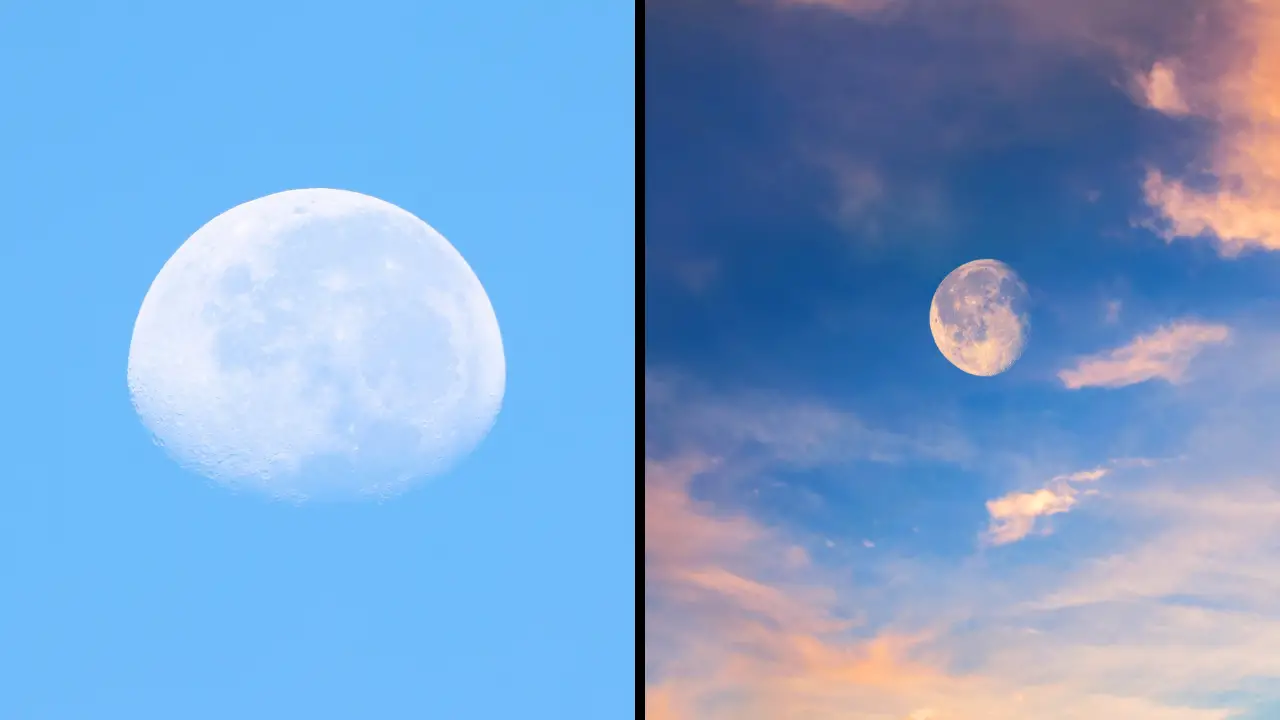

Credit: Adobe Stock
NASA Explains Why You Can Sometimes See The Moon During The Day
NASA has explained why you can sometimes see the moon during the day.
Most people associate the Moon with darkness, bedtime, and glowing night skies.
It’s one of the most recognizable nighttime symbols in the world, appearing everywhere from children’s books to weather forecasts and movie scenes.
So when people suddenly notice the Moon hanging in the middle of a bright blue daytime sky, it can feel strangely unsettling.
For years, social media users have shared photos of daytime moons alongside confused captions asking whether something unusual is happening in the sky.
Others jokingly ask if the Moon is ‘out early’ or somehow ‘forgot to leave.’
But according to NASA, seeing the Moon during the day is actually completely normal, and it happens far more often than most people realize.
People have always been fascinated by the daytime Moon
Spotting the Moon in broad daylight tends to stop people in their tracks.
Unlike stars, which disappear once sunlight brightens the sky, the Moon can sometimes remain clearly visible for hours after sunrise or before sunset.
Many people admit they spent years assuming the Moon only appeared at night.
“That genuinely blew my mind as a kid,” one person wrote online.
Another joked: “Every time I see the Moon during the day I feel like I’ve unlocked a secret level of Earth.”
Others shared bizarre theories they believed growing up.
“I thought there were two moons when I was little, one for day and one for night,” another admitted.
The phenomenon regularly goes viral online whenever someone posts a particularly clear daytime Moon photo.
And while plenty of users know the scientific explanation, many are still surprised by how often it actually happens.
The Moon isn’t only a nighttime object
One major reason people find the daytime Moon so strange is because of how it’s portrayed in media and popular culture.
The Sun is typically used as a symbol for daytime, while the Moon represents night.
But in reality, the Moon spends almost as much time in the daytime sky as it does at night.
NASA scientist Sarah Noble previously explained that the Moon is always there — we just don’t always notice it.
Unlike the Sun, the Moon doesn’t create its own light.
Instead, it reflects sunlight off its surface.
That reflected light is bright enough that we can often still see it even while the sky itself is illuminated by the Sun.
Stars are also technically still present during the daytime, but they’re far dimmer from our perspective, so sunlight scattered through Earth’s atmosphere drowns them out.
The Moon, however, reflects enough sunlight to remain visible under the right conditions.

Other strange Moon mysteries people obsess over
The daytime Moon isn’t the only lunar mystery people constantly debate online.
Social media is full of discussions about why the Moon sometimes looks enormous near the horizon, why it appears orange during certain seasons, or why it can occasionally be visible before sunset.
Some conspiracy theories even claim the Moon looks ‘too close’ or ‘different’ on certain days.
Scientists, however, say most of these strange effects are simply caused by lighting, perspective, atmospheric conditions, or the Moon’s natural orbit around Earth.
NASA has repeatedly explained that the Moon’s appearance changes constantly depending on its phase and position relative to both the Earth and Sun.
And that changing position is also the reason we sometimes see it during the day.
So why can you sometimes see the Moon during daylight?
According to NASA, the answer comes down to geometry, timing, and the Moon’s orbit around Earth.
The Moon orbits our planet roughly every 27 days while reflecting sunlight back toward Earth.
Depending on where the Moon is positioned during that orbit, it can appear in the sky during both daytime and nighttime hours.
During a full Moon, the Moon sits opposite the Sun in the sky, which is why it typically rises around sunset and sets around sunrise.
But before and after a full Moon, its position shifts.
In the days leading up to a full Moon, the Moon can often be seen rising in the eastern sky before sunset.
After a full Moon, it may remain visible in the western sky after the Sun has already come up.
NASA explains that the Moon is especially easy to spot during daytime around its quarter phases because it’s bright enough to see while also positioned far enough away from the Sun in the sky.
So while it may feel unusual, the daytime Moon is actually one of the most normal sights in astronomy.
The reason you can sometimes see the Moon during the day is simply that it reflects sunlight brightly enough to remain visible while orbiting Earth, as long as it’s positioned in the right part of the sky.
Related Article: NASA Astronaut Reveals The Shocking Truth He Learned After Seeing Earth From Space
Related Article: Astronaut Who Spent 178 Days In Space Shares The Big ‘Lie’ He Realized After Seeing Earth
Want more stuff like this?
Get the best viral stories straight into your inbox!