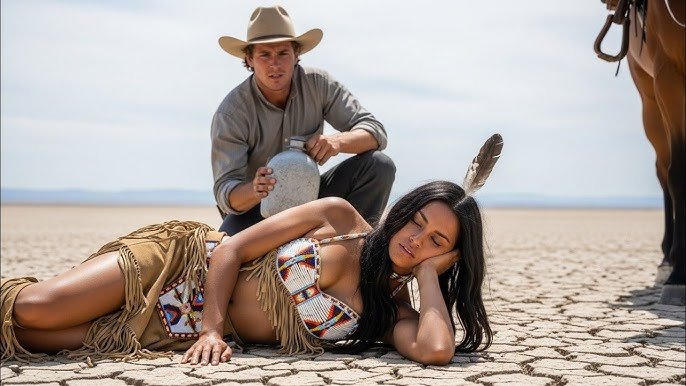
Ethan Cole had been riding empty for so long his own heartbeat echoed like a stranger’s drum. The desert around him was bleached bone-white, the sky a cruel mirror throwing heat back at the sand. His canteen clanked hollow against his saddle, a joke without a punchline. He followed the old riverbed because maps lied and memory was thirstier than fact. That was when he saw the shape—a crumpled scrap of darkness against the glare, moving only when the wind brushed it.
He drew closer, boots sinking, rifle loose in his hand. A girl, maybe twenty summers, lay half-buried in her own blood and dust. An arrow stub jutted from her side like a snapped promise. Her lips were cracked, her eyes slits of pain. When she saw him she did not flinch; she simply whispered in Apache, a sound dry as corn husks. Ethan understood the tone if not the words: water, please, or maybe just don’t let me die alone. He up-ended his canteen. Three swallows left—his last insurance against the desert’s grin. He let every drop fall into her mouth. Her fingers clamped his wrist, life clinging to life, and in that swallow the world shrank to the two of them and the taste of mercy.
Getting her onto the horse took the last of his strength. She weighed no more than a saddlebag, yet felt heavier than any gold he had ever hauled. He rode for a canyon he knew, where a sneaky spring still slipped between rocks. There he washed her wounds, soaked cloth, and watched color crawl back into her cheeks. She slept like someone falling off a cliff in slow motion. He sat with his back against stone, rifle across his knees, and told himself he had only done what any man should. Deep down he knew most men would have ridden on.
At dawn her eyes opened wide and dark as mountain water. She touched her chest: Nia. He tapped his own: Ethan. Names felt small after what had passed between them, but they were a beginning. She pointed east where smoke ribboned against the sky—her people. Ethan’s stomach tightened. Apache country swallowed more riders than drought, yet he lifted her onto the horse and turned the mare toward that distant plume. Every step felt like walking on someone else’s story, but the desert had already rewritten his.
Warriors rose from the rocks the way thunderheads pile on hot afternoons—silent, painted, many. Ethan raised both hands, empty. Nia spoke fast and sharp, her voice steady despite the fever still in her skin. An older man, face carved by sun and sorrow, stepped forward. His eyes moved from his daughter’s bandaged shoulder to the empty canteen on Ethan’s belt, then to the white scar of the dry riverbed. A younger man translated: “You gave her water when the land took it back. Our law says life given is life joined. She is your wife before this sun sets.” Ethan’s mouth opened, closed. Arguments died in his throat; they would sound like begging, and he had forgotten how to beg.
They did not ask his consent. They simply drew him into a circle of cedar smoke and painted stones. Hands joined, wrists brushed with cool water, songs low as running creeks. When it ended someone pressed a token into his palm—half wood, half stone—warm from Nia’s fingers. Around them the camp celebrated with soft laughter and drums that sounded like heartbeats learning a new rhythm. Ethan sat apart, stunned, tasting the dust of a future he had not chosen. Nia brought him stew and sat close enough that her shoulder touched his. “Eat,” she said in careful English. He ate, and the taste was unfamiliar, but it filled hollow places he had carried so long they felt like home.
Days slipped into a new shape. Ethan fixed bridles, hauled water, learned to walk quieter than regret. Children tugged his sleeves, asking cowboy questions in two languages. Nia taught him to draw a bow without fighting the wood, her hands steady on his arms, her breath warm against his neck. Each evening they traded stories the way other people trade coins—hers of storms that talked to mountains, his of cattle that flowed like rivers across the plains. One afternoon raiders came, hungry for horses and old scores. Ethan’s rifle cracked beside Apache bows. When the dust settled, the camp still stood. The chief nodded once: “You fought as one of us.” That night Nia’s hand found his by the fire, and neither let go.
Weeks later, when the cottonwoods turned gold and the air smelled of leaving, Nia walked with him to the edge of the valley. “You still planning to ride north?” she asked. Ethan looked back at the lodges, the smoke, the girl who had once been a dying stranger and was now the center of his compass. “North feels empty,” he said. “This place feels loud with things I didn’t know I was missing.” She smiled then, wide and startled, as if the future had suddenly learned her name.
They returned to the spring where it had begun. Water still slipped between the stones, stubborn and clear. Ethan knelt, filled the canteen, and handed it to her first. She drank, then offered it back. Their fingers brushed, wet and warm. “Maybe the water didn’t save you,” she said. “Maybe it showed you where you already belonged.” Ethan thought of the desert, the swallow, the promise he had never spoken aloud. He took her hand, ringless yet real, and felt the current run between them—stronger than thirst, deeper than law.
No priest ever blessed them, no paper ever recorded their names side by side. Yet when the tribe moved camp they rode together, her horse beside his, the token wood-and-stone hanging from his neck on a rawhide cord. Years later, when travelers asked how a blue-eyed cowboy came to speak Apache like a born son and carry children with sun-brown skin and storm-dark eyes, Ethan would lift the canteen and say, “Water gave me a wife, and she gave me a world.” Nia would laugh, add softly, “The desert never gives, it only loans. But sometimes, if you’re willing to pay with your heart, the interest is a life you never thought to live.”