The sun over Arizona hammered the land until even the lizards looked for shade. Out where the dust curled like smoke, six riders spotted a shape on the ground—dark, still, wrapped in torn buckskin. A woman. Apache. Legs twisted, face burned, knife in her grip. The men circled, horses stamping, jokes already flying.
“Dead squaw,” one spat.
“Half-dead,” another laughed. “Leave her for the buzzards.”
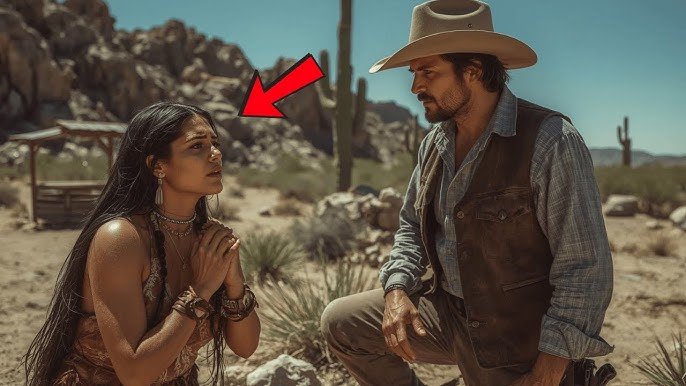
Only Flint Dawson kept his mouth shut. He swung down slow, boots settling in the hot sand, and walked toward her like she was a rattler he didn’t want to startle. The woman lifted the blade higher, eyes slits of fury.
“Easy,” Flint murmured. “I ain’t the ending you’re looking for.”
Behind him the cowboys hooted. Flint ignored them. He uncorked his canteen and held it out, arm extended, palm up. The woman stared at the water, then at him, then at the water again. Finally she drank, gulping so hard the canteen rattled against her teeth. When it was empty she let it fall and waited for whatever came next.
Flint wiped his mouth. “Can you ride?”
She tapped her dead legs once. “Not anymore.”
The laughter behind him died. Flint nodded, lifted her as gentle as glass, and set her across his saddle. He climbed up behind, one arm keeping her steady, the other gathering reins.
One of his men found his voice. “You gone crazy? That’s a damn Apache.”
Flint looked back, eyes flat. “She’s mine now—the Apache nobody wanted.”
The words landed like a slap. Nobody answered. The desert wind just kept blowing, filling the silence with dust.
They rode west to Flint’s ranch, a squat house huddled against red cliffs. He carried her inside, laid her on his bed, and started a pot of beans. She watched every move, knife still in reach. When the food was ready he set the bowl on the floor and stepped back. She ate with her fingers, never dropping her gaze.
That night Flint spread his bedroll on the porch boards. He slept with the door open so the lamp showed her he wasn’t coming in. Morning found him fixing fence with the woman’s name burning in his head—Sani. He said it aloud once, testing the shape. It felt like a stone he might carry a long way.
Days slipped by. She learned the rasp of his boots, the creak of the porch swing, the way he sang off-key to the horses. He learned the curve of her silence, the sharp edge of her laugh when the mule bit him, the strength in her arms as she stitched a torn shirt. She refused pity the way other people refuse poison.
Word rode ahead of them. Folks in Red Springs whispered when Flint hauled her into the store for flour and coffee. Sani sat straight in the wagon, blanket across her lap, eyes daring anyone to stare too long. Clint McGraw, cattle baron and self-crowned king, blocked the street one afternoon.
“That thing brings trouble,” he drawled. “Apache trash belongs in the dirt.”
Flint’s voice stayed soft. “She’s mine. My dirt, my roof, my choice.”
McGraw’s face went purple, but the street was listening. He rode off, hatred trailing like dust.
Three nights later the ranch caught fire. Torches arced out of the dark, flames clawed the barn. Flint moved through smoke and heat, rifle cracking. Sani sat in the doorway, legs useless, arms steady, picking off shooters who tried the window. When the raiders fled, the barn was gutted but the house still stood. Dawn showed scorched earth and two people still breathing.
McGraw sent professional guns next—twenty hard cases who rode in at sunrise expecting easy pickings. They found empty corrals, cold ashes, no sign of life. Then the ridge exploded—rifles, arrows, rolling rocks. Sani had drawn maps in the dirt, planned kill zones the way other women planned gardens. By nightfall the gunnies were gone, leaving behind wounded pride and a ranch the desert hadn’t claimed.
Word spread faster this time. A crippled Apache woman and a quiet cowboy had whipped twenty killers. The story grew legs and walked into every saloon from Tucson to Santa Fe. Some folks cheered, some spat, but everybody remembered the four words Flint had spoken beside the cactus: She’s mine now.
Weeks later McGraw came alone, hat in hand, pride ground down to nubs. “I’m done,” he muttered. “Land ain’t worth the blood.” He looked at Sani sitting on the porch, rifle across her knees, and something like respect flickered in his eyes. He rode away, smaller than when he arrived.
Spring eased over the range. Grass crept up through charred boards. Sani planted morning-glory seeds along the porch edge, vines reaching for a sky that finally seemed wide enough. One evening she wheeled herself—Flint had built a chair with wagon wheels—beside him where he watched the sun drown in red.
“Before you,” she said, “the desert only wanted my bones. Now it gives me flowers.”
Flint rubbed the back of his neck. “Desert don’t give. It loans. We just decided to pay the interest together.”
She laughed, the sound rolling out like water finding a creek bed. He joined her, rough and rusty, two notes that somehow harmonized.
Folks still argue about what Flint meant that first day—whether he claimed her like property or offered himself like shelter. Sani only smiles when she hears the talk. She knows the truth: four words can be a cage or a key. Flint handed her the key and never asked for it back.
Nowadays, when travelers ride up to the ranch tucked under red cliffs, they see a woman with dark hair and steady eyes rolling between garden rows, children on her lap, laughter spilling like seed. They see a tall cowboy limping in from the pasture, hat tipped, arms full of firewood. And if they ask how such a place was built, Flint shrugs and says, “Started with water and a knife. Ended with a promise I intend to keep.”
Sani finishes the story every time, voice soft but sure: “He called me his. Not because he owned me—because he chose me when the world threw me away. Choice is stronger than chains. Choice is what turns a broken woman into a warrior with flowers climbing her porch.”
Out where the dust still swirls and buzzards still circle, the land remembers the day a quiet cowboy shocked every man watching. Four words rode the wind and came back bigger than hate: She’s mine now. And in those words two people found the edge of death—and stepped back together.