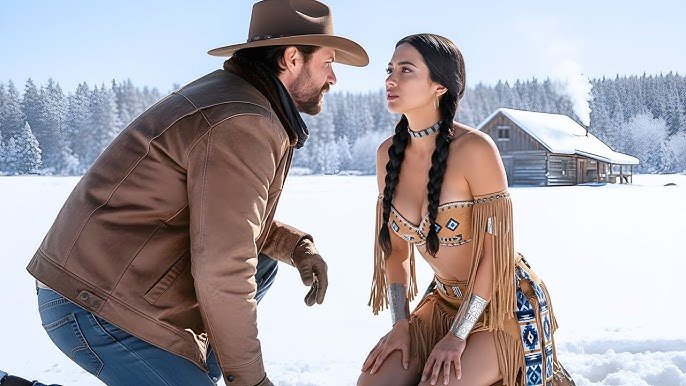
Cole Merrick had been on his feet for three days and his leg burned like a branding iron when he finally pushed open the cabin door. The woman inside flinched as if the hinges themselves might strike her. She wore widow’s black and fear the way other women wore perfume. Her voice came out low, almost a prayer: “Make me your wife tonight.” Cole’s hand froze on the latch. He had come in out of the rain, expecting only to warm coffee and thaw his bones. Instead he found a stranger willing to trade her name for safety.
He shut the door softly, the way you close a gate so the cattle don’t spook. “I won’t touch you,” he said. “Not unless you ask for more than a word.” She studied his face, looking for the lie. Cole let her look. He knew what it felt like to be sized up by hungry eyes; he had been doing it to himself since the day his brother died on a trail drive and left him alone with blame and a bad leg.
Outside, hooves had stopped in the dark. Riders who smelled of whiskey and old grudges circled the cabin once, then moved on. The woman—Nielli—watched the window until the last sound died. Only then did her shoulders drop. “They think I owe them for my husband’s debts,” she said. “They killed him outside a saloon in Laramie. Said his widow would pay the rest.” She touched the bruise on her throat as if it were a necklace someone had forced on her.
Cole poured coffee, black and bitter, and slid the cup across the table. “You can sleep here,” he told her. “Door barred, rifle loaded. I’ll take the floor.” She shook her head. “If they come back, a ring on my word would slow them more than a gun in your hand.” She spoke like someone who had learned the hard way that laws and legends both hang on stories people believe. A wedding band, even an unchurched one, could be armor out here.
Cole thought of the gold band he still carried in his pocket, the one that had belonged to his mother. He had never found a woman he trusted to wear it. Tonight he slid it across the wood. “We’ll tell the world you’re my wife,” he said. “But inside these walls we stay strangers if that’s what you need.” Nielli picked up the ring, held it to the firelight, and nodded. The deal was struck without kiss or preacher, sealed by two tired people who understood the weight of silence.
He gave her the bed, took the chair, and kept watch until the fire settled into coals. Somewhere in the small hours she whispered from the blanket, “You on that chair looks heavier than any man should carry.” He answered without turning. “Chairs don’t mind the load.” She rose then, quilt wrapped around her like a cape, and sat on the floor beside him. “Share the warmth,” she said. “Not the bed—just the warmth.” They leaned against the wall, shoulders touching, two pieces of broken pottery trying to make one whole cup.
Morning came gray and still. Cole’s leg throbbed, but his chest felt lighter than it had in years. He built up the fire and started coffee again. Nielli stood at the window, watching smoke rise from the chimney the way other women watch the ocean. “I meant what I said,” she told the glass. “But I didn’t expect you to give me dignity instead of demand.” Cole shrugged. “World asks too much of women and too little of men. Figured I could balance the ledger a little.”
They spent the day preparing for riders who might never come. She cleaned the rifle while he split wood. Every so often their eyes met and something passed between them that needed no language. By dusk the cabin felt smaller, not from crowding but from shared purpose. Supper was beans and stale bread eaten by lamplight. Afterward she washed the tin plates; he dried. When the last dish was stacked, she spoke to his back. “I’d like to keep the ring on, if you don’t mind. Just till the trail turns cold.”
He turned, met her steady gaze, and felt the ground shift under his boots. “Keep it,” he said. “Story’s already traveling faster than we can ride.” She smiled then, small and surprised, as if the expression had been misplaced for so long she forgot she owned it. They moved through the evening like dancers who had never learned the steps but found the rhythm anyway. He banked the fire; she checked the latch. At the door to the bedroom she paused. “Floor’s hard on that leg. I left you half the mattress. No obligations, just wood and wool between us.”
Cole hesitated, then nodded. He lay down atop the quilt, boots off, coat still on. She stretched out beside him, not touching, yet close enough that he could hear her breathe. Sleep came slow, but it came. In the middle of the night he woke to find her hand resting light on his chest, the way a bird lands on a branch it isn’t sure will hold. He covered her fingers with his own. No more was asked; no more was given.
Dawn painted the window gold. Cole rose first, careful not to wake her. He stepped outside to sniff the wind like a man testing ice. The world smelled of pine and possibility. When he returned she was at the stove, coffee boiling, his mother’s ring still on her finger. She glanced up, cheeks flushed from the heat. “I figured a wife ought to know how her husband likes his coffee.” He tasted it—strong, slightly burnt—and told her it was perfect.
They rode into town together three days later. Nielli wore his spare coat and the ring. Folks stared, but the story had already curled through the saloon like smoke: Cole Merrick had taken a widow under his name and his roof. The men who had hunted her heard it and turned their horses south, looking for easier prey. Cole watched them go from the general-store porch, her small hand tucked in his large one. When the last rider disappeared he felt her exhale, the sound of chains falling open.
That night back at the cabin she returned the ring, holding it out on her palm. “Trail’s cold,” she said. “Thought you might want it back.” He closed her fingers over the gold. “Keeps the story true,” he told her. “And truth is a scarce thing.” She wore it then because she chose to, not because she needed shielding. Months later, when the first snow came, she still wore it. Months after that, when the river ran high and wild, she wore it. The ring never left her hand, and Cole never asked for it back, because some promises grow roots deeper than the fear that planted them.
They never stood before a preacher, never filed a paper, yet the town spoke their names as one. If asked, Cole would say, “We married the night we decided to keep each other breathing.” And Nielli, quieter now but no longer afraid, would add, “Love came later, riding on the back of mercy.” Under the wide sky they built a life plank by plank, nail by nail, the way you build anything worth keeping—slow, steady, and without lies.