Jonas Hail had lived alone so long the cabin had begun to echo his footsteps back at him. Red Bluff was hard country—sun-scorched, wind-scoured, a place that taught a man to keep his wants small and his doors shut. He lit the morning fire the same way every day: one match, one chunk of mesquite, one prayer that today would pass without a memory sharp enough to draw blood.
Then came the scrape of bare feet outside.
The boy stood no taller than a saddle horn, ribs counting themselves beneath brown skin. Apache, Jonas guessed, and starving. The child’s eyes held the flat shine of someone who had seen too much and understood it all. Jonas set the poker down, moved slow, and laid a square of cornbread on the step. He backed away, gave the boy room to decide. Hunger won. The child ate like a wild thing, then curled on the porch boards and slept, small fingers clutching the crust.
Jonas covered him with an old blanket and watched the rise and fall of that fragile chest until dawn. When he woke, the blanket was folded neat and the boy was gone—only the shape of a child pressed into the boards remained.
Something stirred in Jonas that morning, something he thought the war had burned out. He did not name it; he only set out another piece of bread and went about his chores.
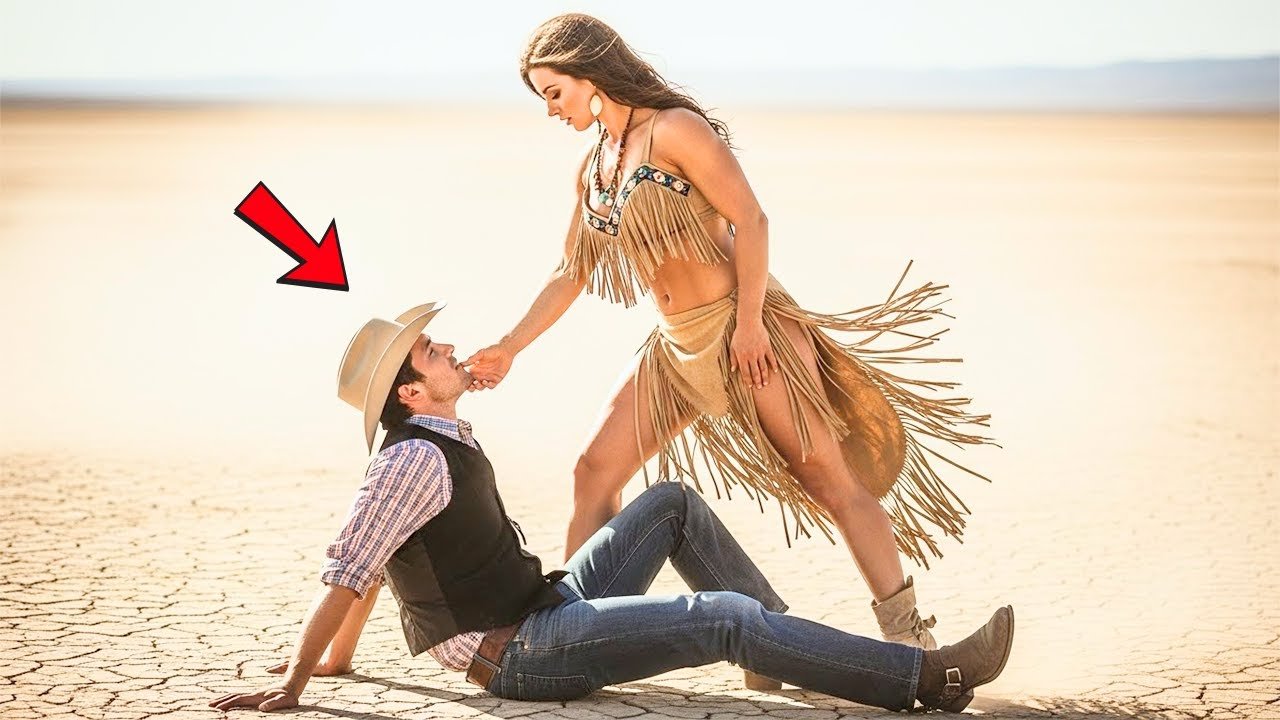
The next afternoon they came together: the boy and a woman tall as Jonas, shoulders squared by hardship. She moved like someone who had fought every step of her life and still expected the ground to rise against her. Bruises bloomed along her arms; dried blood mapped her legs. Her eyes never rested.
“Please,” she said, voice rough as gravel. “Let us stay the night. We have been hunted… many days. No food. No water.”
Jonas opened the door wide. “Come in. No one will harm you here.”
The woman—Saka—crossed the threshold like a deer entering a trap, ready to bolt. The boy, Tawi, walked straight to the shelf and pointed at a wooden horse Jonas had carved years ago for a child who never lived to play with it.
Jonas set the toy in the small hands. “It’s yours now.”
The smile that broke across the boy’s face was sunrise in a dark room.
Days slipped into weeks. Saka worked like a man, splitting wood, mending roof, kneading dough with fists that had once held weapons. At night she collapsed onto the cot, asleep before her head found the pillow. Jonas moved quiet, careful not to startle her, speaking mostly to the horses and the wind.
Tawi followed him everywhere, wooden horse tucked under one arm, questions spilling like beans from a sack. Jonas showed him how to gentle a colt, how to read sky for weather, how to hold a nail steady. Each small skill passed from cracked fingers to small ones, and the cabin began to hold new sounds: childish laughter, a woman’s humming, the creak of a second chair pulled up to the table.
One evening Tawi ran inside shouting, “Papa Jonas, can we go to the creek?”
The word hung in the air like a lantern. Jonas felt it settle on his skin, warm and weighty. He looked at Saka. She nodded once, eyes bright with permission and something softer.
Spring came gentle that year. Grass dared to green, the creek laughed over stones, and the three of them walked its banks—Tawi skipping ahead, Jonas and Saka side by side, not touching yet, but close enough to feel the heat of shared living.
Trouble arrived on a black horse. A man with scarred knuckles and a smile like a slammed gate reined up at the fence, asking after a “big Apache woman and a boy.” Jonas felt the old war rise in his chest, steady and cold. He lifted the shotgun, barrel pointing where manners should have been.
“She doesn’t belong to you,” Jonas said.
The rider laughed until he saw Jonas’s eyes. Something there—memory of fields soaked in blood—made him yank his horse around and thunder away.
That night Saka sat on the porch, stars spilled across the sky. Jonas joined her, leaving space for choice. She closed it, shoulder brushing his.
“I don’t want to run anymore,” she whispered.
“Then don’t,” he answered. “This place can hold all three of us.”
Years later folks speak of Red Bluff as if it were always gentle. They forget the years of drought, the wind that skinned cattle, the man who lived alone. What they remember is the porch light that stayed lit, the woman who split wood like thunder, the boy who rode a real horse clutched in one hand a wooden toy in the other.
And they remember the lesson Jonas never spoke aloud but lived every day: keep the door open, leave bread on the step, and sometimes—just sometimes—the broken world walks in and becomes whole again.