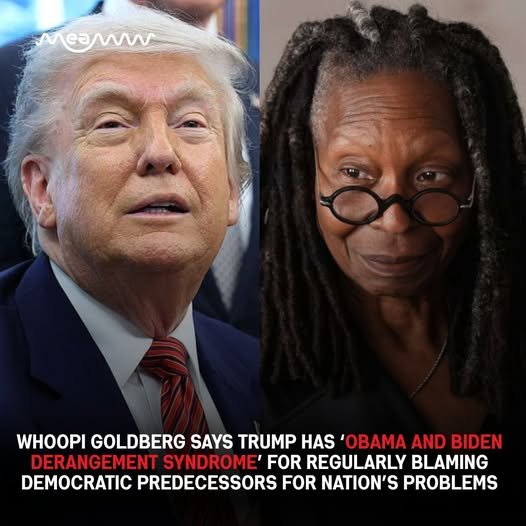
Whoopi Goldberg has heard enough. Day after day Donald Trump climbs on stage, points backward to Barack Obama and Joe Biden, and says the same sentence dressed in different words: whatever is broken, they broke it. On a recent broadcast of The View she finally answered with a new label of her own—“Obama and Biden Derangement Syndrome”—a twist on the favorite Trump-era insult that once mocked critics of the former president. Goldberg’s point was blunt: if blaming the last guy is your only trick, the act has expired, and the audience deserves a refund.
The habit started early. From the moment Trump descended the golden escalator he told crowds the economy was a wreck, the military was depleted, and the borders were wide open, all thanks to Obama. Years later, when prices jumped and pipelines snarled, he added Biden to the chorus. The story never changed; only the villain count went up. Rally signs still read “Promises Kept,” yet the speeches sound like a broken record stuck on “Promises Prevented by Them.” Goldberg’s joke simply gave public shape to a fatigue many Americans feel but cannot name.
Political blame is as old as the republic itself. Every president inherits headaches and every president complains about the medicine cabinet left behind. Yet most leaders mix complaint with cure, pointing forward as often as backward. Trump’s innovation is the endless loop, a rhetorical treadmill where yesterday’s ghosts are always fresher than tomorrow’s plans. The strategy works for a base that loves a fight, but it shrinks the room for new ideas. When every press conference is a history lesson, the future never gets its turn to speak.
Goldberg’s counterattack matters because it flips the script Trump once wrote for his enemies. “Derangement syndrome” used to be what his fans called irrational hatred of the former president; now it describes his inability to release the past. The comic reversal lands because it names a real behavior. Obsessive blame is a kind of derangement, a refusal to live in the present where the buck actually stops. By laughing at the loop, Goldberg invites viewers to step outside it, to ask what solutions sound like when the echo finally dies.
The larger lesson is not about one host or one politician; it is about the moment when excuse-making starts to eat the excuse-maker. Voters will tolerate inherited messes for only so long before they demand cleanup. Goldberg’s taunt is a reminder that leadership begins where finger-pointing ends, and that the country is ready to hear what comes after the word “but.” Until Trump offers that next sentence, the well will stay dry, the syndrome will stick, and the applause will grow a little quieter every time the old names are dragged out for one more bow.