Clint Mercer drove the last cedar post into the hard skin of Broken Mesa, each blow of the hammer ringing like a clock ticking off empty years. He had come here to disappear—no more bugle calls, no more burning villages, no more small graves under big sky. Just the scrape of wire, the grunt of labor, and the hope that sweat might wash the smell of smoke from his dreams. Then he straightened, reached for his canteen, and saw a lone figure standing on the ridge, so still she looked like part of the stone.
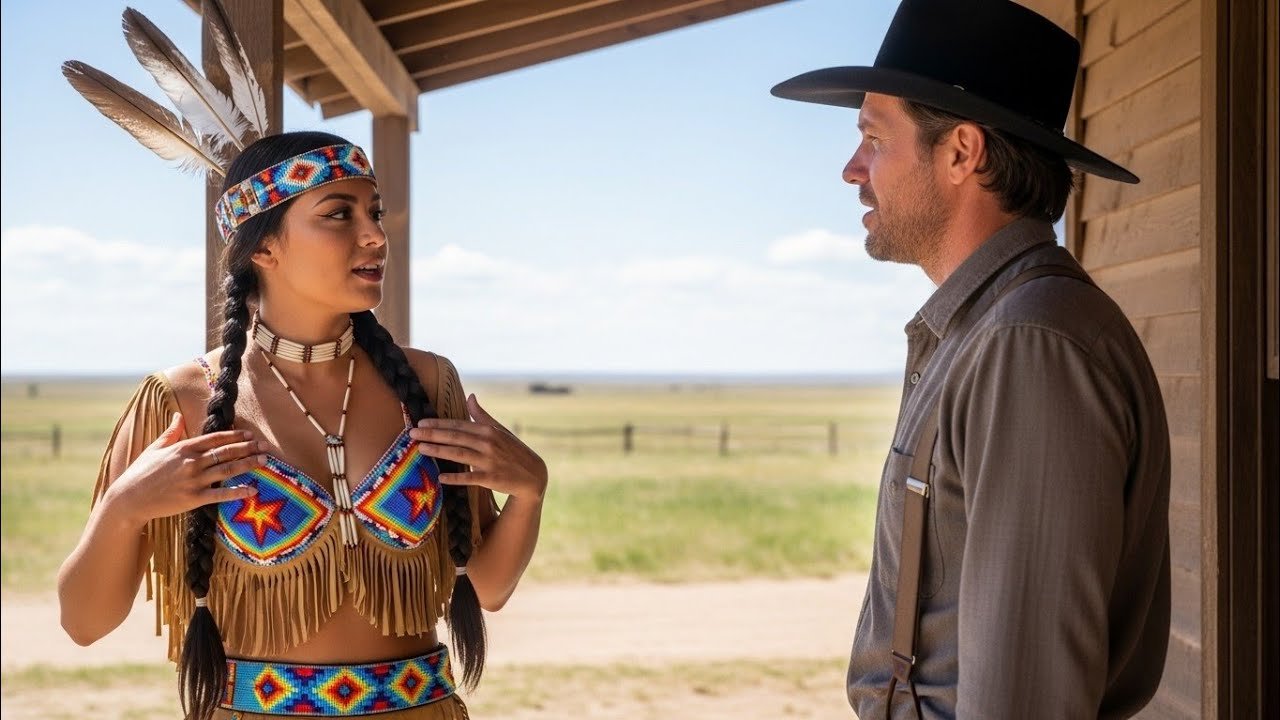
She came down slow, the sun at her back turning the rips in her deer-hide dress into wounds of light. Every third step she touched the rock, as if the earth itself might decide to let her fall. Bruises bloomed across her collar-bone; rope burns ringed her wrists like angry bracelets. When she reached the fence she wrapped both hands around the top rail, knuckles whitening, and spoke in a voice scraped raw by sand and hope.
“Do you remember me, cowboy?”
The words hit harder than any bullet. In a heartbeat he was back in the chaos of that raid—pine trunks blazing, rifles cracking, a child’s scream rising above the roar. He had plunged through fire, hauled a little girl from beneath a fallen branch, and carried her out while embers settled in his hair. He never knew her name, never asked, never wanted to know if she lived. He had carried her away from death and then carried her memory like a scar.

“I’m Tala,” she said. “You pulled me from the fire. I told myself I would grow tall enough to stand beside the man who did not leave me to burn.”
Her knees buckled. He vaulted the fence, caught her before the ground could claim her, and felt how light she was—like the desert had been carving pieces off her ever since that night. He carried her to the cabin, laid her on the narrow cot, and set water to her lips. She drank, then caught his wrist with surprising strength.
“I came to marry you,” she whispered. “Children remember the hands that pull them from death. I walked across years to find yours again.”
He wanted to tell her marriage needs more than memory, that he had failed every person he ever promised to protect, that the only thing he knew how to build now was fence. But the stubborn fire in her eyes melted the iron he had wrapped around his heart, and he simply said, “First we heal you. Then we talk about forever.”
He cleaned the rope burns, wrapped her ribs, and laid his coat over her like a promise. Outside, the mesa kept its secrets; inside, the cabin began to smell of willow bark and fresh coffee instead of old regret. She slept, and he watched the door, rifle across his knees, the way he had watched battlefields years ago—only this time he meant to keep someone alive, not just count the dead.
Two days later dust rose on the western road—three riders led by Harlan Pike, the man who had tied her to a wagon and called it business. Clint stepped onto the porch, rifle easy in his hands. Pike smiled the way a wolf smiles when the sheep looks small. He spoke of ownership, of debts, of runaway property. Clint answered with calm that ran deeper than gunfire: “She stays. You don’t.”
The riders reached for iron. Clint moved first—one shot, one fall, one rider deciding the price was too high. The others turned tail, dragging their wounded behind them. Clint walked back inside, blood on his sleeve, and found Tala standing, rifle steady against her shoulder, eyes wide but unbroken.
“You came back,” she breathed.
“I promised I would,” he said. “I’m done leaving you in burning places.”
Weeks later they finished the fence together, her hands learning the feel of wire and wood, his learning the feel of trust. Some evenings she stood on the ridge and called down, “Do you remember me, cowboy?” He would tip his hat, heart lighter than it had ever been, and answer, “You’re the girl I pulled from the fire and the woman who taught me to walk out of my own smoke.”
Between broken mesa and rebuilt fence line, between memory and morning light, the promise she had carried for years took root in the only soil it had ever wanted—two lives that had decided standing still together beat running alone.