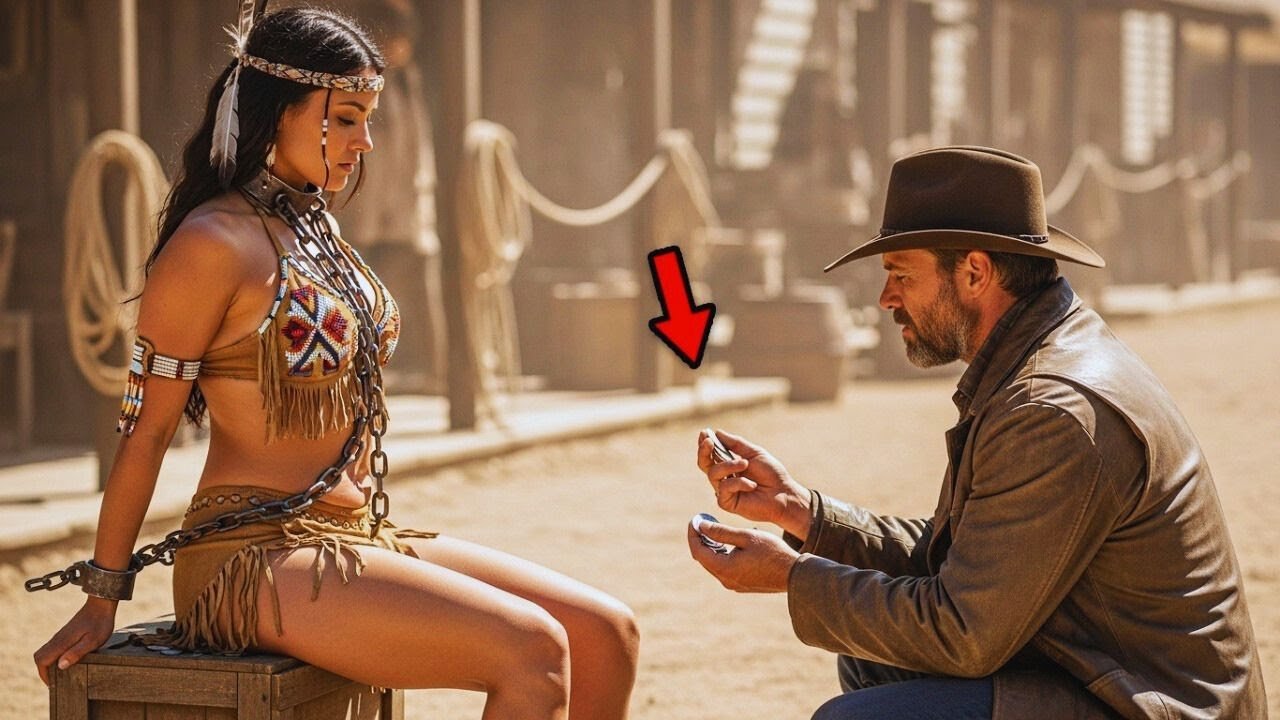
The autumn wind in the border town smelled of whiskey and cheap tobacco. Men crowded the auction block built for cattle, shouting numbers at a woman who stood barefoot on splintered boards. Nielli’s dress hung in tatters, rope burns circled her wrists, and bruises painted her ribs in shades of purple and yellow. The auctioneer called her “filthy savage” and laughed when someone spat near her feet. The bids climbed slower than the price of a lame mule—two dollars, three, a drunken joke of four. She kept her eyes down, whispering the names of her dead, because dignity was the only thing left that couldn’t be sold.
Rowan Pike meant to buy winter feed and ride out before dark. The old cavalry wound in his shoulder ached with the cold, and he wore loneliness like his weather-stained coat—close, familiar, and nobody’s business. But the laughter coming off the platform cut him worse than shrapnel ever had. He turned, saw the girl, saw the greedy eyes, and heard his own voice slice through the noise.
“Six.”
The crowd hushed. Six dollars was more than they thought she was worth. Rowan dropped the coins into the auctioneer’s greasy palm, took the rope from her wrists, and stepped between her and the crowd the way a cliff steps between earth and sky. She stumbled when the chains fell, so he offered his hand—not to grab, just to steady. She took it, surprised that touch could come without pain.
Behind the feed store he gave her water, bean stew, and a blanket that smelled of cedar and solitude. She drank too fast, coughed, then drank again slower, learning trust one swallow at a time. He helped her onto his horse, seating her in front so she could lean back without fear, and rode west until the town’s noise shrank to a bad memory.
His cabin squatted near a leaning corral, one room, one bed, one chair. He built up the fire, set beans to warm, and laid a clean shirt on the quilt. “You change,” he said, and stepped outside, giving her the privacy no auction block had ever allowed. When he returned she wore the shirt like armor, sleeves rolled, hem brushing her knees. She looked small, but her eyes followed every move, calculating distances the way a trapped bird maps sky.
Days slipped into weeks. She learned the creak of the third porch board, the way he rubbed his shoulder when storms brewed, the sound of his step that said stranger or friend. He taught her to split wood, to aim a rifle, to laugh when the axe finally bit clean through cedar. Her ribs filled out, her hands grew sure, and humming returned—soft songs of her people that floated over the corral at dusk.
Word rode in ahead of trouble: the drunk who had bid on her was asking questions, waving receipts, calling theft. Rowan cleaned his revolver, checked the gate, and told her, “You stay because you choose, not because I paid coin.” She answered by slipping the simple silver band he offered onto her finger the day the circuit preacher came through.
They stood before him on the same horse, her arms around his waist, his hand covering hers. The preacher spoke words, the town watched, and some shook heads while others quietly hoped love might be stronger than paper ownership. Back at the cabin that night two cups waited on the table, two blankets lay side by side, and two names—Nielli and Rowan—were spoken like new stars in a sky that had forgotten how to hold light.
Spring brought calves and green shoots. The cabin stayed small, but the silence inside it changed from empty to full. Some nights coyotes called and distant hooves passed, but no one crossed the threshold that now carried a woman’s chosen name. The auction block was miles away, yet it lived in their memories like a scar—proof of what they had survived, not what they had become.
Years later, when travelers asked how a scarred cavalryman and an Apache woman built something unbreakable, they would smile and say the same thing: “We started with six dollars, a blanket, and the crazy idea that freedom is worth more if you give it away.”