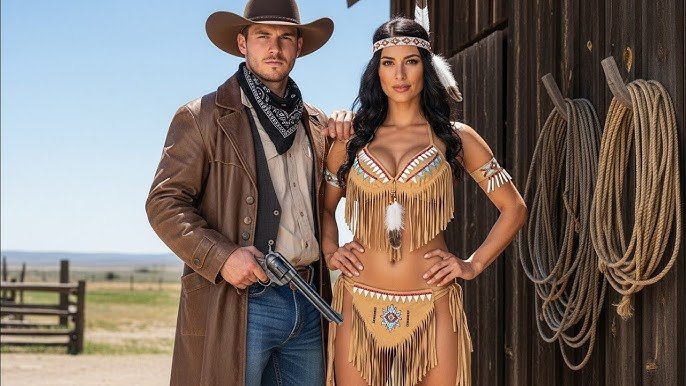
Colt McAllister had buried more promises than calves born on his spread, and he liked it that way—quiet land, quiet mornings, no one to answer to except the wind and the occasional banker. Then a dust-streaked girl with a bleeding ankle and a bone necklace limped out of a ruined mining camp and into his campfire light. She was eleven, maybe twelve, Apache, and alone in a way that made the coyotes sound gentle. He cleaned the cut, fed her beans, and when nightmares shook her small frame he told her the only story he had left: “Grow up strong and I’ll marry you someday.” He meant it the way you mean “the sun will rise”—a kindness, nothing more, tossed into the dark so she could find the floor with her feet.
Years folded themselves over the ranch like pages in a book no one reads aloud. The girl—Ayoka—became shadow, then sound, then strength. She learned to coil rope, to curse stubborn wire, to laugh at Hayes’s grumbling. Colt kept his distance without knowing he was keeping it, the way a man steps back from a fire he’s afraid might warm him too much. At seventeen she could outshoot half the hands and outride the other half, and the town started looking at her the way towns do—curious, judging, hungry. Colt’s jaw grew tighter, his silences longer, and the promise he’d spoken to a child slept in a drawer beside a carved wooden horse, worn smooth by nights he told himself he was only checking the latch.
The day she left, she rode Daisy bareback, hair snapping like a banner. A small Apache band had come looking for kin; Ayoka went to find the part of herself the raids had chopped away. Colt stood on the porch, boots planted, throat full of splinters. “Go learn who you are without me in the room,” he said. “If you still want that old promise when you’re done, come back free and tell me so.” She touched his cheek once, fierce and gentle, and disappeared into heat shimmer and dust.
Years passed—enough for his hair to silver, for joints to predict storms, for the wooden horse to become a talisman he held while the world outside grew louder with strangers and quieter with friends. He told himself the promise had been a joke, a thread to keep a child from unraveling, nothing more. Yet every sunrise he checked the horizon the way other men check clocks.
Then one copper evening a rider appeared—one horse, no hurry, silhouette cutting the rim of the world like a blade. She swung down, taller, harder, eyes still old in a young face. “I buried my father,” she said. “I found my mother. I learned the songs and the silence. I walked the world and chose it. Now I choose you.”
His heart hammered against his ribs like a colt trapped in a stall too small. “I’m old, mean, full of ghosts,” he warned.
“I know ghosts,” she answered. “I learned to walk beside them without letting them lead. I don’t need saving, Colt. I need standing with.”
He stepped off the porch, boots creaking like old leather admitting it still held shape. “Then stand,” he said. “The promise was yours to keep or burn. If you keep it, I’ll answer as the man I am, not the fool I was.”
She smiled—sunrise after drought—and took his hand. “I claim you,” she said, “not as debt, but as choice.”
Behind them the cabin waited, small and sturdy, like the word they spoke together that night—marriage—simple as wire pulled tight between two posts, strong enough to hold whatever storms came next. And the promise made to a frightened child settled at last into the shape it had always wanted: two adults choosing to keep the fire going instead of merely remembering the dark.