Ethan Cole had written ten letters to a woman he pictured in calico and quiet smiles—someone who would step down from a stagecoach, blink at the prairie, and call his cabin “quaint.” He scrubbed the table, mended the porch, and waited like a man holding his breath against the wind.
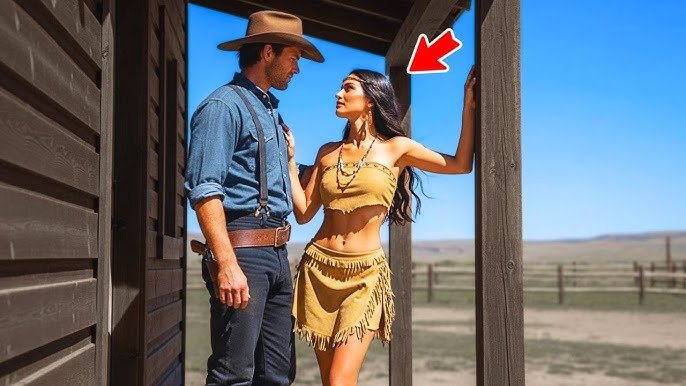
When the lone rider appeared, the sun was a low ember behind her. Bead-work flashed on the horse’s bridle; white feathers fluttered at the ends of two long black braids. She sat the saddle straight as a lodge-pole pine and dismounted without waiting for permission.
“I am Sunna,” she said. “The woman who answered your letters.”
Ethan’s imagined bride dissolved like chalk in rain. He stared—at the buck-skin dress, the dark eyes that had already measured the cabin, the children peeking from behind her skirt—while the paper fantasy he’d carried crumpled in his chest.
“You’re Apache,” he managed.
“I am my father’s daughter,” she corrected. “And I am the woman who chooses her own road.”
She told him the rest: how her father had burned the later letters, how she had ridden out at dawn anyway, how crossing the prairie alone was easier than crossing a life someone else had drawn for her. She had come to see if the man who wrote of shared sunsets and equal voices meant what he said now that ink became flesh.
Before he could shape an answer, dust rose on the ridge—warriors from a neighboring band who believed she had been promised to them, riders from her own people come to drag her back. Ethan stepped between them and the woman who had never once asked him to be a hero. Rifles spoke; arrows answered; blood soaked the dust while the sun looked on without blinking.
When the guns fell quiet, her father dismounted and studied Ethan the way a man studies sky before trusting it with rain. “Do you want her because you pulled her from death,” he asked, “or because she pulls you toward life?”
Ethan looked at Sunna—really looked—at the steady hands that had loosed arrows beside his, at the voice that could gentle a horse or scold a child, at the courage that had ridden through fire to stand on his porch.
“I want her,” he said, “because she chooses to stand here.”
The chief nodded once, the way a man closes a gate he will never open again. The warriors turned their horses; the dust swallowed them; the prairie settled into a silence wide enough for two people to build something new inside.
Later, when the cabin held four coffee cups instead of one, Ethan slipped a turquoise ring—carved by his own hand—onto her finger. Sunna smiled, the curve of it soft as moonrise.
“You asked for a bride,” she said. “I brought you a partner. Let’s see what life we can carve from that.”