Elias Ward had spent years teaching himself to feel nothing—no grief, no hope, no hunger for company—because feeling had once cost him everything. He rode fence, patched roofs, and counted cattle the way other men count rosary beads: one, two, three, and still the ache refuses to leave.
Then the valley gave him Aayoka—half-drowned, rope-burned, fever-bright—left for the sun to finish what rough hands had started. He carried her home because leaving her would have been like leaving his own wife and daughter a second time. While she slept he watched the door the way he used to watch the horizon for raiders, rifle across his knees, promising the dark that no one would cross the threshold unless they stepped over his body first.
On the third night, when the fever broke and the cabin smelled of pine smoke and willow-bark tea, she whispered from the bed, “If they come tonight, I will not be afraid.”
The words slid under his ribs like a key turning. He realized he had not been afraid in years—not of death, not of pain, not of loneliness—but the idea of her being afraid cracked the stone he had wrapped around his heart. He checked the rifle, tested the shutters, and answered softly, “Then neither will I.”
Morning brought no riders, only the sound of her moving through the rooms—bare feet on plank floors, the kettle singing, her voice teaching Lily how to braid grass into tiny horses. He listened from the corral and felt the ground shift beneath his boots: the ranch was no longer a place to wait for death; it was a place someone else had chosen to live.
Days turned into preparations—crates across windows, extra grain for her mare, a second coffee cup that sat beside his like a promise neither had spoken aloud. She showed him how men would flank, where they would bunch, how fear expects chaos and meets its match in calm. He showed her how to split wood without splitting knuckles, how to plant tomatoes along the south wall, how to say his wife’s name without flinching.
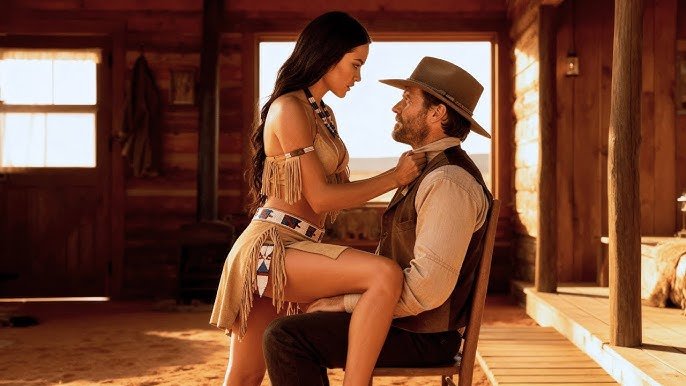
One evening she found him oiling the rifle, hands steady but eyes far away. She placed her palm over his, turquoise ring catching the lamplight, and said, “You remembered how to care whether someone lives or dies. That is enough for now.”
He covered her hand with his, rough skin against the scars on her wrist, and understood that saving her had never been about heroism—it had been about choosing not to let the world take one more thing he loved. The valley had given him a second chance wearing buckskin and braids, and this time he would hold the line until his last breath or the last bullet—whichever came first.
Outside, the wind carried the scent of rain and distant horses. Inside, two silhouettes sat shoulder-to-shoulder, rifles within reach, coffee cooling in shared cups—no longer guarding against ghosts, but standing watch for the life they had decided to build together.