Thorne Maddox had come to the high canyon to die quiet—no bugle, no flag, no wife left to cry. The war had taken his knee and his belief that two men could share the same air without one of them bleeding. He split wood, fished the river, and talked to the stove the way some folks talk to graves. Then the water gave him Teya.
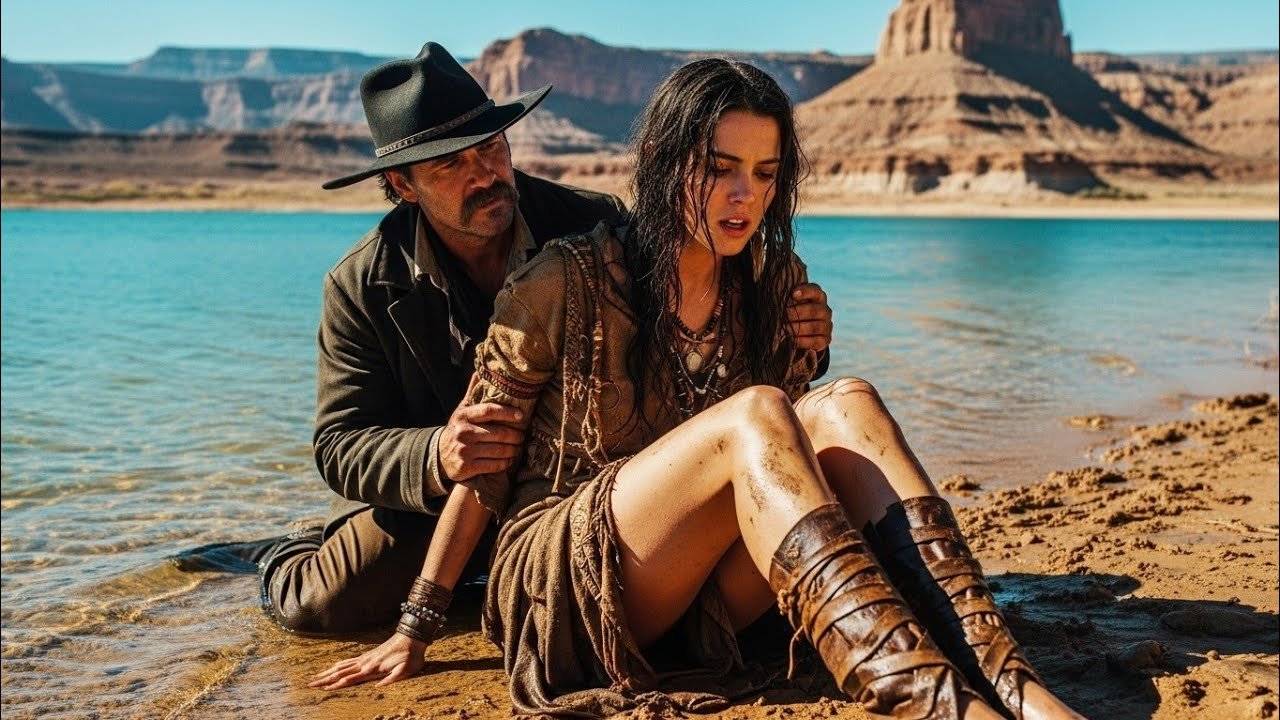
She spilled out of the spring flood like something the river had stolen and decided to return—half-drowned, dress torn, hair full of silt and defiance. He hauled her onto the bank, pumped the water from her lungs, and told himself saving a life wasn’t the same as asking for one. While she slept he kept watch, rifle across his knees, the way he had kept watch over men who never woke.
Days passed in small mercies: coffee cut with honey, shirts mended by firelight, the way she learned the creak of the third board so she wouldn’t wake him when nightmares drove her to pace. She told him her name and little more, until one evening the story slipped out—how the chief’s wife had fallen, how the young men rode on, how the river closed over her like a fist. She finished with a sentence that sounded like law instead of tale: “Man who pulls a woman from death belongs to her story, and she to his. River law. Life for life.”
He tried to laugh it off, but the words settled, heavy as shot, and would not be dug out.
Weeks later hoofbeats drummed along the ridge—five riders, faces painted for travel, not war. Her uncle sat his horse like a man carrying grief he had finally decided to set down. In rough English and rougher silence he said the law had been broken when Teya was left to drown; the only way to mend it was for Thorne to claim her or for her people to take her back and forget her name.
Thorne looked at her—really looked—at the woman who now poured his coffee and carved his name into the soft wood of the windowsill when she thought he wasn’t watching. He asked the question no one had ever asked her: “Do you want this?”
She answered with the same steady voice she used to warn him the coffee was boiling: “If I go back, I am proof of their shame. If I stay, I am proof that a woman can choose where her life begins again.”
Her uncle listened, eyes ancient, and finally nodded. “River takes, river gives,” he said, and turned his horse. The others followed, disappearing into pine and memory, leaving behind only the sound of hooves growing fainter than regret.
Later, inside the cabin that had known only one heartbeat for too long, they stood beside the stove—not touching, not yet, but close enough to feel the new rhythm between them.
“River law,” she said softly, tasting the words.
“River gave,” he answered. “Now we decide what to do with the gift.”
Outside, the water kept running, carrying away the last echo of horses and the old story that almost ended beneath a tree. Inside, two people who had belonged to ghosts learned the first line of a new story—one they would write together, one log, one choice, one sunrise at a time.