I have taken seventeen lives. Fifteen wore gray, two wore nothing but fear. Each face still visits me when the room is too quiet. They do not speak; they only stare, patient as stones, waiting for the day I join them in the dark they carry.
The one face that never leaves, though, is the face I never saw. It belongs to the officer who gave the order to burn my parents’ farm while I lay far away, my own bones held together by strangers’ thread. He turned my home into smoke and my mother and father into silence. Twenty winters have passed, and the ache still feels brand-new.
My name is Caleb Stone. I raise cattle outside Copper Ridge, Arizona Territory. The war left me with a limp, a sergeant’s memories, and a head full of funerals. When the fighting ended, I kept riding west until the sky opened wide and the land forgot my name. I told myself the quiet out here could bury anything. I was wrong.
One evening, three shots cracked across the mesa. Not the wild pops of drunk boys, but the slow, sure sound of men finishing other men. I took my Winchester, saddled Thunder, and followed the echo. At Sun Hollow I found an overturned wagon, broken pots, and three Apache men face-down in the dirt, shot while running. Cowards’ work.
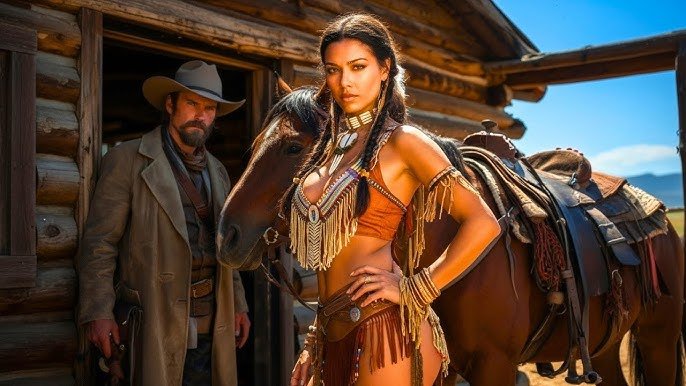
A girl lay under a torn deerhide, blood in her hair, fire in her eyes. “They took my father,” she rasped. One word slipped through her pain: “Harland.” The whole territory knew that name. Victor Harland wore Confederate gray like Sunday clothes and bought land with forged papers and terror. I lifted the girl onto my horse and promised the dead I would come back.
Her name was Kaia. Her father was Running Bear, a Chiricahua chief. While I cleaned the bullet groove in her shoulder, she watched me as if I might still turn into a wolf. The next morning I dug three graves and laid the men facing the rising sun. I did not know their songs, so I gave them my silence instead.
Before I left, Kaia pressed a crumpled pouch into my hand. Inside lay a map older than any of us, inked by Spanish priests and Apache scouts. It said Eagle Bluff belonged to her people long before Harland’s lies. “He chained my father when he would not sign,” she said. “You buried my dead when no one watched. I trust what you do in the dark.”
I rode to town and found Samuel Crow beating iron in his forge. Sam and I had marched together, bled together, and learned that some debts are measured in heartbeats. When he heard Harland’s name, his hammer stopped mid-swing. We sat at my table with Kaia between us, tracing canyons and counting guns. Thirty hired rifles stood between us and one old devil. We decided to cut the head.
Sam slipped away with sticks of dynamite. Kaia and I crawled along the ridge above the Silverton slave mine where men entered tunnels and never saw daylight again. Guards smoked and joked while chains clinked below like sorrow keeping time. We waited for Sam’s blast. Instead, Harland’s voice rolled up the stones.
He walked into view with Sam held at gunpoint. “Come down alone, Stone, or your friend dies and your ranch burns.” Kaia clutched my sleeve, but I was already walking. Down in the dust, Harland looked smaller than the nightmare I carried, yet his smile still felt like a knife. He remembered Cedar Creek; I remembered Harrisburg. We both knew the same fire had started our story.
They chained Sam and me inside the mine. Rows of prisoners swung picks, eyes empty except for the flicker that says a man still hopes. Running Bear stood among them, back bent, spirit straight. One careless guard, one stolen key, one sudden crack of bone, and the revolver was mine. Chains fell. Rage rose. Sam vanished toward the powder stores.
The mountain shook. Rocks thundered down and sealed the canyon mouth, trapping Harland’s hired guns with the ghosts they had made. We poured out, rifles in fists and years of hurt in our chests. The fight was short, ugly, and honest. Bullets answered bullets until only Harland remained, backed against the stone he thought he owned.
Ten paces, two Colts, twenty years of smoke. He fired high and wild. I fired true. When he folded into the dirt, the only sound left was my own breath saying, “Tell my parents I said hello.”
We found Kaia behind a boulder, one hand pressed to her bleeding side, bow still in reach. The bullet had gone clean through. Running Bear knelt, speaking soft Apache words that mean “stay.” Two days later, a federal marshal rode in with badges and questions. The map, the mine records, and thirty freed prisoners told a story no coin could silence. Eagle Bluff went back to Kaia’s people, paper at least. Land remembers longer than men, but it was a start.
That night I leaned on my porch rail while the sky bled sunset. Sam puffed his pipe and asked what came next. “Same as always,” I said. “Cattle, fences, and keeping both kinds of coyotes honest.” He laughed, said it sounded dull. I told him I had swallowed enough excitement to choke a lifetime.
Hooves crunched behind us. Kaia sat straight in her saddle despite the bandage circling her ribs. She dismounted and walked toward us, eyes holding mine like coals that refuse to dim. “Running Bear says thank you,” she said. “For his life, for our land, for giving our dead back to the earth.” I shifted, uncomfortable with gratitude. “Any man should have done the same.”
She shook her head once, certain as sunrise. “Any man could. Few men did.” She looked past me at the dark coming down over the mesas. “The war is not over for people like us,” she murmured. “But tonight one fire is out.”
We stood together while stars stepped into the sky, and for the first time in twenty years the faces at the foot of my bed seemed farther away. Justice is never clean, never finished. Yet sometimes, if you keep walking long enough, it leans a little toward the light.